
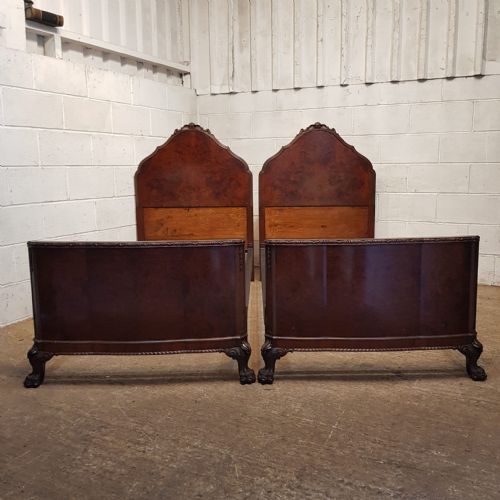


1920s Walnut Bed
A 1920s walnut bed brings rich grain and distinctive period geometry to a bedroom, combining practical sleeping space with strong decorative character.
1920s Walnut Bed
When you search for a 1920s walnut bed, you are looking at substantial furniture pieces built during the interwar years and the early thirties. These items span traditional revival designs and the clean lines of the Art Deco movement.
You will most commonly encounter double beds and single bed frames on this page, alongside occasional headboards with integrated bedside tables. French regional pieces and English cabinet maker productions appear regularly among the listings.
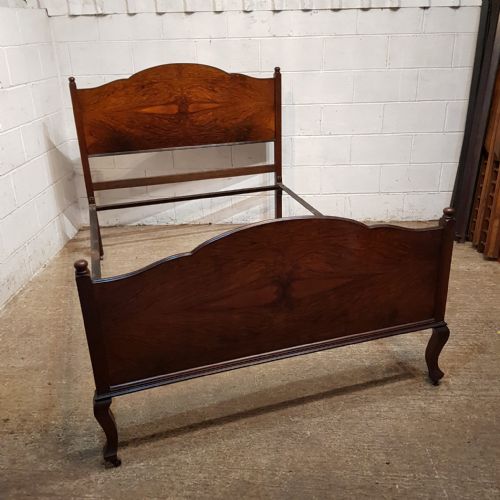
The aesthetic divides broadly between the figured warmth of burr walnut veneers and the cooler, architectural symmetry of Art Deco forms. Revival pieces borrow classical Queen Anne proportions while retaining the darker timber tones favoured in the interwar period.
Construction and materials
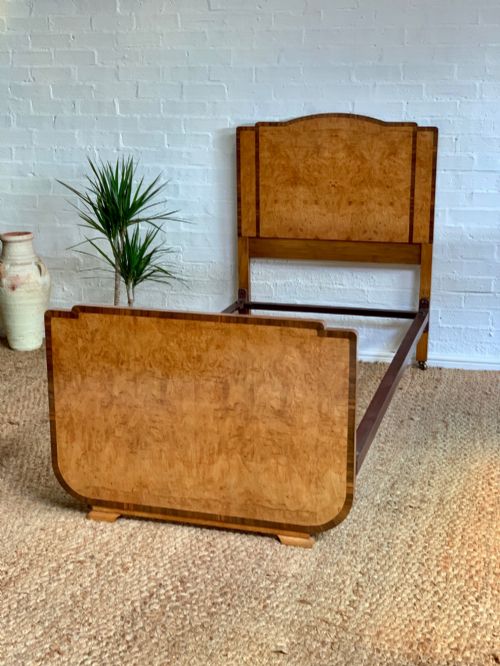
Makers utilised solid walnut for structural framing and applied finely figured burr walnut veneers to prominent headboard and footboard panels to display striking decorative grain patterns. Timber selection was central to the visual impact, contrasting straight-grained walnut with swirling burr surfaces.
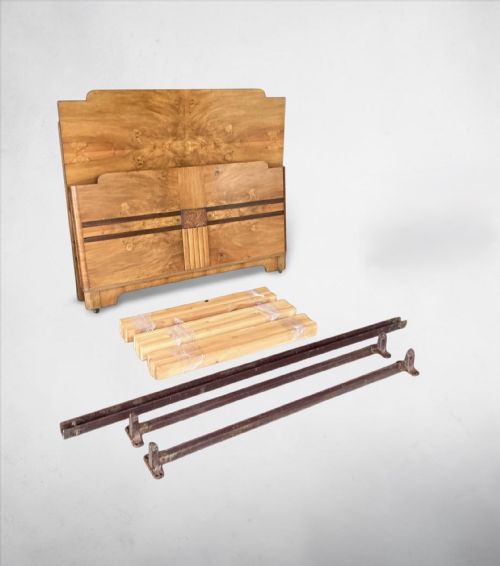
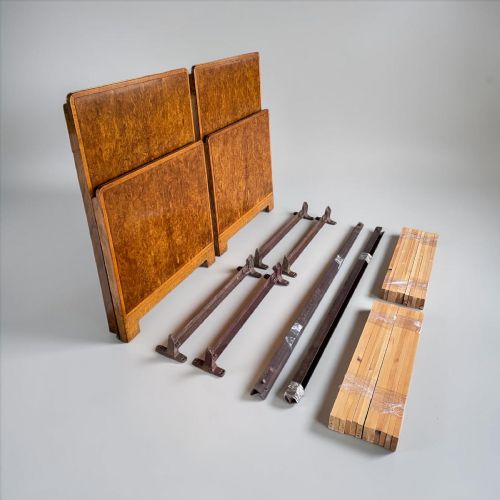
Metal components such as iron and steel internal frames or brackets were introduced to reinforce wooden side rails and provide sturdy modern support. This combination of traditional cabinet making with hidden metal framing ensured the large headboards and footboards remained stable.
Headboards with attached bedside tables appear alongside traditional French double bedsteads and matching single bed pairs.
Assessing quality
Quality rests heavily on the selection and matching of the veneer panels across the headboard and footboard. Symmetrical book-matching of burr walnut separates exceptional cabinet work from standard production.
The integration of functional elements, such as attached bedside tables or parcel gilt detailing, indicates higher-tier workshops. Better examples maintain crisp geometric lines in Art Deco designs or accurate proportions in Queen Anne revival pieces without looking heavy.
Waring and Gillow England·Beresford and Hicks of London
The 1920s Walnut Bed Glossary
- Burr walnut
- A thin slice of wood veneer taken from the wart or growth on a walnut tree, yielding a swirling, highly decorative pattern. It was frequently applied to the main panels of beds and cabinets.
- Art Deco
- A design style spanning the 1920s and 1930s characterised by sleek geometric shapes, stylised motifs, and streamlined forms. It marked a sharp departure from heavy Victorian revival furniture.
- Veneer
- A thin layer of superior timber bonded over a secondary wood base to provide a decorative surface. This technique allowed makers to showcase expensive grain patterns economically.
- Bedstead
- A framework of a bed supporting the mattress and springs, distinct from the bedding itself. In antique pieces, this usually comprises a matching headboard, footboard, and side rails.
1920s Walnut Bed: Frequently Asked Questions
Will a 1920s walnut bed fit modern mattresses?
Many antique frames were built to historical dimensions rather than today's standard metric mattress sizes. Single and double frames often require careful measurement of the internal wooden rails to ensure standard mattresses drop in correctly.
Some beds accommodate modern slat systems or custom bases, while others may need minor adjustments by a specialist to sit modern bases securely without damaging the antique side rails.
How do I care for walnut veneer?
Walnut veneer requires protection from direct sunlight and sudden humidity changes to prevent the wood from drying or the adhesive underneath from failing. Keep the timber away from direct heat sources like radiators.
Dust regularly with a dry, soft cloth and occasionally apply a quality beeswax rather than modern silicone sprays. This preserves the warm natural lustre of the polished wood.
Are these beds easy to assemble?
Most period bed frames utilise traditional metal bed bolts or iron slot-in brackets that connect the headboard and footboard to the side rails. This construction allows the entire piece to be dismantled for transport.
Assembly typically requires two people to align the heavy wooden components squarely. Once bolted tightly, the frame gains structural rigidity from the side rails.
How do I distinguish Art Deco from revival styles?
Art Deco pieces display bold geometric symmetry, stepped cornices, and stepped headboards that reflect machine-age modernism. They often incorporate integrated side tables and streamlined surfaces.
Revival pieces, by contrast, draw on historical forms like the eighteenth century, featuring softer curves, shaped panels, and classical proportions. The timber treatment remains similar, but the architectural vocabulary differs entirely.