





1920s Line Bracelet
A 1920s line bracelet brings geometric Art Deco grace and brilliant stones to the wrist, offering timeless elegance for daily wear.
1920s Line Bracelet
A 1920s line bracelet is an articulated wrist ornament composed of a continuous chain of symmetrical links, predominantly framed in the Art Deco style. These pieces span the 1920 and 1930 periods, capturing the architectural motifs of the era.
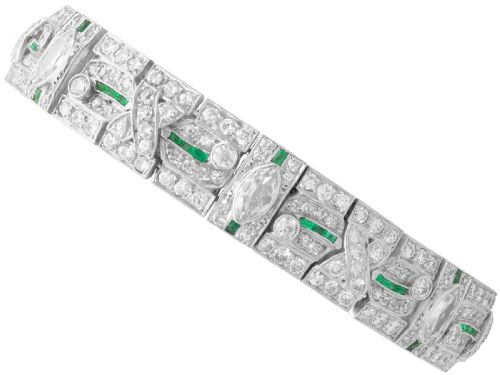
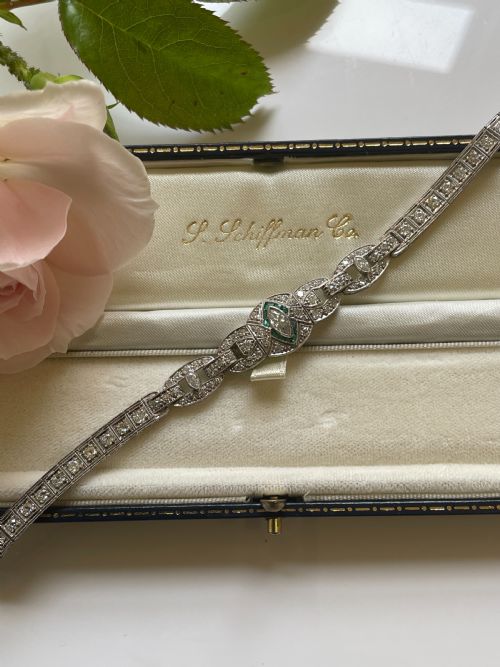
You are most likely to meet platinum and white gold pieces set with diamonds, often punctuated by sapphires or emeralds. The construction relies on flexible linkages that allow the bracelet to drape smoothly around the wrist.
Makers of these items utilised calibrated gemstones to create seamless geometric patterns that define the aesthetic of the period. Every surviving example demonstrates the characteristic low profile and linear discipline typical of early twentieth-century jewellery.
How they were made
Platinum served as the primary metal of choice for fine examples, offering the structural strength needed to hold intricate stone settings with minimal visible metal. White gold and yellow gold also appear, providing alternative warm and cool tones for the mountings.
Goldsmiths set old cut diamonds alongside square and rectangular calibrated sapphires and emeralds, securing them within meticulous channel or prong settings. The articulation between individual links required precise hand-crafting to ensure fluid movement without sacrificing durability.
Every link was articulated by hand so the bracelet could whisper against a silk cuff without catching a single thread.
What varies in quality
The sophistication of the geometric metalwork and the precision of the stone matching determine the standing of an individual piece. Superior examples display uniformity in stone size and colour, paired with hand-pierced gallery work that lightens the overall weight.
The integrity of the articulation points dictates longevity, as continuous daily wear tests the small hinges connecting each link. Master jewellers achieved a tight, fluid connection that resists lateral twisting while maintaining a supple drape.
The 1920s Line Bracelet Glossary
- Art Deco
- A design style dominant in the 1920s and 1930s characterised by sleek geometric shapes, stylised motifs, and streamlined symmetry. It rejected floral Victorian curves in favour of industrial modernity.
- Old cut diamond
- A diamond cut by hand before modern machinery standardised facet proportions, featuring a smaller table and a higher crown. These stones produce a distinctive softer, candlelit sparkle.
- Calibrated stones
- Gemstones cut to exact, uniform dimensions to fit specific geometric channels within a mounting. They allow for uninterrupted colour lines in complex multi-stone layouts.
- Platinum
- A dense, strong white metal favoured during the 1920s for its ability to hold delicate gemstone settings securely. It develops a soft patina over decades of wear.
1920s Line Bracelet: Frequently Asked Questions
How do I wear a 1920s line bracelet?
These bracelets sit close to the skin and pair easily with both evening attire and simple daytime clothing. Their flexible design makes them comfortable for regular use.
Take care to secure the safety clasp properly before wearing to prevent accidental loss during movement.
What metals were used in the 1920s?
Platinum is the predominant metal found in these pieces, valued for its strength and bright white finish. Yellow gold and white gold also appear in period examples.
Metal choice often reflects the specific workshop traditions and the prevailing fashions of the decade.
Are these bracelets set with coloured stones?
Many pieces combine diamonds with calibrated sapphires or emeralds to create contrasting geometric patterns. These coloured accents define the classic Art Deco aesthetic.
Diamonds remain the primary stone across most surviving examples, punctuated by smaller pools of colour.