


1920s Hand Knotted Rug
A 1920s hand knotted rug brings tactile warmth and enduring regional patterns into a room, offering a functional floor covering grounded in historical craft.
1920s Hand Knotted Rug
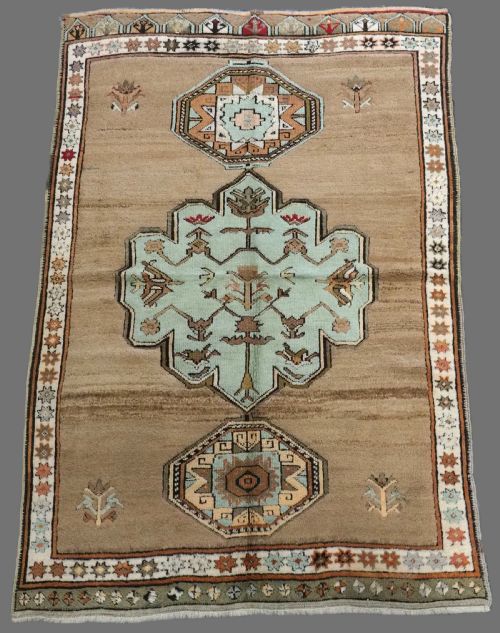
When searching for a 1920s hand knotted rug, a buyer encounters a diverse array of tribal and village floor coverings originating from Persia, Anatolia, the Caucasus, and Afghanistan. These range from substantial carpets and area rugs to long runners and specific prayer rugs featuring architectural mihrab designs.
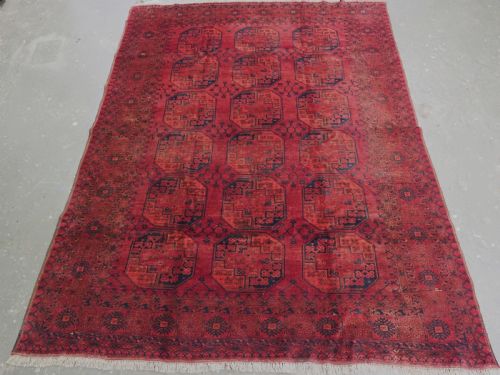
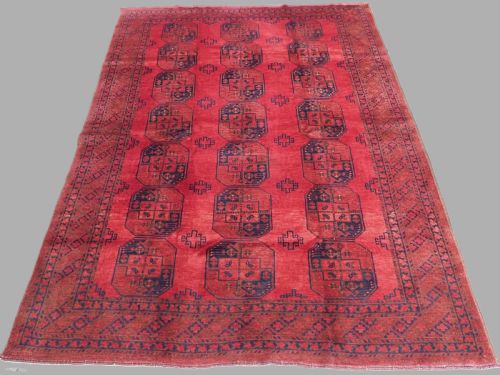
The selections on this page heavily feature Afghan tribal weaves, alongside Persian city and village pieces such as Kashan, Tabriz, Heriz, and Sarouk examples. Buyers will frequently meet traditional motifs including geometric guls, floral vases, and repeat herati patterns executed during the early twentieth century.
Originating from domestic and regional workshops, these textiles serve both utilitarian and decorative roles in modern interiors. Their construction reflects traditional weaving traditions passed down through generations in regions with rich carpet-making histories.
How they were made
These textiles rely on foundations of spun wool and cotton, utilising natural dyes to achieve rich, enduring colour palettes. Artisans tie individual knots by hand onto warp and weft threads, incorporating materials like camel wool and lambswool in specific regional traditions.
The technical execution varies from dense city workshop knots to coarser tribal weaves designed for heavy domestic use. Long kilim ends and finished selvedges complete the structural integrity of these early twentieth-century floor coverings.
Listings span multiple regional traditions from the 1910s and 1920s, featuring wool, cotton, camel wool, and silk materials.
What varies in quality
The standard of a 1920s hand knotted rug depends heavily on the density of the knotting and the precision of the design execution. Finer city pieces demonstrate intricate curves and detailed floral vases, while robust tribal carpets prioritize thick pile and sturdy construction.
Material selection also dictates the character of the piece, with variations between standard wool, soft camel wool, and lustrous silk highlights. The subtlety of the natural dye palette and the preservation of original edges and kilim ends further distinguish exceptional examples from standard village production.
Benlian
The 1920s Hand Knotted Rug Glossary
- Mihrab
- The niche design found on prayer rugs, often indicating the direction of prayer and appearing in single, double, or triple formats.
- Gul
- An octagonal medallion or repeating motif characteristic of Turkmen and Afghan tribal carpets.
- Herati
- A fine, all-over pattern composed of a central rosette framed by lancet leaves, commonly seen in Persian rugs.
- Kilim end
- The flat-woven section at either end of a pile rug, functioning to prevent the knotted field from unravelling.
- Selvedge
- The bound or reinforced side edges of a carpet that protect the structure from fraying during daily use.
1920s Hand Knotted Rug: Frequently Asked Questions
How do I clean an antique rug?
Gentle surface brushing and professional specialist washing preserve the natural wool pile and traditional dyes without causing structural damage.
Avoid harsh chemical treatments and excessive water immersion to maintain the integrity of the early twentieth-century foundation.
Can I place these rugs in high traffic areas?
Many heavy duty tribal carpets and village runners were built for enduring utility and withstand regular movement when paired with a quality underlay.
Finer silk or delicate prayer rugs benefit from placement in low traffic zones to protect the intricate pile from premature wear.
How are regional styles identified?
Design elements like geometric guls point towards Afghan and Turkmen origins, while floral vases and detailed medallions typically indicate Persian city workshops.
Border patterns and colour palettes provide further clues to distinguish Anatolian and Caucasian pieces from one another.
What is the purpose of prayer rugs?
Prayer rugs traditionally feature a distinctive mihrab arch that was oriented toward Mecca during daily devotions.
Over time, these pieces transitioned into decorative wall hangings and small accent rugs within domestic interiors.