
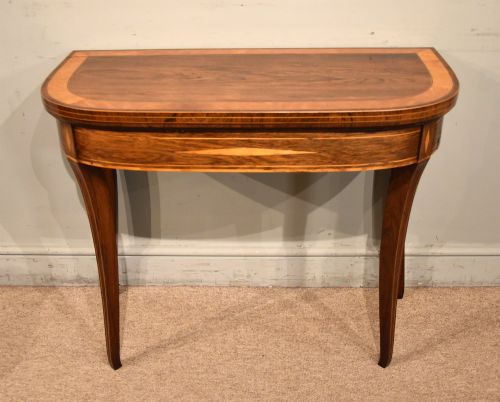


18th Century Rosewood Table
An 18th century rosewood table brings dense grain and rich colour to a room, and on this page you will meet card tables, Pembroke tables and writing desks from Georgian, Regency and Louis periods.
18th Century Rosewood Table
An 18th century rosewood table covers a broad range of domestic forms designed for writing, gaming and display. You will regularly encounter fold-over card tables, Pembroke tables with drop leaves, and occasional tables intended for specific rooms.
The pieces span several distinct design idioms including George III, Sheraton, Regency, and continental styles such as Louis XV and Portuguese Baroque. Most examples rely on rectangular or serpentine proportions suited to period interiors.
While formal writing desks and bureau plat forms appear among the selections, smaller occasional and card tables dominate the group. These items reflect the shifting social habits of the Georgian era, where multifunctional furniture served polite society.
Materials and construction
Makers utilised dense rosewood as a primary timber, frequently pairing it with contrasting veneers such as satinwood, boxwood, tulipwood and mahogany. Cross-banding and marquetry inlay provide decorative borders on table tops and friezes.
Ormolu mounts, brass hinges and delicate stringing details support the structural integrity of the timber while adding metallic contrast. Painted timber surfaces and trompe l'oeil decoration also emerge in select continental and English workshops.
Listings for rosewood tables frequently combine satinwood, boxwood and mahogany within inlaid borders and cross-banded tops.
Differences in quality
Quality rests in the precision of the veneer work and the choice of secondary timbers beneath the rosewood surface. Superior examples display tight, continuous grain matching across folding leaves and crisp execution of inlaid boxwood or satinwood stringing.
The refinement of the structural framing and the integration of decorative elements like ormolu mounts or cross-banding distinguish standard production pieces from masterworks. Proportions that feel balanced and unified signal the hand of a skilled cabinet maker.
Ince and Mayhew
The 18th Century Rosewood Table Glossary
- Cross-banding
- A decorative border technique where veneer is laid perpendicular to the grain of the main surface. This frames the top of a table with contrasting timber lines.
- Pembroke table
- A small occasional table with hinged drop leaves on two opposing sides. These tables were easily moved around a room for breakfast or writing.
- Ormolu
- Gilded bronze applied as decorative mounts on furniture. It gained widespread use in French and high-end English cabinet making during the period.
- Marquetry
- The art of forming decorative patterns using fitted pieces of wood veneer. It creates complex pictorial or geometric designs on table tops.
- Bureau plat
- A freestanding flat-topped writing desk fitted with drawers. These desks typically stand on cabriole or tapered legs and display elaborate mounts.
18th Century Rosewood Table: Frequently Asked Questions
What is a Pembroke table?
A Pembroke table is a small, versatile table featuring two hinged drop leaves supported by folding brackets. They were designed to sit against a wall and move into the centre of a room when needed.
Cabinet makers of the 18th century produced them in various timbers, frequently incorporating rosewood and satinwood veneers with delicate stringing.
Where should I place an occasional table?
An occasional table suits smaller spaces, hallways or beside seating where surface area is required without dominating the room. Their compact proportions allow them to integrate easily into modern or traditional interiors.
Protect the rosewood surface from direct heat and moisture by using coasters and avoiding placement in direct sunlight.
How do I tell Sheraton from Regency styles?
Sheraton style pieces from the late 18th century lean towards classical restraint, straight tapered legs and delicate contrasting veneers like satinwood and boxwood. Regency furniture, emerging slightly later, often adopts bolder forms, heavier rosewood grains and classical brass or ormolu mounts.
Examining the leg profiles and secondary timber choices helps clarify the transition between these two design periods.