
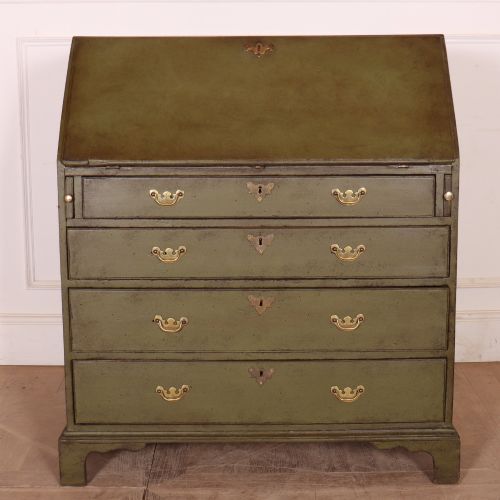


18th Century Painted Desk
An 18th century painted desk brings character and historic utility into a room through aged pigment over timber.
18th Century Painted Desk
An 18th century painted desk comprises writing furniture surfaced in decorative paintwork, lacquer or japanning originating from periods such as the Georgian era. Buyers seeking this search phrase most frequently encounter freestanding bureaux, secretaire tallboys and bureau bookcases executed in pine, mahogany or satinwood.
The selection ranges from vernacular English country pieces with simple painted finishes to sophisticated satinwood Bonheur du Jour writing cabinets and Chinoiserie examples. Regional variations include Dutch and Swedish writing tables alongside English workshop production.
Beyond standard writing surfaces, related seating and occasional tables frequently appear bearing complementary painted decoration or period lacquer work to match the primary writing furniture.
Materials and construction
Construction relies upon timber carcasses built from pine, mahogany and satinwood, joined using period cabinetmaking methods appropriate to the Georgian era. Surfaces were prepared and finished with traditional oil or water-based paints, often incorporating hand-painted floral motifs or elaborate Chinoiserie scenes.
Hardware elements such as brass handles, escutcheons and hinges provide structural and decorative punctuation to the painted timber forms. Applied gilt details occasionally accentuate carved elements on high-status seating and desk combinations.
Listings feature 18th century painted desks and bureaux constructed from pine, mahogany and satinwood alongside related Georgian seating.
Distinctions in quality
Quality rests upon the preservation of the original painted surface relative to later overpainting, alongside the crispness of any hand-painted decoration or lacquer work. Finer examples display harmonious proportions and sophisticated cabinetry, such as fitted interior pigeonholes and secret compartments within a bureau.
The integrity of the underlying timber construction and the subtlety of the ageing process dictate the standing of a piece within the range. Superior craftsmanship is evident in the weight of the brass hardware and the stability of the writing flap hinges.
Gillows
The 18th Century Painted Desk Glossary
- Bureau
- A sloping flap desk enclosing a fitted interior of small drawers and pigeonholes. It typically sits above a chest of drawers or a stand.
- Secretaire
- A piece of furniture containing a drawer or compartment that pulls out or folds down to form a writing surface. These often form part of tallboys or bookcases.
- Chinoiserie
- European imitation and interpretation of Chinese and East Asian artistic traditions, popular for surface decoration on lacquer and painted furniture. It utilises motifs of figures, pavilions and landscapes.
- Bonheur du Jour
- A light lady's writing desk featuring a small cabinet or superstructure with shelves and drawers above the writing surface. This form emerged during the eighteenth century.
- Japanning
- A type of European varnish finish that imitated East Asian lacquerwork, built up in layers and hardened by heat. Artisans often decorated the surface with raised gilt figures and landscapes.
18th Century Painted Desk: Frequently Asked Questions
How do I clean an antique painted surface?
Dust gently with a dry, soft cloth to prevent abrasive particles from scratching the aged pigment.
Avoid liquid cleaners, modern polishes and excessive moisture which can lift or damage historic paint layers.
Are writing flaps sturdy enough for daily use?
Period writing flaps rely on internal or pull-out wooden supports designed to bear moderate writing pressure.
Heavy leaning or placing excessive weight on the open flap should be avoided to protect the historic hinges and woodwork.
How can I identify original paint from later decoration?
Original finishes exhibit natural craquelure, uniform wear patterns and integration with the underlying timber grain and structure.
Later overpainting often feels flat, conceals historical wear or sits heavily across joins and hardware.