

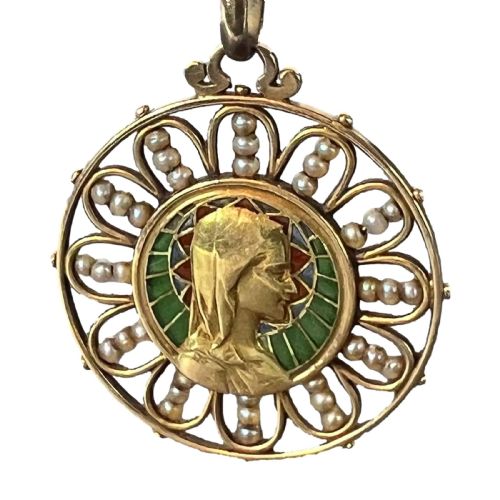


18k Gold Necklace
An 18k gold necklace brings together high-purity yellow, white, and rose gold with stones, enamel, and intricate metalwork across centuries of design.
18k Gold Necklace
An 18k gold necklace encompasses a diverse selection of pendants, chains, lockets, and religious medals originating from the Victorian era through the mid-twentieth century. Buyers frequently encounter French devotional and charm pendants alongside Victorian snake designs, gemstone clusters, and woven link chains.
The selection ranges from delicate Art Nouveau floral motifs and plique-a-jour enamel work to bold mid-century geometric links and diamond-set solitaires. Many examples feature specialised regional forms such as French religious medals or convertible brooch pendants designed to transition between settings.
How they were made
Maker techniques rely heavily on high-purity 18ct yellow, white, and rose gold shaped into hollow forms, textured flat links, or elaborate openwork frames. Gemstones including diamonds, rubies, garnets, sapphires, and natural pearls are secured via claw settings, flush mounts, or intricate wirework.
Enamelling techniques such as plique-a-jour create translucent stained-glass effects within gold partitions, while specialised casting and hand-engraving define the detailed surfaces of figural charms and devotional medals.
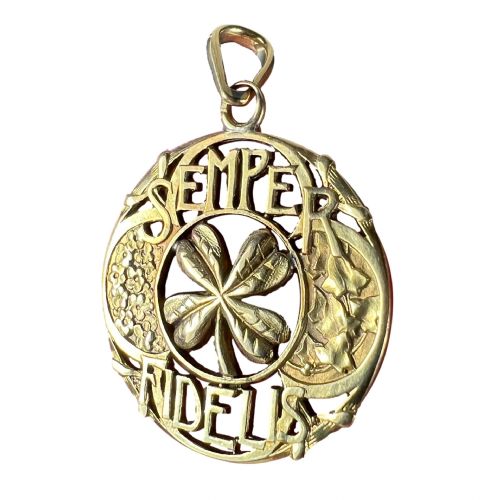
A tiny enamelled clover pendant whispers semper fidelis, offering a permanent reminder to keep faith close to the heart.
What varies in quality
The degree of hand-finishing and the complexity of the goldsmith's construction differentiate standard production pieces from masterworks. Intricate piercing, multi-tone metal combinations, and the crisp preservation of delicate enamel work signal superior execution.
Design sophistication also dictates the range, where sculptural depth in figural charms or specialised gemstone matching elevates an object above simpler commercial equivalents.
Paul Brandt·Georges Lenfant·Gauthier·Kria Gioielli
The 18k Gold Necklace Glossary
- Plique-a-jour
- An enamelling technique where enamel is applied to open cells without a backing, allowing light to shine through the transparent colour much like miniature stained glass. This method requires exceptional skill to prevent cracking during firing.
- Holbeinesque
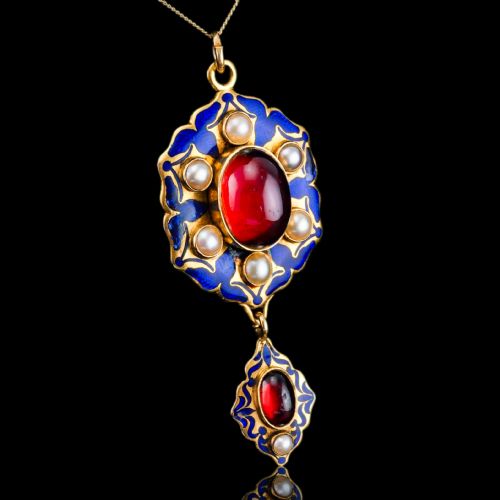
- A Victorian revival style drawing on sixteenth-century portraiture, characterised by symmetrical architectural pendants set with multiple stones and pearl drops. These pieces often feature complex geometric arrangements.
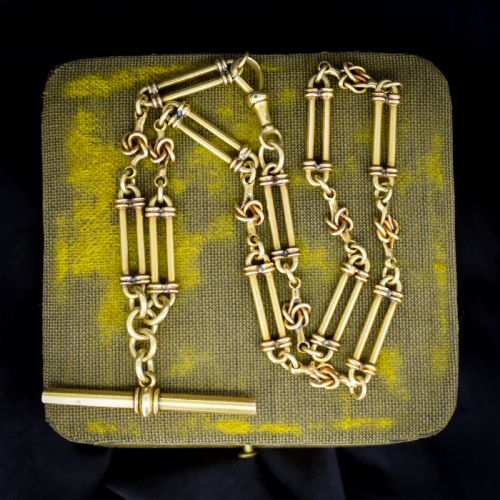
- Trombone link
- An elongated rectangular metal link resembling the slide of a trombone, frequently utilised in nineteenth-century watch chains and necklaces. It provides a distinct linear rhythm to the piece.
- Neglige necklace
- A style featuring two unequal pendants suspended from a central drop, popular during the Belle Epoque and Edwardian eras. This configuration creates an asymmetrical, graceful neckline silhouette.
- Monogram medal
- A personal pendant engraved with intertwined initials, often serving as a commemorative token or gift in French jewellery traditions. These objects combine typography with decorative border work.
18k Gold Necklace: Frequently Asked Questions
How do I identify a French 18k gold necklace?
French pieces often utilise eagle head hallmarks to denote 18-karat gold fineness and frequently incorporate regional styles such as devotional medals, plique-a-jour enamel, and textured link chains.
Makers' marks stamped in diamond or rectangular cartouches further verify French origin and workshop attribution.
What periods are common for these necklaces?
The available selection spans the Victorian era, Art Nouveau, Edwardian Belle Epoque, Art Deco, and mid-century modern design movements.
Earlier nineteenth-century examples often lean toward sentimental or naturalistic motifs, while twentieth-century items emphasise geometric forms and religious iconography.
How were snake necklaces worn in the Victorian period?
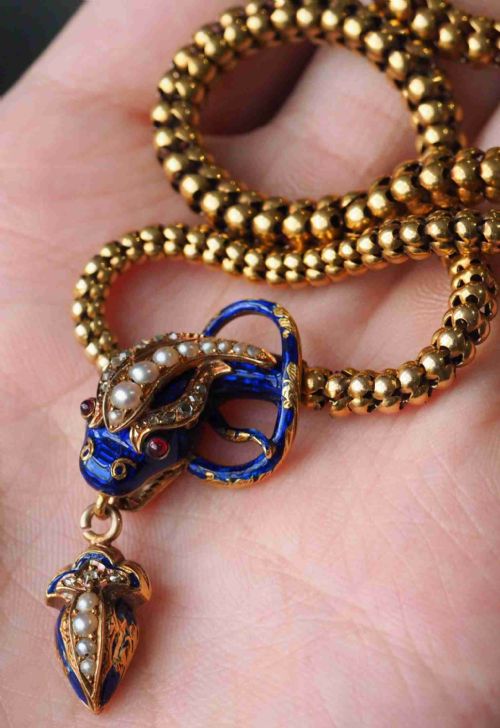
Victorian snake necklaces were typically wrapped flexibly around the neck, utilising the serpent's body as a continuous chain secured with hidden clasps or overlapping heads and tails.
Cobras and serpents served as popular motifs symbolizing eternal love and wisdom, frequently embellished with diamond crests and enamel scales.
Are pendant medals reversible?
Certain religious and commemorative pendant medals feature double-sided designs, displaying different devotional scenes or inscriptions on the reverse.
This construction allows the wearer to alternate the visible motif depending on orientation.