



Victorian Gold Serpent
A victorian gold serpent is a potent token of eternity, taking the form of a coiled reptile fashioned in precious metal and jewelled with diamonds or pearls.
Victorian Gold Serpent
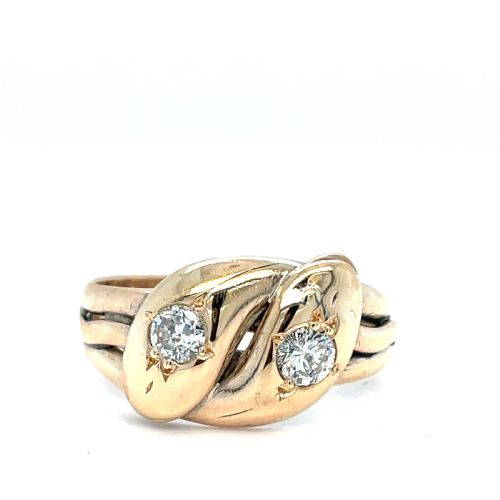
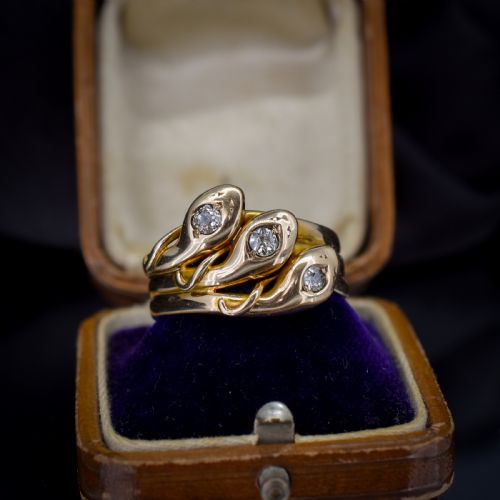
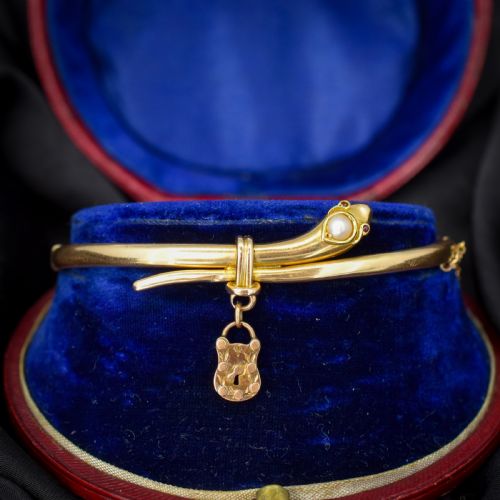
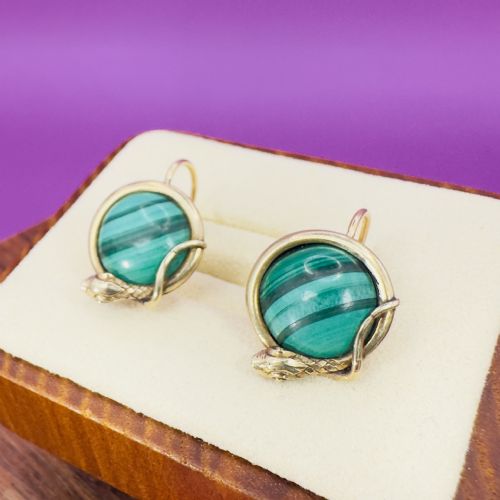
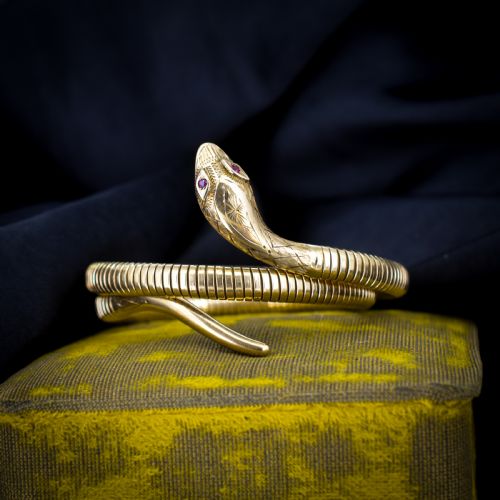
When you search for a victorian gold serpent, you enter a world of coiled jewellery where reptiles symbolise eternal attachment and wisdom. The pieces on this page span rings, necklaces, bangles, earrings, and pendants that translate a potent Victorian motif into wearable art. You will most frequently meet rings and bracelets formed from loops of yellow gold, often coiled to encircle the finger or wrist multiple times.
The selection ranges from Victorian and Edwardian periods into later revivals, crossing 9ct, 15ct, 18ct, and 18K gold. While rings dominate the available stock, bangles and necklaces appear alongside drop earrings and belt buckles. This variety reflects how extensively the serpent motif permeated nineteenth-century ornamentation, crossing from high-status gem-set pieces into simpler sentimental tokens.
How They Were Made
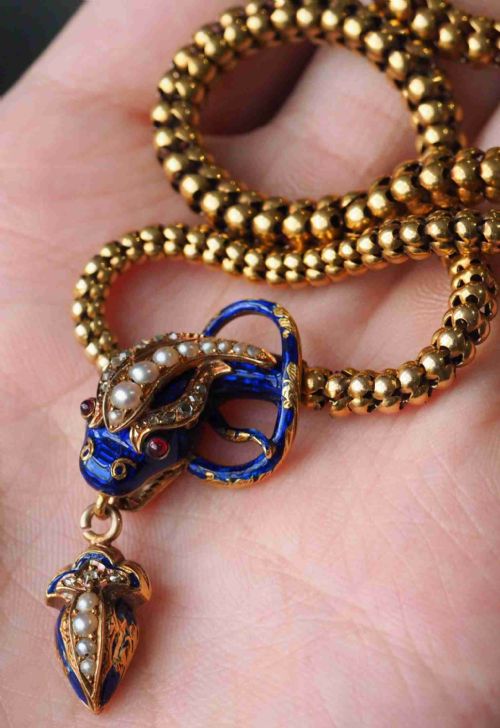
Goldsmiths constructed these serpents using various purities of yellow gold, principally 9ct, 15ct, and 18ct, shaped into articulated bands or solid cast coils. Gemstones such as old-cut diamonds, rubies, sapphires, garnets, and pearls were flush-set or claw-set into the head to serve as sparkling eyes or crests. Enamel work also appears, adding coloured surface detail to scales and skin.
Some Victorian serpents gaze back with garnet or ruby eyes, ensuring your jewellery collection maintains a permanent, watchful reptile guard.
What Varies in Quality
Quality rests upon the crispness of the hand-chased scale work and the structural integrity of the coiled form. Superior pieces exhibit deeply carved details that retain their definition despite decades of wear, rather than soft or worn surfaces.
The selection and grading of set stones dictate the upper tier of craftsmanship. Matched old-cut diamonds or natural pearls fitted securely into the serpent's head elevate an ordinary band into a notable work of jeweller's art.
The Victorian Gold Serpent Glossary
- Old-cut diamond
- A hand-faceted diamond cut before the standardisation of modern brilliants, typically featuring a small table, high crown, and open culet. These stones catch candle or gas light with a softer, broader flash.
- Coiled serpent
- A design where the body of the snake wraps multiple times around the finger, wrist, or neck. This configuration allows the jewellery to adjust slightly to the wearer's body.
- Repoussé
- A metalworking technique where the gold is hammered from the reverse side to form a raised design in relief. It gives dimensionality to the bodies and heads of these reptiles.
- Hallmark
- An official stamp applied to precious metals indicating purity, the assay office, and the year of testing. These marks provide definitive chronological anchors for dating the object.
Victorian Gold Serpent: Frequently Asked Questions
What do snake rings mean?
In the nineteenth century, serpents represented eternal love and wisdom, a sentiment famously popularised when Prince Albert gave Queen Victoria a snake engagement ring featuring an emerald-set head.
This romantic symbolism made the reptile motif an exceptionally common choice for tokens exchanged between couples during the Victorian period.
How do I know my ring size?
Because many antique snake rings feature rigid or wrap-around bands, measuring your finger accurately with a professional jeweller's mandrel is essential before purchase.
Keep in mind that coiled or bypass designs can sometimes offer slight natural give, though resizing older gold bands requires specialist skill to preserve the hallmarking and side engravings.
Are these pieces meant for daily wear?
While these items were constructed for regular adornment, their age demands a mindful approach to modern activities like heavy lifting or swimming.
Items set with delicate pearls or softer stones require particular care to protect the gems and the fine chased scales from unnecessary impact.
How can I date my gold serpent?
Dating relies primarily upon official assay office hallmarks stamped into the interior of the gold bands, which record specific assay years.
Stylistic markers, such as the cut of the diamonds or the specific hue of the gold, also help narrow down whether a piece originates from the Victorian or Edwardian eras.