




A 2026 Guide by Sellingantiques
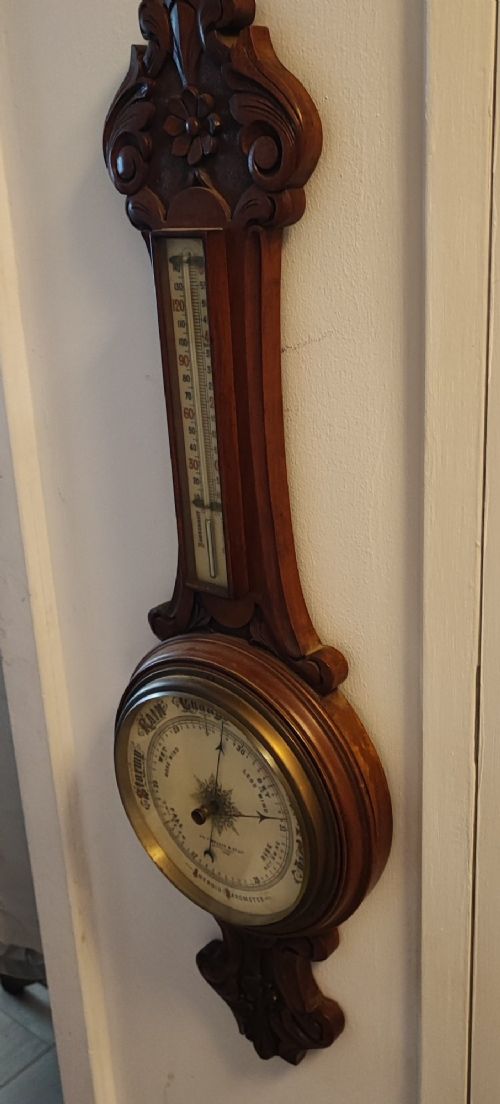
Antique George III Quality Rosewood Banjo Barometer, 19th Century
Priced at £985 from London City Antiques
Wheel barometers took off in Britain during the late eighteenth century.
Italian immigrants drove the early trade, setting up workshops in provincial towns.
Look at the golden age of the antique banjo barometer, running from 1800 into the 1850s.
Designs shifted from flat architectural pediments to rounded tops over time.
Many surviving pieces carry names from the large Italian emigrant network working in London.
Charles Tulley produced scientific instruments in Islington and signed several surviving wheel barometers.
Provincial retailers putting their own names on dials of instruments assembled from wholesale parts.
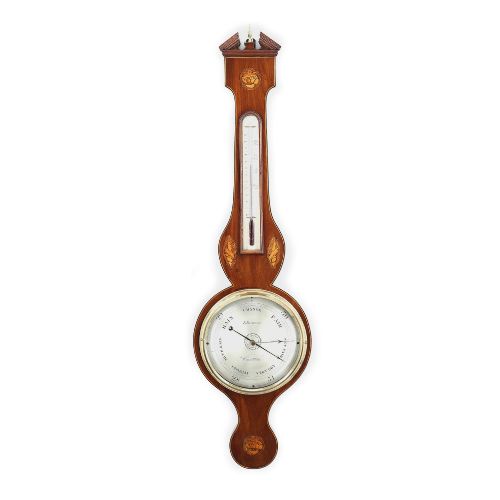
Large Antique Victorian Quality Rosewood Banjo, 1860
Priced at £985 from London City Antiques
The 2026 retail price guide for Antique Banjo Barometers is drawn from a proprietary archive of over 1.1 million retail prices indexed by Sellingantiques since 2003. This guide relies exclusively on their own internal data; no external sources or auction records are used.
Analysing nearly 25 years of UK antique market history alongside current retail values, the data indicates that typical UK retail prices for Antique Banjo Barometers range between £300 and £1,300. Entry-level prices generally fall under £300 and premium examples upwards of £1,300.
The main silvered dial dominates the lower half of an antique banjo barometer.
A smaller secondary dial near the top holding a removable spirit thermometer.
Turn the bone knob located directly beneath the main face to adjust the brass set hand.

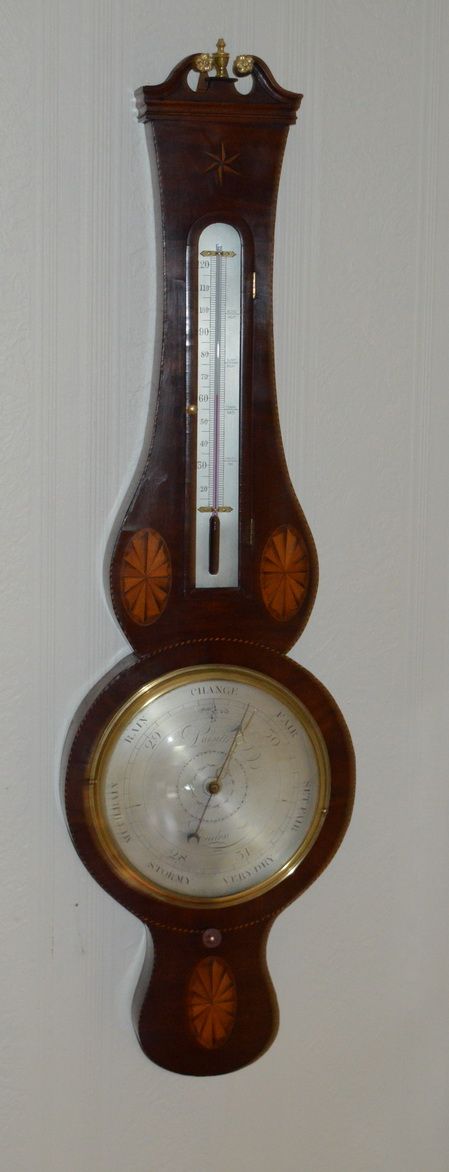
19th Century Inlaid Mother of Pearl Rosewood Barometer., 19th Century
Priced at £850 from Ruby Antiques
Early cases were narrow and relied on edge banding to frame the flat mahogany surface.
Cabinet makers shaping the cases with deeper curves and adding convex glass covers.
Observe the intricate engraving work on the brass dials, cut with traditional burins.
"The oat beard used inside the hygrometer dial reacts so reliably to humidity that it still functions after a century."
"Some examples hide a small mirror set into the neck, turning a practical weather station into a hall looking glass."
"Discovering the original maker instructions pasted onto the back board adds genuine context to an instrument."
Based on almost 25 years of Sellingantiques UK antique market data, Antique Banjo Barometers appeared 578 times (out of 1,100,000 antiques) which gives it a rarity score of 89/100.
This score measures scarcity within the Sellingantiques archive only and is not a survey of the entire antiques market, so these statistics may not be indicative of the general availability of Antique Banjo Barometers elsewhere.
You need to plug the mercury tube before moving the instrument. Most antique banjo barometers have a small wooden plug tied to the back board for this purpose. You tip the case gently to a forty-five degree angle until the mercury reaches the top of the tube, then push the plug into the open end.
Keep the barometer at an angle while carrying it. If you keep it upright without a plug, the mercury will bounce and smash the glass tube. Laying it flat causes air bubbles to enter the mercury column, which stops it reading pressure correctly.
Damp walls cause serious problems for the wooden case. The carcase is usually pine, which absorbs moisture from the plaster and swells. This swelling forces the mahogany or rosewood veneers to split and peel away from the front of the instrument.
Moisture also degrades the silvered dials. The brass oxidises under the silvering, turning the bright surface black and making the numbers hard to read. You should hang the barometer on an internal wall away from direct heat sources and damp patches to keep it functioning.
The words engraved on the dial are only a rough guide. Atmospheric pressure changes tell you what the weather is doing, rather than the static numbers on the brass face.
Tap the glass gently. If the needle drops, pressure is falling and you can expect wet weather.
A stuck needle usually means the pulley system behind the dial has failed. The needle sits on a small brass arbor with a groove, holding a silk thread that connects the glass float to a counterweight. Over time, the silk thread snaps or slips off the wheel.
Fixing it requires removing the back panel and restringing the pulley mechanism. It is a fiddly job that involves balancing the glass float on top of the mercury column. Many owners leave this task to a clockmaker or specialist restorer.
Please note: This Antique Banjo Barometers guide and its associated pricing data are provided for general informational purposes only. It does not constitute formal financial, investment, or appraisal advice and should not be relied upon as the sole basis for any commercial activity, purchasing, or sales decisions. Sellingantiques.co.uk accepts no liability for any actions taken in reliance on this information. Always consult with a qualified professional or independent appraiser.
