17,714  PAGES BROWSED TODAY PAGES TODAY 109 ANTIQUES UPLOADED TODAYNEW ARRIVALS
109 ITEMS ADDED TODAY
Sort Order
Items Per Page
Browse Categories
Sort order
Items per page
ID #SA96271
SOLD
Email Phone WhatsApp
Save
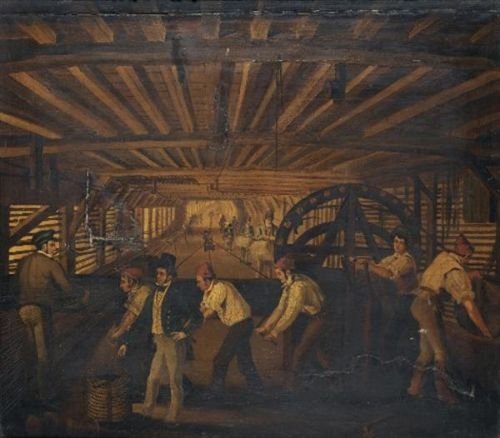
The Rope Makers Winding the Rope with a Rope Walk Beyond; English School
Sold by Artware Fineart
sold SA96271
Sorry, but this item has been sold.

Artware Fineart

Sellingantiques Verified Since Sep 2008
Id #SA96271
PDF SHARE
SAVE

The Rope Makers Winding the Rope with a Rope Walk Beyond; English School

19th century
Description

medium: Oil on Canvas

size: 51.00 x 61.00 (cm) 20.08 x 24.02 (ins)

A rope is a length of fibres, twisted or braided together to improve strength for pulling and connecting. It has tensile strength but is too flexible to provide compressive strength (i.e. it can be used for pulling, but not pushing). Rope is thicker and stronger than similarly constructed cord, line, string, and twine.

The use of ropes for hunting, pulling, fastening, attaching, carrying, lifting, and climbing dates back to prehistoric times. It is likely that the earliest "ropes" were naturally occurring lengths of plant fibre, such as vines, followed soon by the first attempts at twisting and braiding these strands together to form the first proper ropes in the modern sense of the word. Impressions of cordage found on fired clay provide evidence of string and rope-making technology in Europe dating back 28,000 years. Fossilized fragments of "probably two-ply laid rope of about 7 mm diameter" were found in one of the caves at Lascaux, dating to approximately 15,000 BC. The ancient Egyptians were probably the first civilization to develop special tools to make rope. Egyptian rope dates back to 4000 to 3500 B.C. and was generally made of water reed fibres. Other rope in antiquity was made from the fibres of date palms, flax, grass, papyrus, leather, or animal hair. The use of such ropes pulled by thousands of workers allowed the Egyptians to move the heavy stones required to build their monuments. Starting from approximately 2800 B.C., rope made of hemp fibres was in use in China. Rope and the craft of rope making spread throughout Asia, India, and Europe over the next several thousand years.

In the Middle Ages (from the 13th to the 18th centuries), from the British Isles to Italy, ropes were constructed in so-called rope walks, very long buildings where strands the full length of the rope were spread out and then laid up or twisted together to form the rope. The cable length was thus set by the length of the available rope walk. This is related to the unit of length termed cable length. This allowed for long ropes of up to 300 yards long or longer to be made. These long ropes were necessary in shipping as short ropes would require splicing to make them long enough to use for sheets and halyards. The strongest form of splicing is the short splice, which doubles the diameter of the rope at the area of the splice, which would cause problems in running the line through pulleys. Any splices narrow enough to maintain smooth running would be unable to support the required weight. Leonardo da Vinci drew sketches of a concept for a ropemaking machine, but just like many other of his inventions, it was never built. Nevertheless, remarkable feats of construction were accomplished without advanced technology: In 1586, Domenico Fontana erected the 327 ton obelisk on Rome's Saint Peter's Square with a concerted effort of 900 men, 75 horses, and countless pulleys and meters of rope. By the late 18th century several working machines had been built and patented. Some rope continues to be made from natural fibres such as coir and sisal, despite the dominance of synthetic fibres such as nylon and polypropylene which have become popular since the 1950s.

Declaration

Artware Fineart has dated this piece to the 19th Century.

Reference Numbers
Sellingantiques Reference
SA96271
Dealers Internal Reference
3403
Description
Medium: Oil on Canvas

size: 51.00 x 61.00 (cm) 20.08 x 24.02 (ins)

A rope is a length of fibres, twisted or braided together to improve strength for pulling and connecting.
Artware Fineart

It has tensile strength but is too flexible to provide compressive strength (i.e. it can be used for pulling, but not pushing). Rope is thicker and stronger than similarly constructed cord, line, string, and twine.

The use of ropes for hunting, pulling, fastening, attaching, carrying, lifting, and climbing dates back to prehistoric times. It is likely that the earliest "ropes" were naturally occurring lengths of plant fibre, such as vines, followed soon by the first attempts at twisting and braiding these strands together to form the first proper ropes in the modern sense of the word. Impressions of cordage found on fired clay provide evidence of string and rope-making technology in Europe dating back 28,000 years. Fossilized fragments of "probably two-ply laid rope of about 7 mm diameter" were found in one of the caves at Lascaux, dating to approximately 15,000 BC. The ancient Egyptians were probably the first civilization to develop special tools to make rope. Egyptian rope dates back to 4000 to 3500 B.C. and was generally made of water reed fibres. Other rope in antiquity was made from the fibres of date palms, flax, grass, papyrus, leather, or animal hair. The use of such ropes pulled by thousands of workers allowed the Egyptians to move the heavy stones required to build their monuments. Starting from approximately 2800 B.C., rope made of hemp fibres was in use in China. Rope and the craft of rope making spread throughout Asia, India, and Europe over the next several thousand years.

In the Middle Ages (from the 13th to the 18th centuries), from the British Isles to Italy, ropes were constructed in so-called rope walks, very long buildings where strands the full length of the rope were spread out and then laid up or twisted together to form the rope. The cable length was thus set by the length of the available rope walk. This is related to the unit of length termed cable length. This allowed for long ropes of up to 300 yards long or longer to be made. These long ropes were necessary in shipping as short ropes would require splicing to make them long enough to use for sheets and halyards. The strongest form of splicing is the short splice, which doubles the diameter of the rope at the area of the splice, which would cause problems in running the line through pulleys. Any splices narrow enough to maintain smooth running would be unable to support the required weight. Leonardo da Vinci drew sketches of a concept for a ropemaking machine, but just like many other of his inventions, it was never built. Nevertheless, remarkable feats of construction were accomplished without advanced technology: In 1586, Domenico Fontana erected the 327 ton obelisk on Rome's Saint Peter's Square with a concerted effort of 900 men, 75 horses, and countless pulleys and meters of rope. By the late 18th century several working machines had been built and patented. Some rope continues to be made from natural fibres such as coir and sisal, despite the dominance of synthetic fibres such as nylon and polypropylene which have become popular since the 1950s.

Date of Manufacture

Artware Fineart has dated this piece to the 19th Century.

Reference Numbers
Sellingantiques Ref
SA96271
Dealers Internal Ref
3403
Artware Fineart
Sellingantiques verified Since Sep 2008
Dealer Profile

You can view the stock and full dealer information on the Artware Fineart Profile Page
PDF SHARE
SAVE
The Rope Makers Winding the Rope with a Rope Walk beyond; English School
1 / 1
Archive I The Rope Makers Winding the Rope with a Rope Walk beyond; English School

The Rope Makers Winding the Rope with a Rope Walk Beyond; English School

Enlarged Archival View
Telephone 07958 699 645
Location
18 La Gare
51 Surrey Row
London
SE1 0BZ
United Kingdom
Verified Since Sep 2008
Items For Sale 243
Items Sold 223
Artware Fineart
Verified Since Sep 2008
View Dealer Info
Location: 18 La Gare , 51 Surrey Row , London , SE1 0BZ , United Kingdom
Verified
Sep 2008
For Sale
243
Sold
223
The Rope Makers Winding the Rope with a Rope Walk beyond; English School
Ref: SA96271
The Rope Makers Winding the Rope with a Rope Walk beyond; English School
Archival Detail
Every single antique dealer on our platform is individually approved by our internal team. We verify their professional trade history, ethical standards, and photographic quality to ensure a secure, high-standard buying environment. Upon joining, every dealer agrees to a strict 9-point code of conduct. While issues can occasionally arise, our dealers typically resolve them swiftly and directly with the buyer. In fact, since our founding in 2002, Sellingantiques has only had to step in to help resolve an issue on roughly five occasions—a true testament to the quality of our dealers and their dedication to your happiness.
Our dealers are highly experienced in packing and shipping fragile, high-value antiques. Because you are in direct contact with the dealer, you will be able to easily go through all available shipping and insurance options together to ensure your item arrives safely.
Antiques are the ultimate green purchase. By choosing historical pieces over newly manufactured goods, you completely eliminate the carbon footprint of modern mass production while preserving exceptional, timeless craftsmanship.
items
Add keywords to the filter
Price
£100
£250000
Era
Movements
Material
Origin
Stock Location
Freshness
Online Payments
Categories