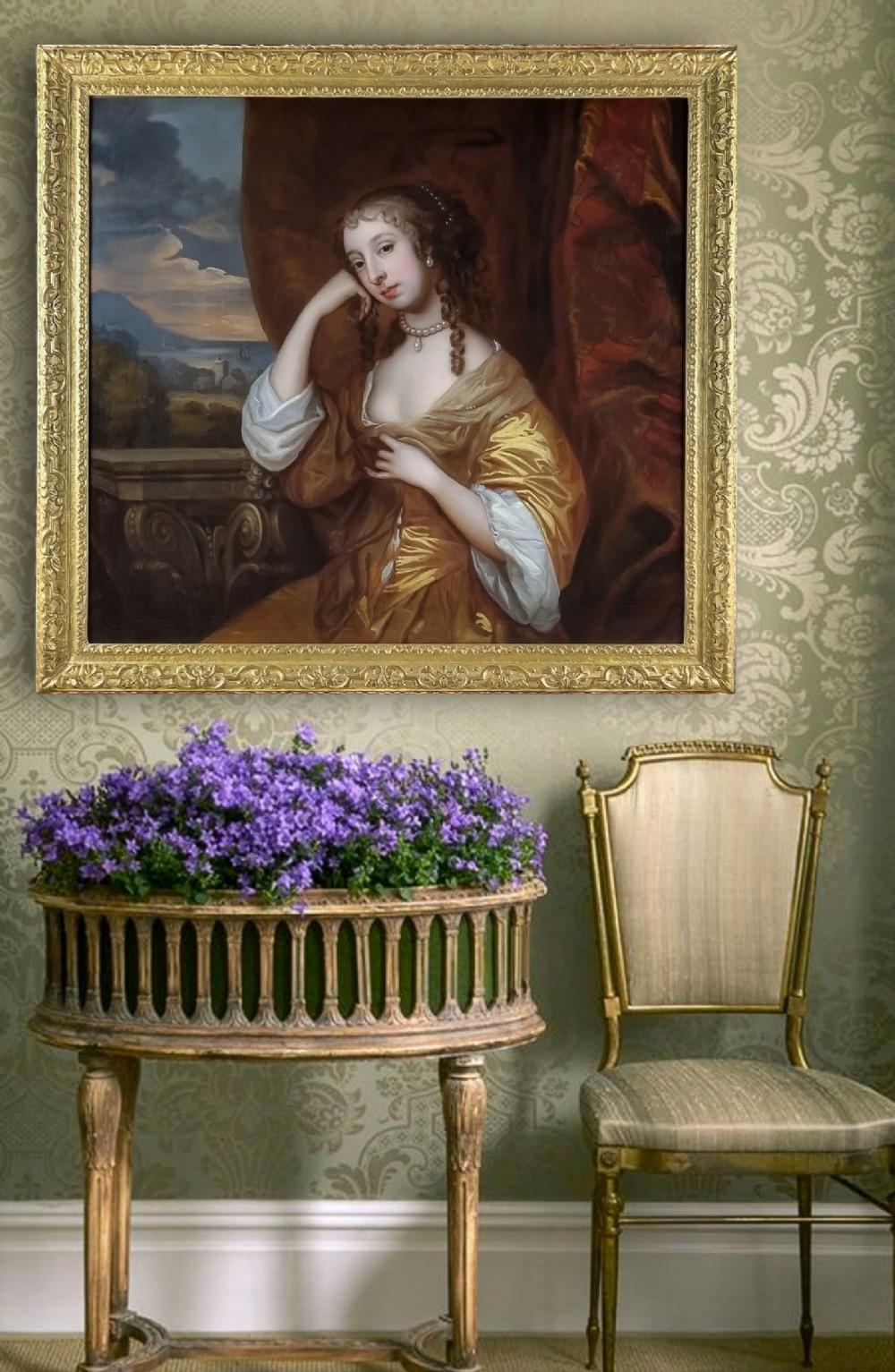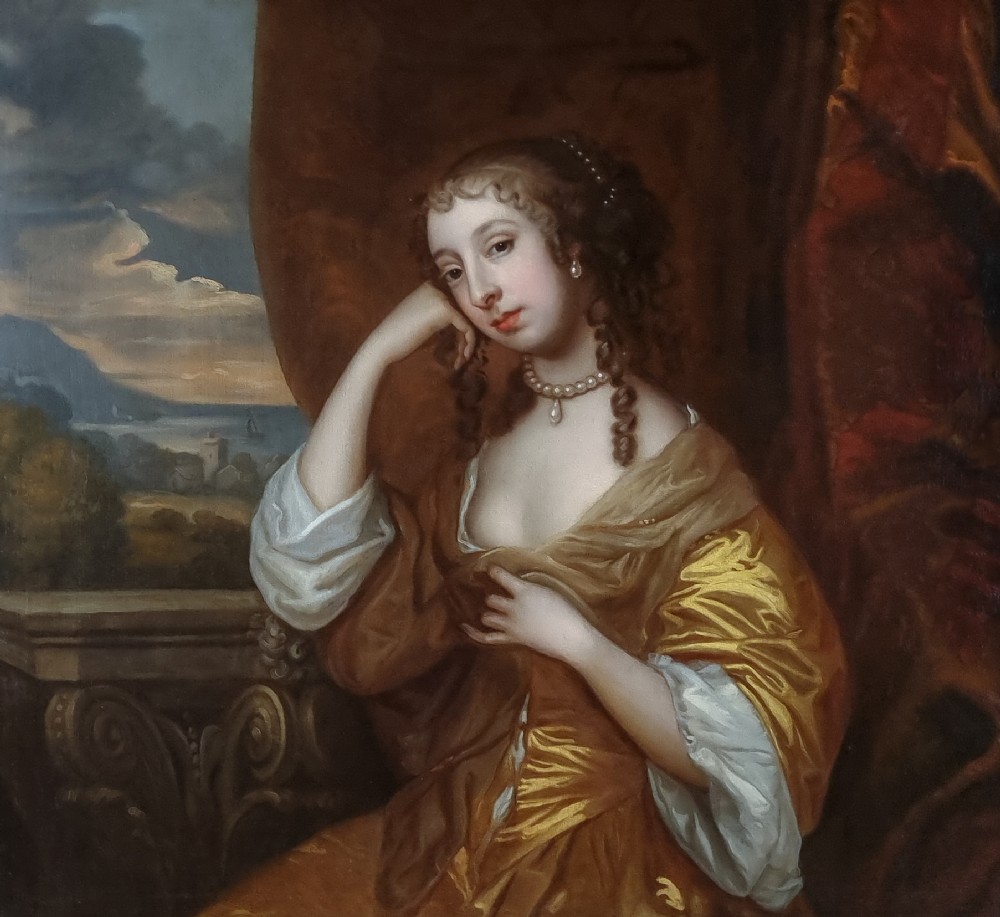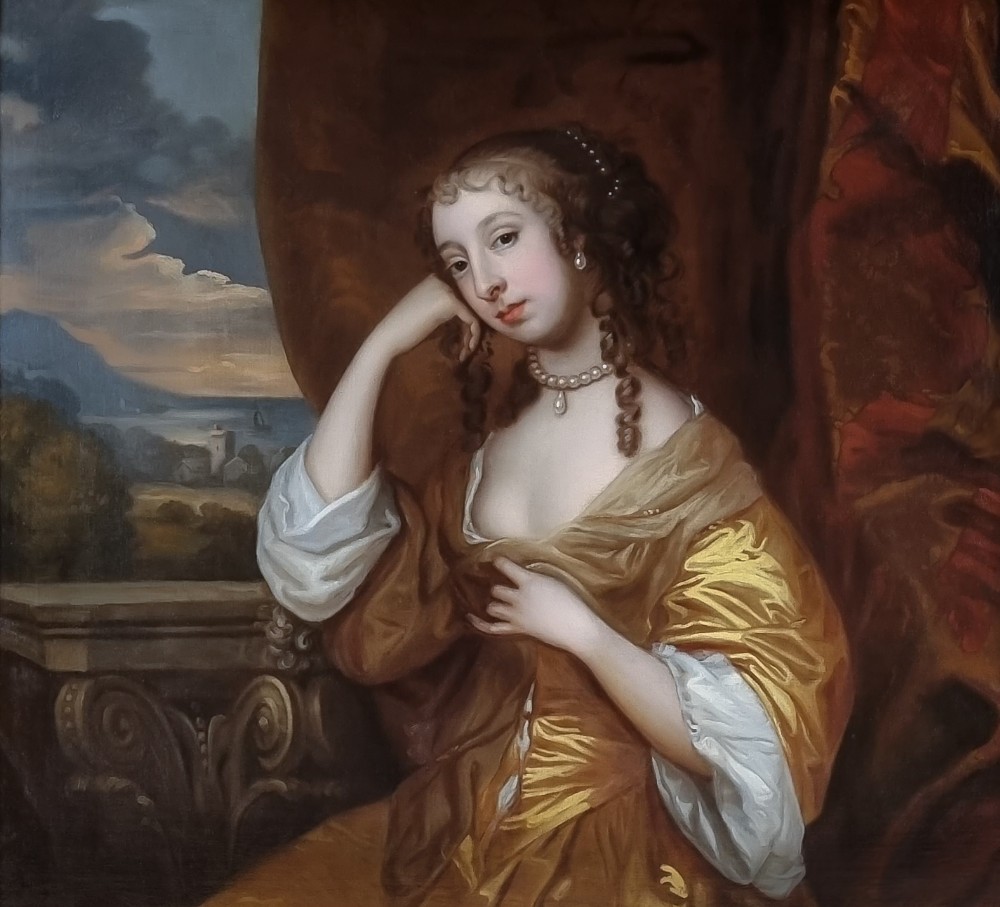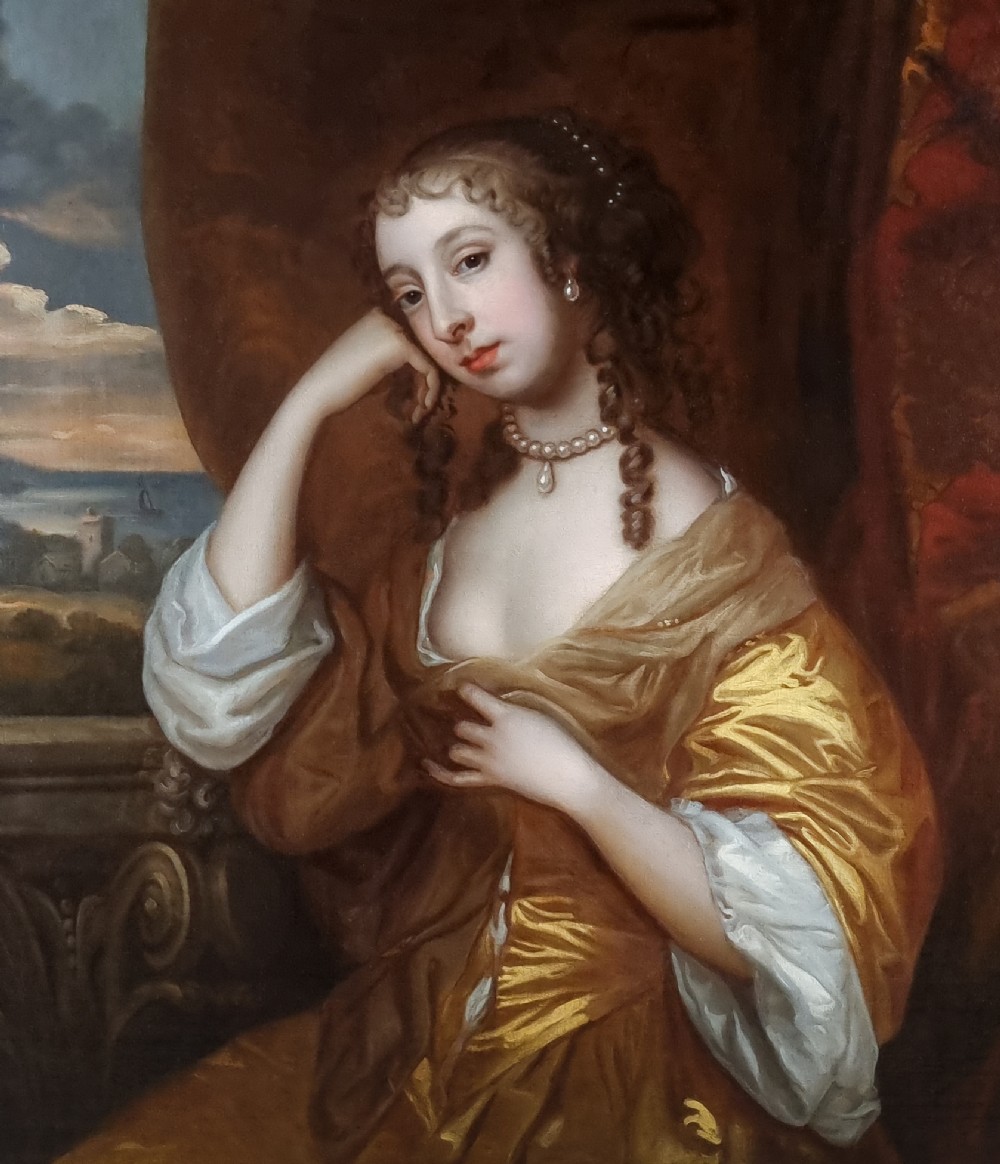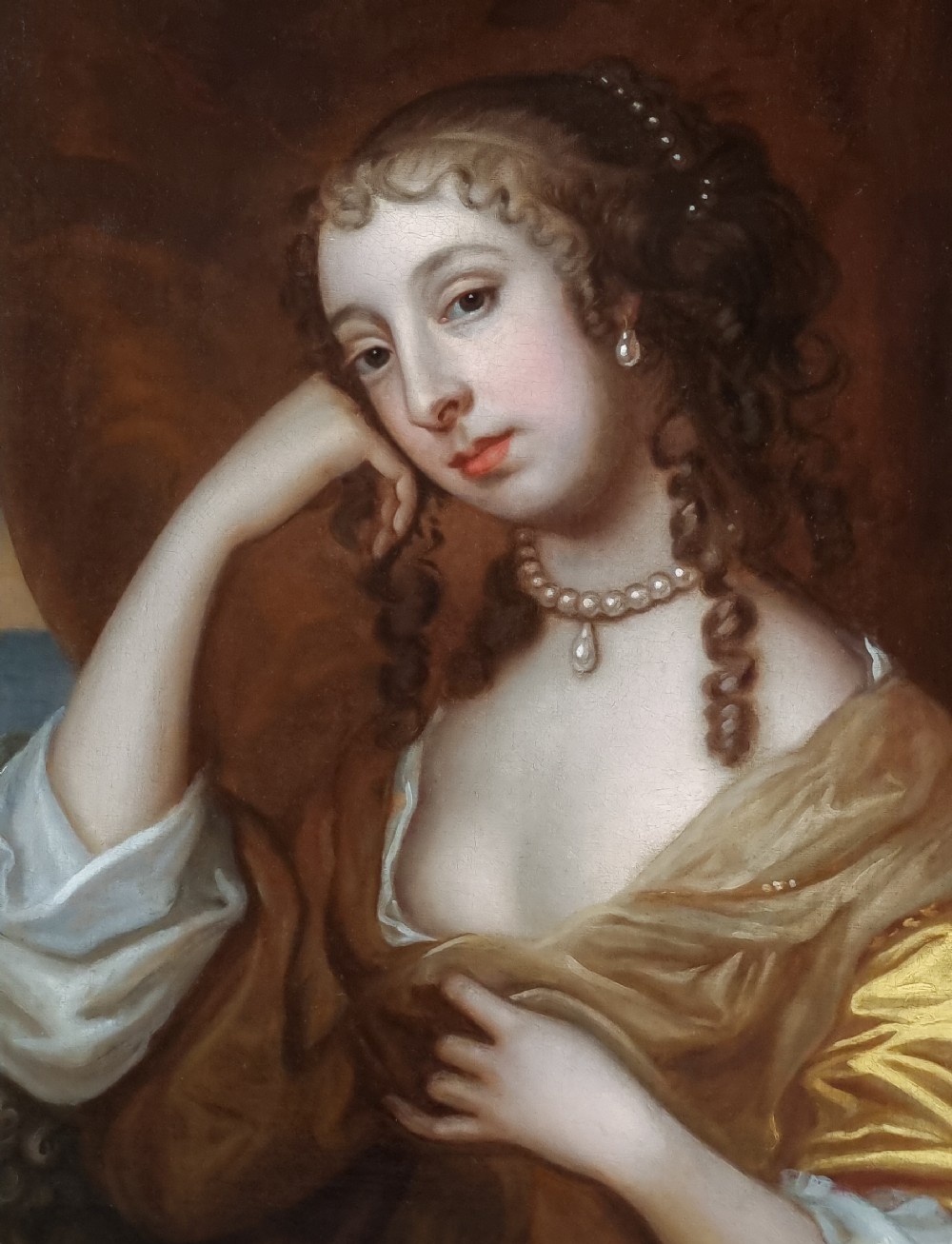
Titan Fine Art has dated this piece to the 17th Century.
The exact pattern and pose was used by Lely in his portrait of a lady, traditionally identified as Barbara Palmer, née Villiers (1640-1709), Countess of Castlemaine and 1st Duchess of Cleveland, three-quarter-length, in a yellow dress, a coastal landscape beyond (Christies London 7 Dec 2017, Lot 29, Sold for £368,750).
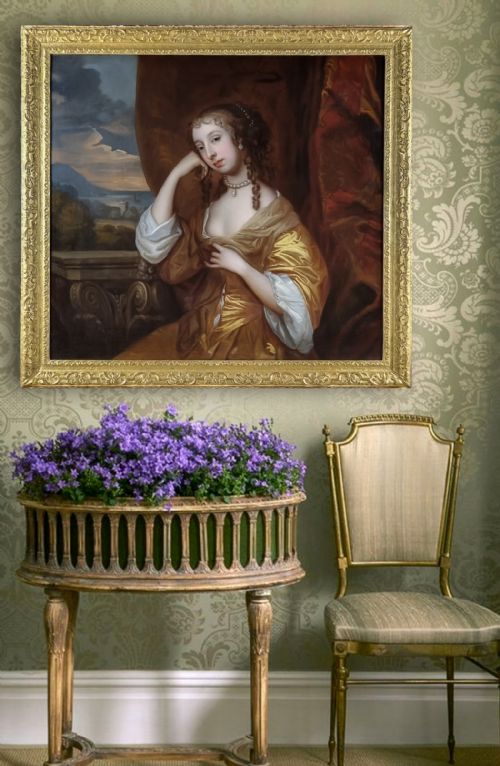
The sitter in this exquisite portrait is Lady Denham, a famous court beauty during the latter half of the seventeenth century and thus a frequently painted women of her generation. Born, Margaret (“Elizabeth" in some sources) Brooke, around 1642, the daughter of Sir William Brooke (c.1598-1643), an English soldier and politician. She and her sister Frances, afterwards Lady Whitmore, were said to be “faites pour donner de l'amour, et pour en prenire". Their profligate uncle Digby, Earl of Bristol, introduced them at Court in the hope that one or both of them would "captivate the heart of the versatile Charles". However, Lady Castlemaine, a well-known mistress of the King, prevented the accomplishment of the Earl's hopes. Miss Margaret next attracted the attention of the Duke of York (future King James II), but in the midst of these affairs she was, by the intervention of her friends, married to the poet and courtier Sir John Denham (1614/15-1669) in 1665. She was then about 18 years of age, while he was a widower and about 30 years older than her. It is true that he had lived a profligate life, and had wasted the great part of his family estates at Egham by gaming, while the rest were confiscated during the Civil War. He was ridiculed for this ‘disproportioned’ union and the embarrassment only increased as his young wife became the mistress of the Duke. Margaret openly declared that she would not, unlike her predecessor Goditha Price (daughter of Sir Herbert Price), "go up and down the privy stairs, but would be owned publicly." The Duke agreed and accordingly visited her publicly, although Lady Denham became almost frantic with jealousy, and overcome with “a short fit of madness." The scandal became notorious when Lady Denham suddenly became gravely ill and died on 7th January 1667, in her twenty-first year. This gave rise to a widespread suspicion that her husband had murdered her by giving her a poisoned cup of chocolate. A post-mortem examination, however, showed no trace of this. In the end the fury of the populace was appeased by a sumptuous funeral at St Margaret's, Westminster. Sir John, a poet who became Surveyor of Buildings to the King, survived his wife two years.
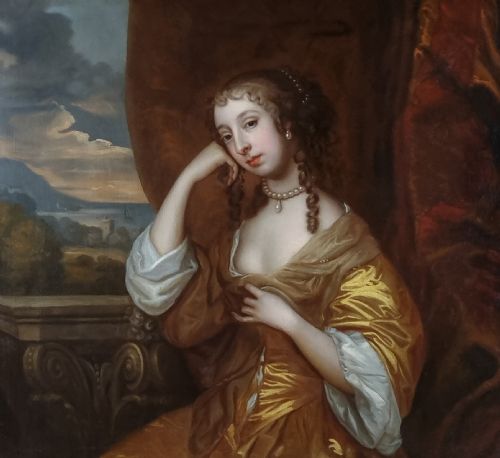
Lady Denham’s portrait was painted by Peter Lely circa 1663-65 and is part of the ‘Windsor Beauties’ series (along with a portrait of her sister Frances), a set of eleven portraits of celebrated women at the Restoration court. The series was apparently commissioned or at least assembled by Anne Hyde, Duchess of York. In 1674, after the death of Anne Hyde, the pictures were hanging as a group in the White Room at Whitehall but were later moved to Windsor, presumably by James II.
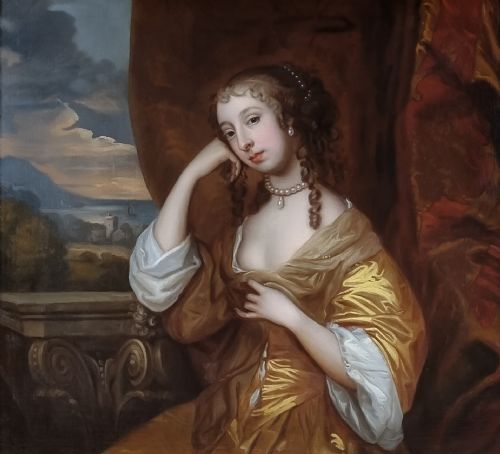
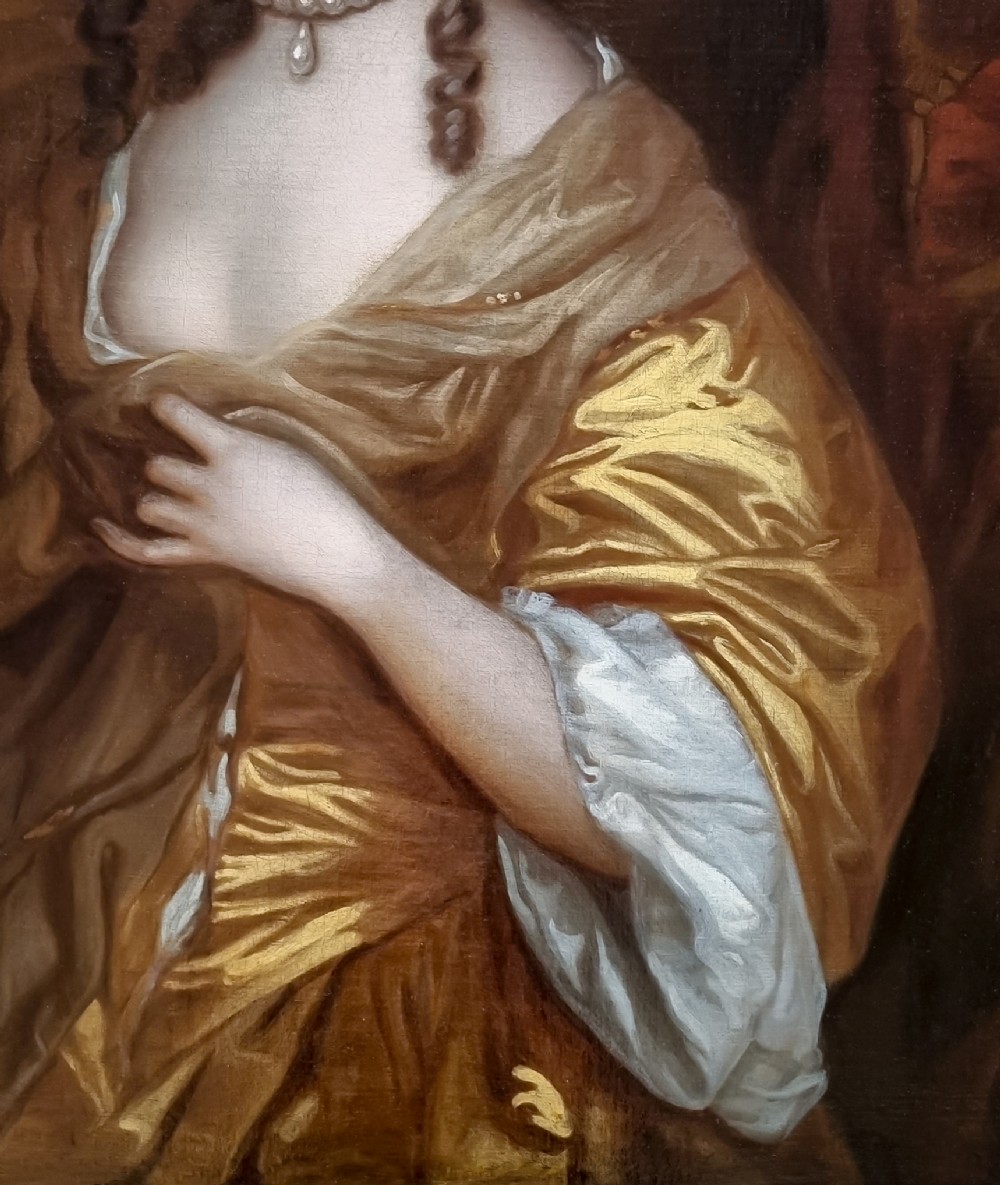
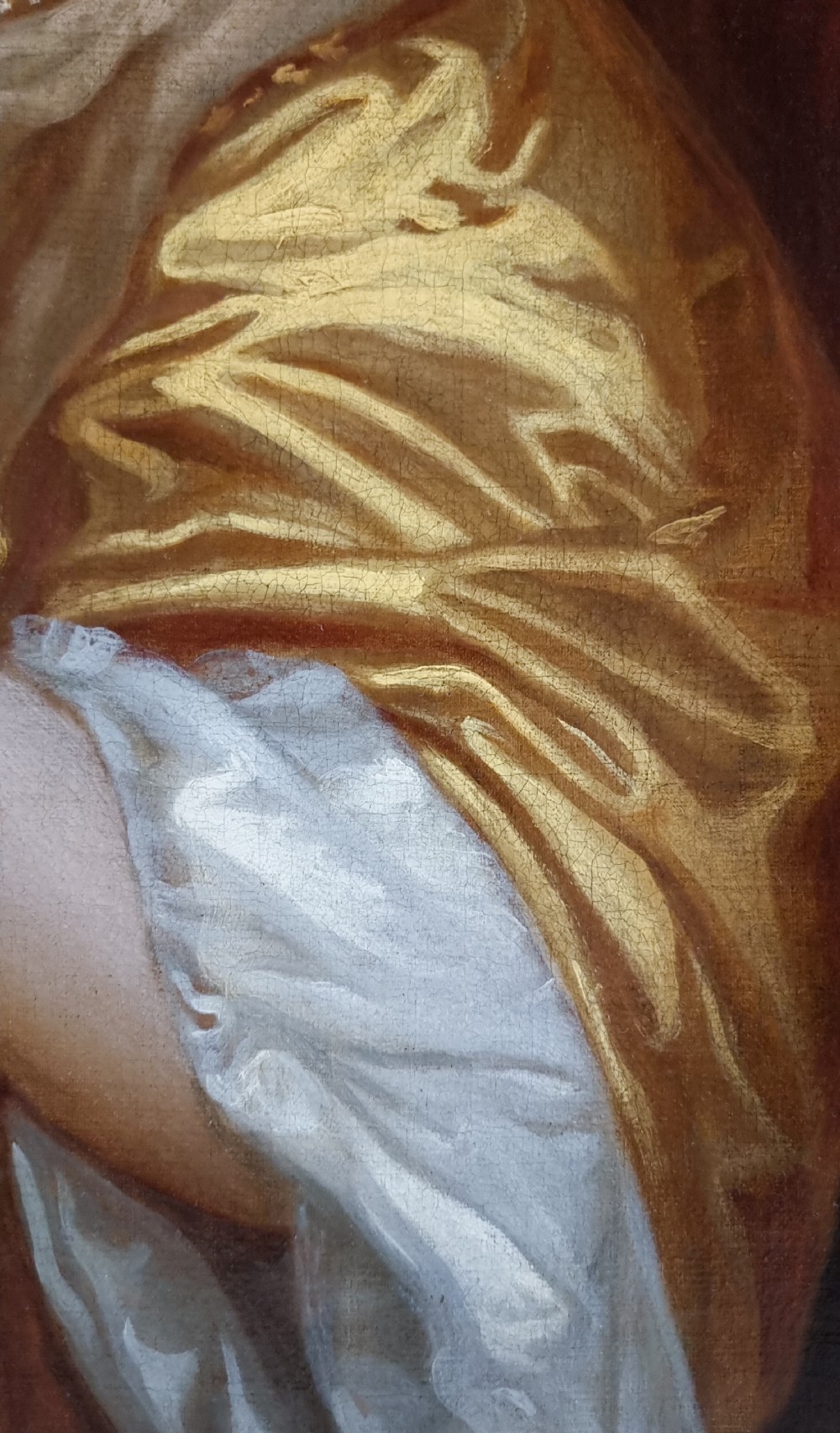
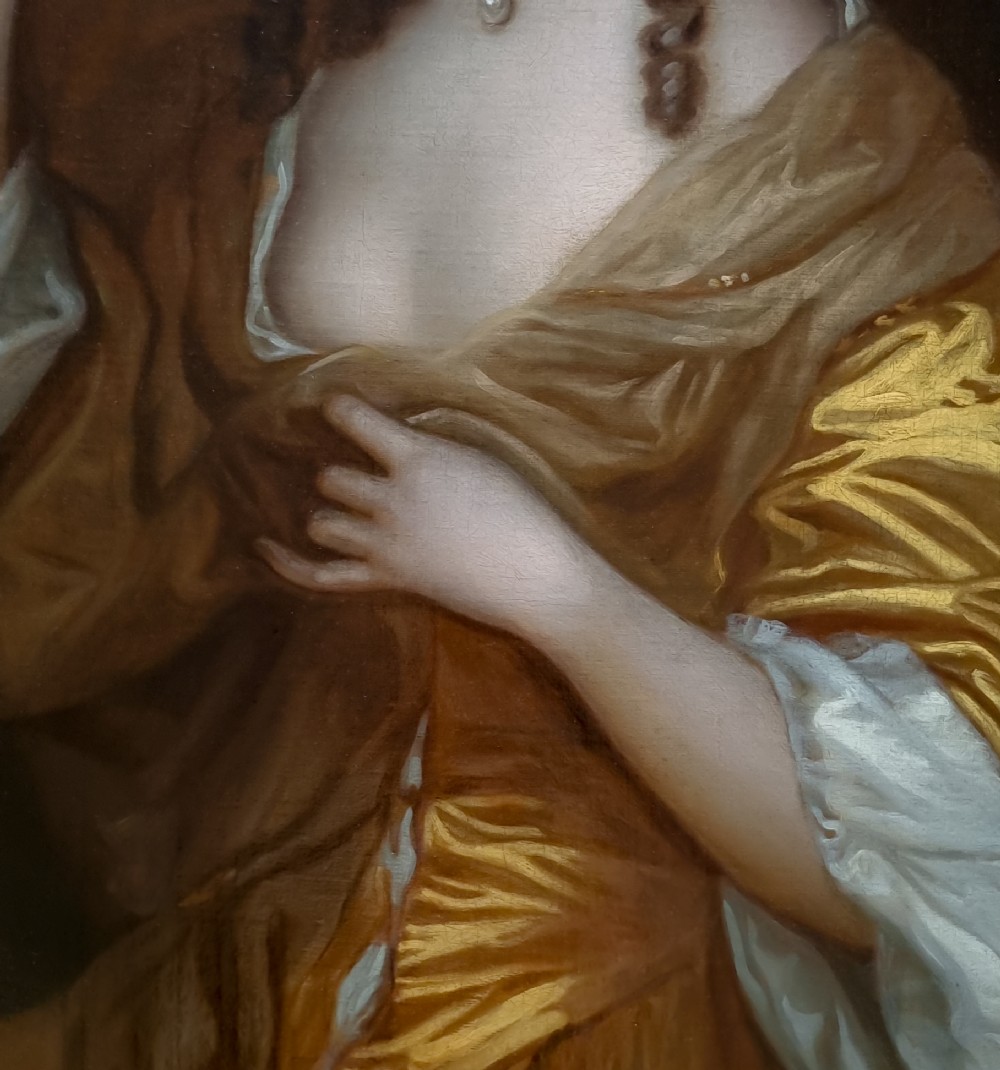
After the careful removal of layers of dirt and discoloured varnish, the original colours, detail, and artist’s virtuoso brushstrokes are visible again. The portrait can now be fully appreciated, and dated, to the 1660’s; it is thus a contemporary work to Lely’s portrait of the sitter in Windsor Castle.
The ‘head on hand’ portrait became hugely popular in England in the 1660’s, largely due to Peter Lely’s artistic.... [continued at: www.titanfineart.com]
Titan Fine Art has dated this piece to the 17th Century.
Specialist in 17th & 18thc portraits. Highly curated selection, museum-level research & pro conservation. Exceptional art, expertly vetted.
You can view the stock and full dealer information on the Titan Fine Art Profile Page

Portrait of Margaret Brooke, Lady Denham (C.1642–1667) C.1660’s; Circle of Peter Lely (1618-80), Antique Oil on Canvas Painting