Cheshire Antiques Consultant Ltd has dated this piece to the 1920s.
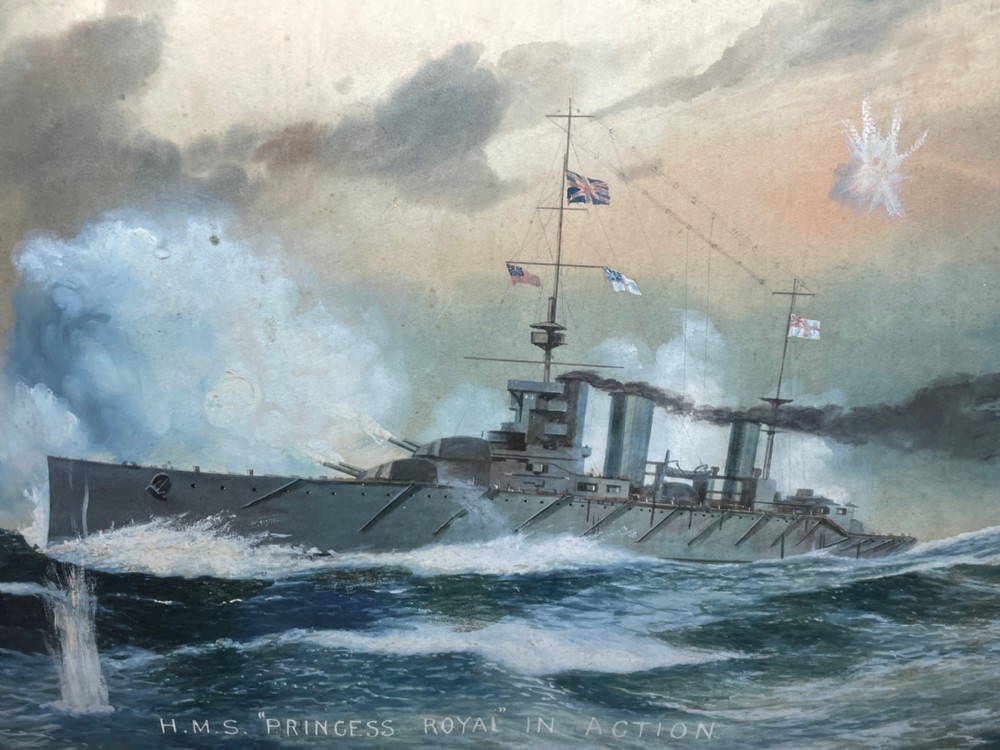
Storm seas crashing and being sprayed by the bow. The British Royal Navy ensign & Union Jack flags can be seen hoisted on the masts. Smoke coming out of the funnels. With dark and overcast grey sky overhead. To the far left in the distance you can view the conning towers masts of other German warships being fired upon. With various shots near misses causing large splashes on the ocean, explosions being seen going off in the sky all around.

Such a dramtatic battle scene.
Title "HMS Princess Royal in Action - Heligoland 1914 - Cuxaven 1914 - Jutland 1916".
Watercolour with protective glass front cover.
Provenance label verso and inscription C.Cozens naval photographer and picture framers.

Set in a traditional original wood frame painted black.
Circa 1920 early 20th century.
HMS Princess Royal was the second of two Lion-class battlecruisers built for the Royal Navy before the First World War. Designed in response to the Moltke-class battlecruisers of the Imperial German Navy, the ships significantly improved on the speed, armament, and armour of the preceding Indefatigable class. The ship was named after Louise, The Princess Royal, a title occasionally granted to the Monarch's eldest daughter. Construction and career Princess Royal and the Russian cruiser Admiral Makarov at Kronstadt, June 1914. Princess Royal was laid down at the Vickers shipyard in Barrow-in-Furness on 2 May 1910. She was launched on 29 April 1911 by Louise, Princess Royal, and commissioned on 14 November 1912. She cost £1,955,922 plus an additional £120,300 for her armament. Upon commissioning, Princess Royal joined the 1st Cruiser Squadron, which was renamed the 1st BCS in January 1913. Rear-Admiral David Beatty assumed command of the 1st BCS on 1 March 1913. The squadron, including Princess Royal, visited Brest in February 1914 and ports in the Russian Empire during June.

Completed in 1913, Princess Royal participated in the Battle of Heligoland Bight a month after the start of World War I in August 1914. She was then sent to the Caribbean Sea to prevent the German East Asia Squadron from using the Panama Canal. After the East Asia Squadron was sunk at the Battle of the Falkland Islands in December, Princess Royal rejoined the 1st Battlecruiser Squadron (BCS). During the Battle of Dogger Bank, the ship scored only a few hits, although one crippled the German armoured cruiser Blücher. Shortly afterward, she became the flagship of the 1st BCS, under the command of Rear-Admiral Osmond Brock.

Princess Royal was moderately damaged during the Battle of Jutland and required a month and a half of repairs. Apart from providing distant support during the Second Battle of Heligoland Bight in 1917, the ship spent the rest of the war on uneventful patrols of the North Sea. She was placed into reserve in 1920, then was sold for scrap in 1922 to meet the terms of the Washington Naval Treaty.

The Lion-class battlecruisers, nicknamed the "Splendid Cats", were designed by Philip Watts, the Director of Naval Construction, to be as superior to the new German battlecruisers of the Moltke class as the German ships were to the Indefatigable class. The increase in speed, armour and gun size forced a 70% increase in size over the preceding battlecruisers. Princess Royal had an overall length of 700 feet (213.4 m), a beam of 88 feet 6.75 inches (27.0 m), and a draught of 32 feet 5 inches (9.9 m) at deep load.

The ship normally displaced 26,270 long tons (26,690 t) and 30,820 long tons (31,310 t) at deep load, over 8,000 long tons (8,100 t) more than the earlier ships. She had a metacentric height of 5.95 feet (1.8
Cheshire Antiques Consultant Ltd has dated this piece to the 1920s.
Source the historic in 17th, 18th, 19th & 20th century fine arts, painting, sculptures & collectibles
You can view the stock and full dealer information on the Cheshire Antiques Consultant Ltd Profile Page

Watercolour Ww1 Battle Hms Princess Royal in Action Heligoland Cuxaven Jutland