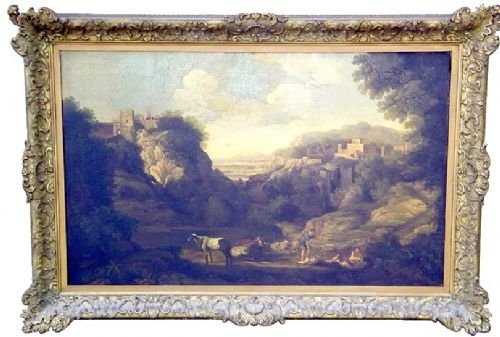
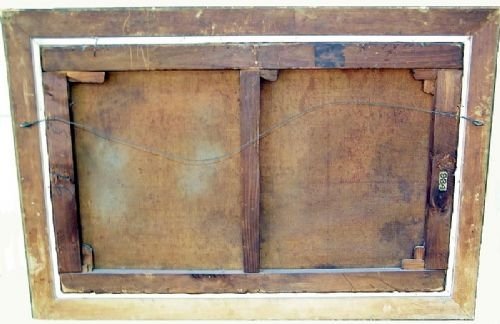
Artware Fineart has dated this piece to the 18th Century.
Medium: Oil on canvas
Born in Antwerp, van Bloemen was a younger brother of Pieter van Bloemen, who had left for Rome in 1674, where Jan Frans joined him in 1689. In 1690 a third painting brother, Norbert van Bloemen (1670-1746), joined them as well. Whereas Pieter returned to Antwerp in 1694 and Norbert left for Amsterdam before 1724, Jan Frans remained in Rome for the rest of his life. The Dutch-born painter Caspar van Wittel, who lived in Rome since 1675, became the godfather of his first child. Van Bloemen was nicknamed Orizonte, on account of the distance he painted in his landscapes. His landscapes have an Arcadian lushness, with mountains, streams, distant hamlets, and small inhabitants painted with imprecise pittori di tocco flourishes. Orrizonte predominantly painted classical landscapes throughout his carrier, taking his inspiration from the Roman campagna. His landscapes, with their recession through a series of planes, soft, warm lightning and classical and religious subject matter, draw on the examples of artists such as Claude Lorrain and Gaspard Dughet. His painting are exquisitely imbued with that "difficult-to-define pastoral ambience" which helped to make him such a great painter in the eyes of his contemporaries. While van Bloemen was a much locally patronized painter of the Roman Schildersbent, or Bentvueghels, the Netherlandish painters guild, he was unable to gain acceptance into the pre-eminent Roman painter's guild, the Accademia di San Luca, till he was over 70 years old. Some of this resistance may have arisen from the Roman establishment disdain for landscape painting as a demonstration of skill. He died in Rome in 1749.
Artware Fineart has dated this piece to the 18th Century.
You can view the stock and full dealer information on the Artware Fineart Profile Page
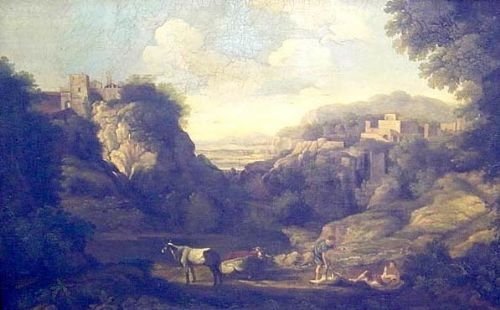
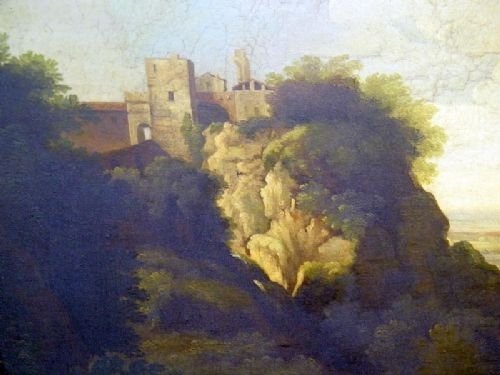
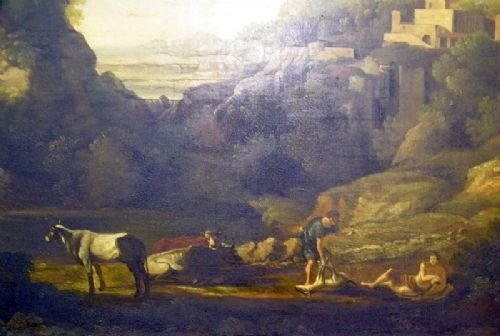
An Italinate Landscape with Travellers in the Foreground and Villas Beyond; Circle of Jan Frans Van Bloemen (1642-1749)