
Artware Fineart has dated this piece to the 18th Century.
size: 76.20 x 63.50 cm; 30.00 x 25.00 ins
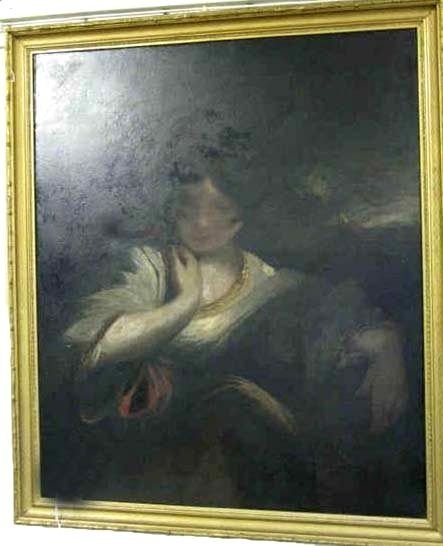
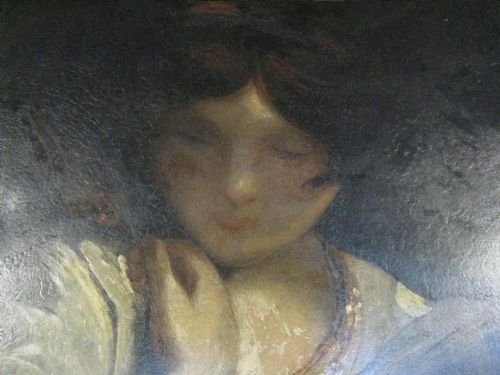
In this portrait the young girl is looking down andtherfore she is not engaging the viewer, the drappery also differs from the portrait in the Tate collection.
Reynolds was born in Plympton, Devon, on 16 July 1723. As one of eleven children, and the son of the village school-master, Reynolds was restricted to a formal education provided by his father. He exhibited a natural curiosity and, as a boy, came under the influence of Zachariah Mudge, whose Platonistic philosophy stayed with him all his life. Showing an early interest in art, Reynolds was apprenticed in 1740 to the fashionable portrait painter Thomas Hudson, with whom he remained until 1743. From 1749 to 1752, he spent over two years in Italy, where he studied the Old Masters and acquired a taste for the "Grand Style". Unfortunately, whilst in Rome, Reynolds suffered a severe cold which left him partially deaf and, as a result, he began to carry a small ear trumpet with which he is often pictured. From 1753 until the end of his life he lived in London, his talents gaining recognition soon after his arrival in France. Reynolds worked long hours in his studio, rarely taking a holiday. He was both gregarious and keenly intellectual, with a great number of friends from London's intelligentsia, numbered amongst whom were Dr Samuel Johnson, Oliver Goldsmith, Edmund Burke, Giuseppe Baretti, Henry Thrale, David Garrick and fellow artist Angelica Kauffmann. Because of his popularity as a portrait painter, Reynolds enjoyed constant interaction with the wealthy and famous men and women of the day, and it was he who first brought together the famous figures of "The" Club. By 1761 Reynolds could command a fee of 80 Guineas for a full-length portrait (Mr Fane); in 1764 he was paid 100 Guineas for a portrait of Lord Burghersh. With his rival Thomas Gainsborough, Reynolds was the dominant English portraitist of 'the Age of Johnson'. It is said that in his long life he painted as many as three thousand portraits. Although not principally known for his landscapes, Reynolds did paint in this genre. He had an excellent vantage from his house on Richmond Hill, and painted the view in about 1780. In 1789 he lost the sight of his left eye, which finally forced him into retirement. In 1791 James Boswell dedicated his Life of Samuel Johnson to Reynolds. Reynolds died on 23 February 1792 in his house in Leicester Fields in London. He was buried at St. Paul's Cathedral.
Professionally, Reynolds' career never peaked. He was one of the earliest members of the Royal Society of Arts, helped found the Society of Artists, and, with Gainsborough, established the Royal Academy of Arts as a spin-off organisation. In 1768 he was made the RA's first President, a position he held until his death. As a lecturer, Reynolds' Discourses on Art (delivered between 1769 and 1790) are remembered for their sensitivity and perception. In one of these lectures he was of the opinion that "invention, strictly speaking, is little more than a new combination of those images which have been previously gathered and deposited in the memory." Reynolds and the Royal Academy have historically received a mixed reception. Critics include many of the Pre-Raphaelites, and William Blake, the latter having published his vitriolic Annotations to Sir Joshua Reynolds' Discourses in 1808. To the contrary, both J. M. W. Turner and James Northcote were fervent acolytes: Turner requested he be laid to rest at Reynolds' side, and Northcote (who lived for four years as Reynolds' pupil) wrote to his family "I know him thoroughly, and all his faults, I am sure, and yet almost worship him." The word worship is second cast; originally Northcote had written adore.
Artware Fineart has dated this piece to the 18th Century.
You can view the stock and full dealer information on the Artware Fineart Profile Page
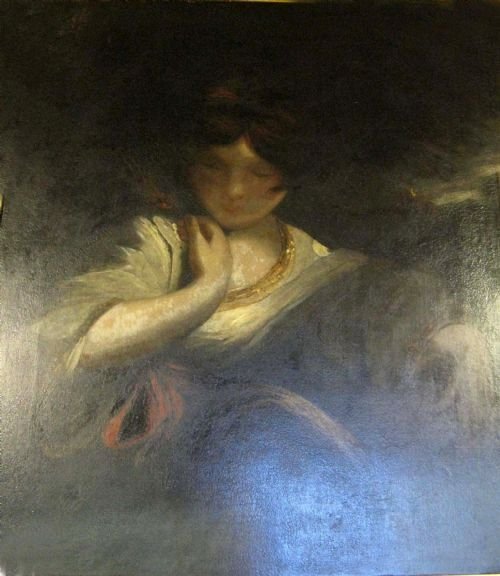
Portrait of Robinetta by Sir Joshua Reynolds, Pra (1723-1793)