
Artware Fineart has dated this piece to the 18th Century.
size: 29.00 x 24.00 ins
in ornate giltwood frame
bearing various labels verso. "Richard Hetherington Esq. President of The Virgin Islands and of The Hill Burton in Lonsdale, Yorkshire. Born 1740 died 1821". "The original of the picture is in the possession of his grandson Charles Richard Robinson Esq. J.P of Brettonby Manor, Yorkshire". "The original is now at Great Chesterfield House, Great Chesterfield, Essex and belongs to Mrs G.G. granddaughters the Misses E.M.S. and L.P. Robinson of Hinxton ." The portrait is inscribed itself "A copy by C. Burlison 1872 from a portrait by Parkinson 176. Clement Burlison (1815-1899 British).
circa 1743, d. 1788 (Thornton in Lonsdale, Lancashire). He was a merchant of Liverpool and Lancaster, and a sugar planter, he was in Tortola by 1777

He owned 5 sugar plantations in Tortola, and owned 225 male slaves and 233 female slaves. From 1811 to 1821 he was the President of the British Virgin Islands. He travelled back to England frequently because he fathered 6 children by his wife, Mary Pickering. She never travelled to Tortola because of the hot and humid climate. She died in 1788 aged 45. A hurricane hit Tortola in 1819; 4 people died and Richard was injured. He died in 1821 in Tortola.
Richard Hetherington was President of the Council during the time of the trial of Arthur Hodge for the murder of the slave "Prosper". Hetherington appears to have taken on the role of prosecuting counsel. In response to the submission that Hodge could not be guilty of murdering his own slave, Hetherington is reported to have submitted to the jury:
"...the law makes no distinction between master and servant. God created white and he created black creatures; and as God makes no distinction in administering justice, and to Him each is alike, you will not, nor can you alter your verdict, if murder has been proved - whether on white persons or on black persons, the crime is equally the same with God and the law.
Hetherington's star would later wane though, and he would eventually be removed from office for financial irregularities.
Arthur William Hodge (1763 - 1811) was a plantation farmer, member of the Council and Legislative Assembly, and slave owner in the British Virgin Islands, who was hanged on 8 May 1811, for the murder of one of his slaves. He was the first West Indian slave owner to be executed for the murder of a slave considered his property, and perhaps the only British West Indian slave owner, or British subject, to be executed for murdering his slave. He was not the first white person to have been lawfully executed for the killing of a slave, as some have claimed.
He was born in the British Virgin Islands, studied at Oriel College, Oxford and served in the British Army. His wife was a sister-in-law of the Marquess of Exeter. He was described as a man of great accomplishments and elegant manners. After his father's death, he returned to the British Virgin Islands to assume control of the family's plantation.
Artware Fineart has dated this piece to the 18th Century.
You can view the stock and full dealer information on the Artware Fineart Profile Page
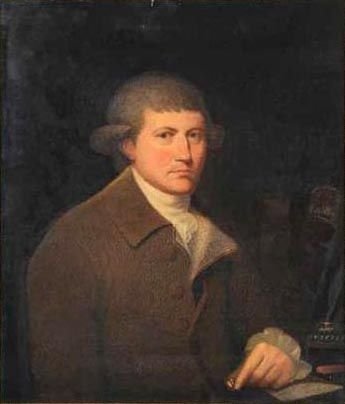
Portrait of Col Richard Hetherington 1737 - 1821 President of the Virgin Islands 1811-1821, After Thomas Parkinson (1744- Circa 1789)