Regent Antiques has dated this piece to the 19th Century.
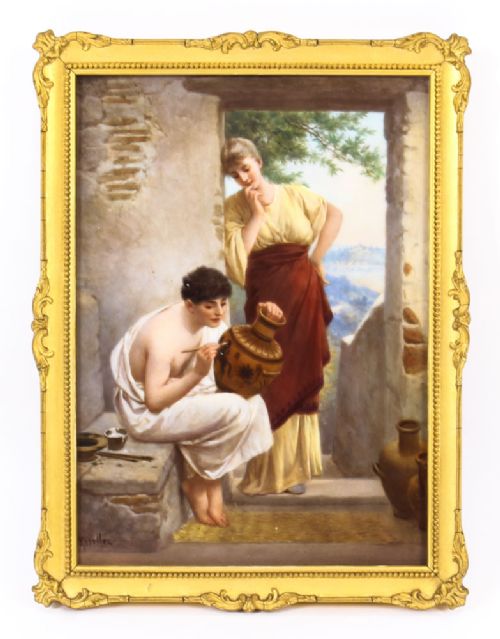
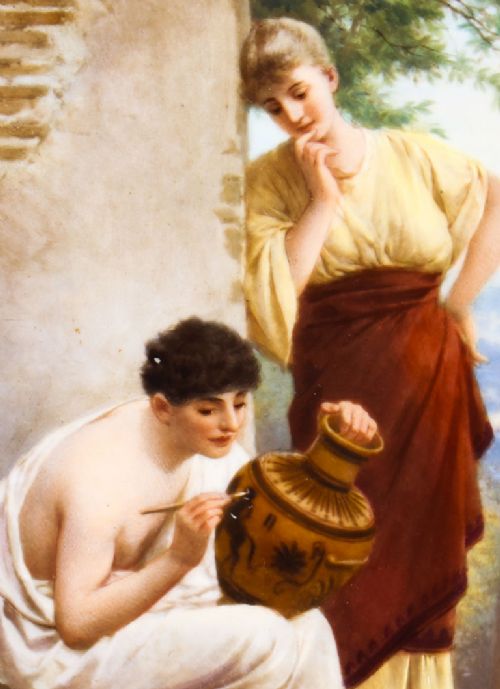
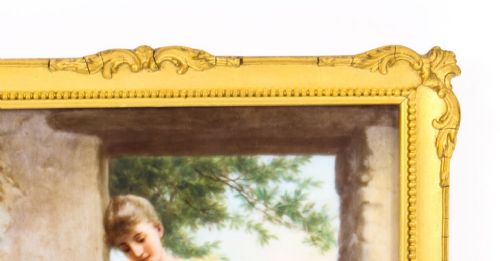
The young artisan is painting a black figure on the surface of the amphora while she is standing tall at the doorway and watching him.
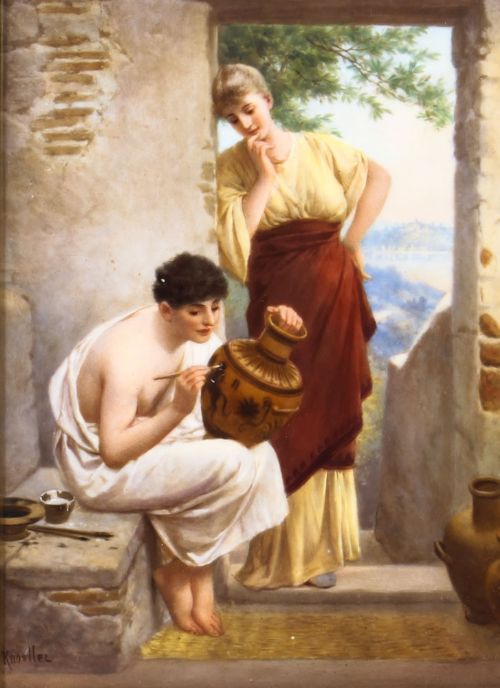
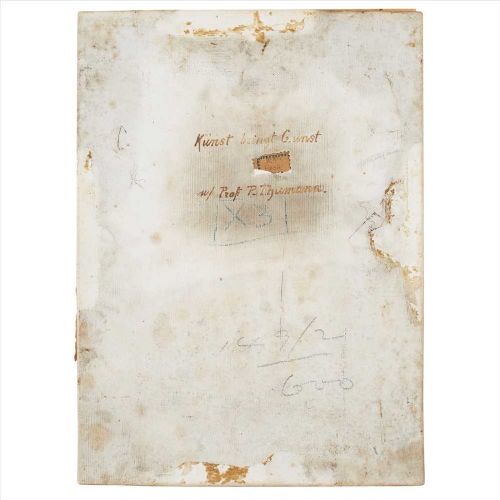
Both figures dress in classical clothes and are set within a nostalgic environment reminiscent of antique ruins and of a paradisiac landscape. Indeed, a sweet and almost melancholy calm prevails. The original painting by the German artist, Thumann, just like many other of his romantic paintings, became very popular and was widely reproduced on porcelain plaques, plates and vases.
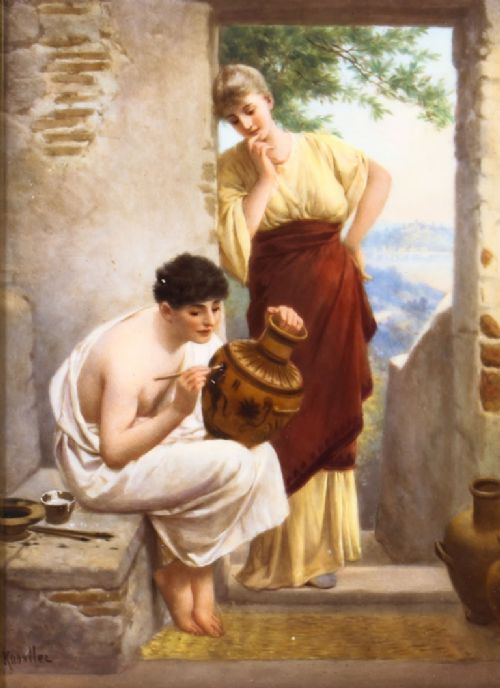
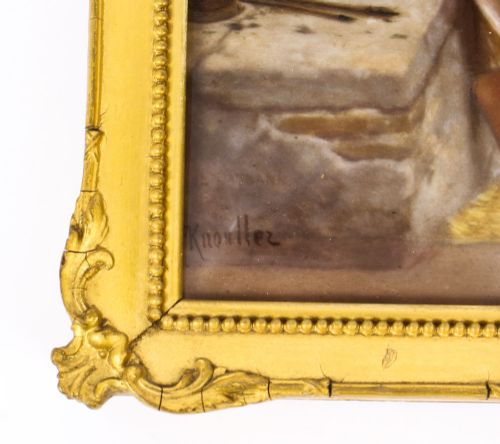
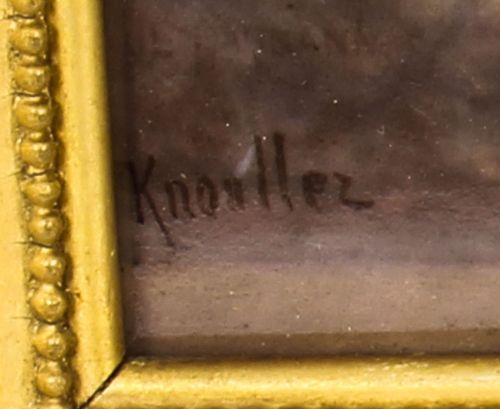
This truly splendid plaque is signed to the left bottom corner 'Knouller' and bears the impressed sceptre mark for KPM.
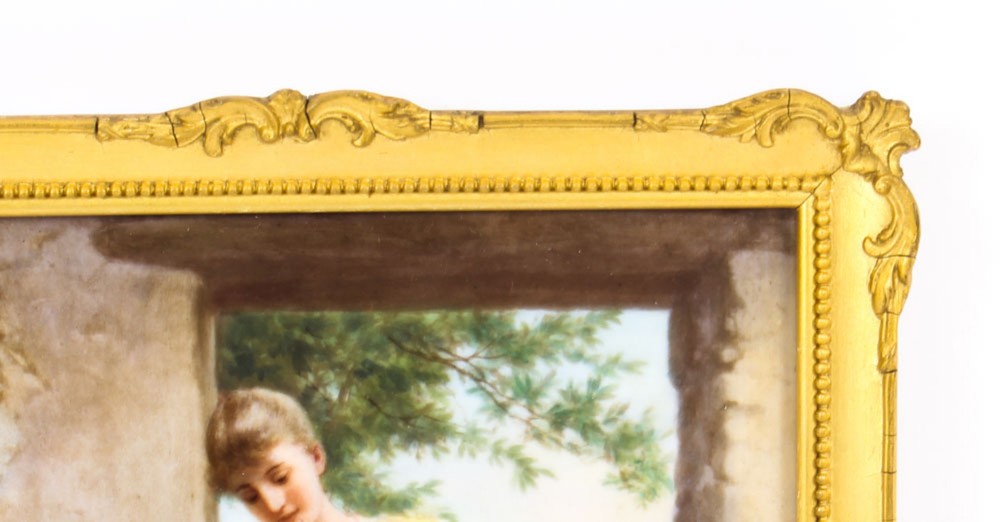
It is set in its original splendid gilt frame displaying foliate decorations to the border.
Add this splendid antique plaque to a very special wall in your home.
Condition:
The plaque and the gilded frame both in excellent condition, please see photos for confirmation.
Dimensions in cm:
Height 24 x Width 18 x Depth 2.5 - Frame
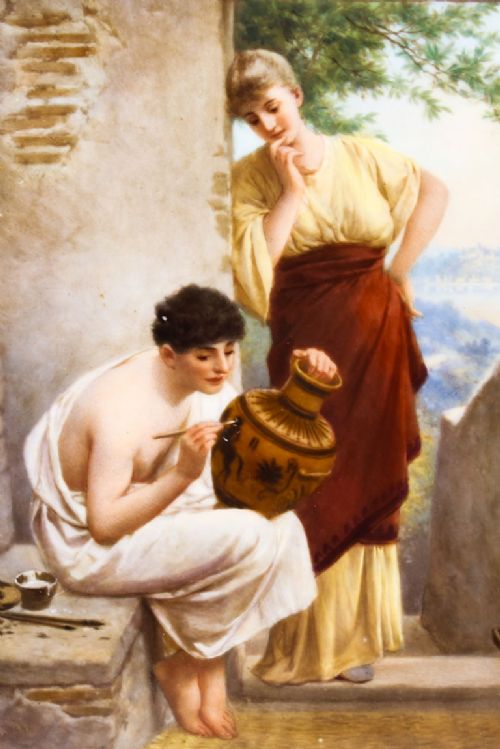
Height 22 x Width 16 - Plaque
Dimensions in inches:
Height 9 inches x Width 7 inches x Depth 1 inch - Frame
Height 9 inches x Width 6 inches - Plaque
The Royal Porcelain Factory in Berlin (German: Königliche Porzellan-Manufaktur Berlin, abbreviated as KPM), also known as the Royal Porcelain Manufactory Berlin and whose products are generally called Berlin porcelain, was founded in 1763 by King Frederick II of Prussia (known as Frederick the Great). Its actual origins, however, lie in three private enterprises which, under crown patronage, were trying to establish the production of "white gold" (i.e. porcelain) in Berlin from the mid-18th century onwards.
Before KPM was founded, two attempts had already been made to establish a porcelain manufactory in Berlin. In 1751, the Berlin wool manufacturer Wilhelm Caspar Wegely was granted the royal privilege to set up a porcelain manufactory in Berlin. Furthermore, Frederick II of Prussia granted him exemption from duties for the import of essential materials and assured him of the exclusion of all competition.
Wegely hired first-class craftsmen from his competitors, and appointed the porcelain sculptor Ernst Heinrich Reichard to the post of chief modeller. However, technical difficulties and the Seven Years' War between Prussia and Saxony soon proved to be the enterprise's downfall. In 1757, he dissolved his company and sold its inventories, equipment and materials to the Berlin businessman Johann Ernst Gotzkowsky.
In 1761, the second porcelain manufactory in Berlin started its operations. Gotzkowsky concluded an agreement with Wegely's chief modeller, Ernst Heinrich Reichard, who was in possession of the secret formula known as the arcanum. Reichard received 4,000 thaler for the arcanum, and another 3,000 for the stock of porcelain and other materials. Furthermore, he undertook to work for Gotzkowsky as a keeper of the arcanum and as the manager. Gotzkowsky also agreed to take over Reichard's eight workers.
Appreciated and supported by the King of Prussia, Gotzkowsky managed to attract important artists and qualified employees. Right at the start, Gotzkowsky appointed Friedrich Elias Meyer, a pupil of Johann Joachim Kändler who came from Meissen, to the post of chief modeller, and Carl Wilhelm Boehme to the post of head of the porcelain-painting department. Gotzkowsky bought another building next to his own property at Leipziger Straße 4, and he began to build a manufactory on the site.
Nevertheless, Gotzkowsky's finances began to deteriorate. Since the royal exchequer was in the red on account of the war, Gotzkowsky believ
Regent Antiques has dated this piece to the 19th Century.
We specialise in english and continental furniture, silver, porcelain and decorative items.
You can view the stock and full dealer information on the Regent Antiques Profile Page
Regent Antiques is a registered member of LAPADA CINOA
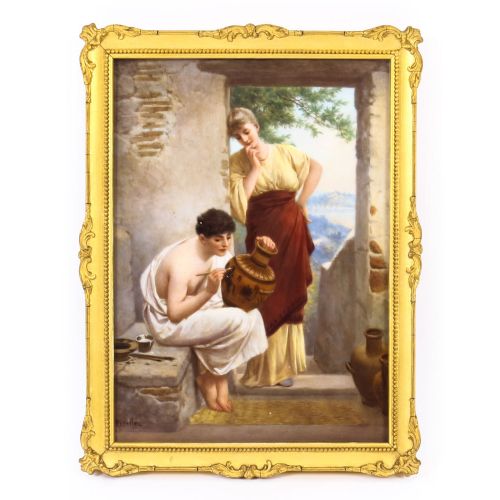
Antique Berlin Kpm Plaque 'Kunst Bringt Gunst Signed Knouller Ca 1880