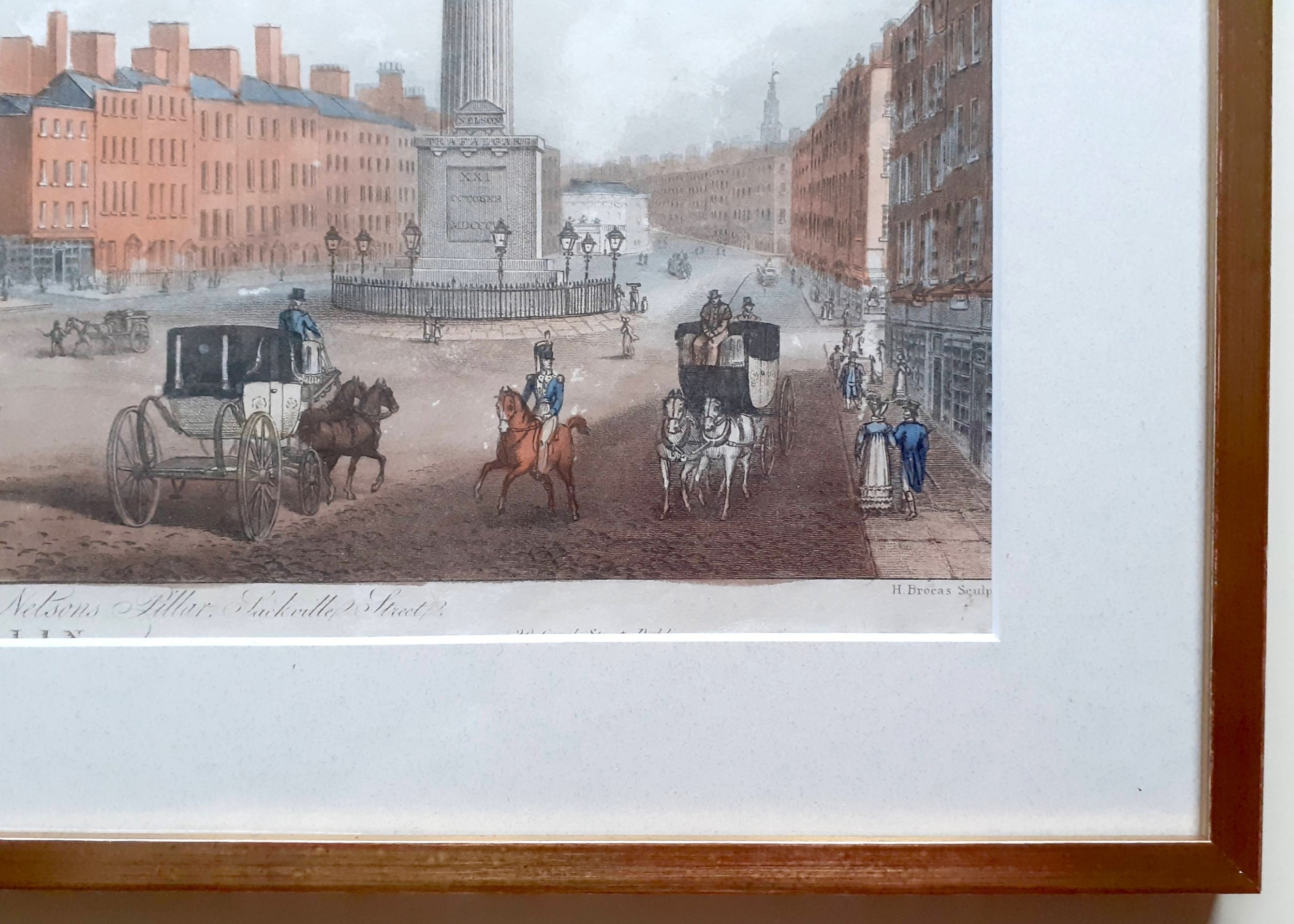
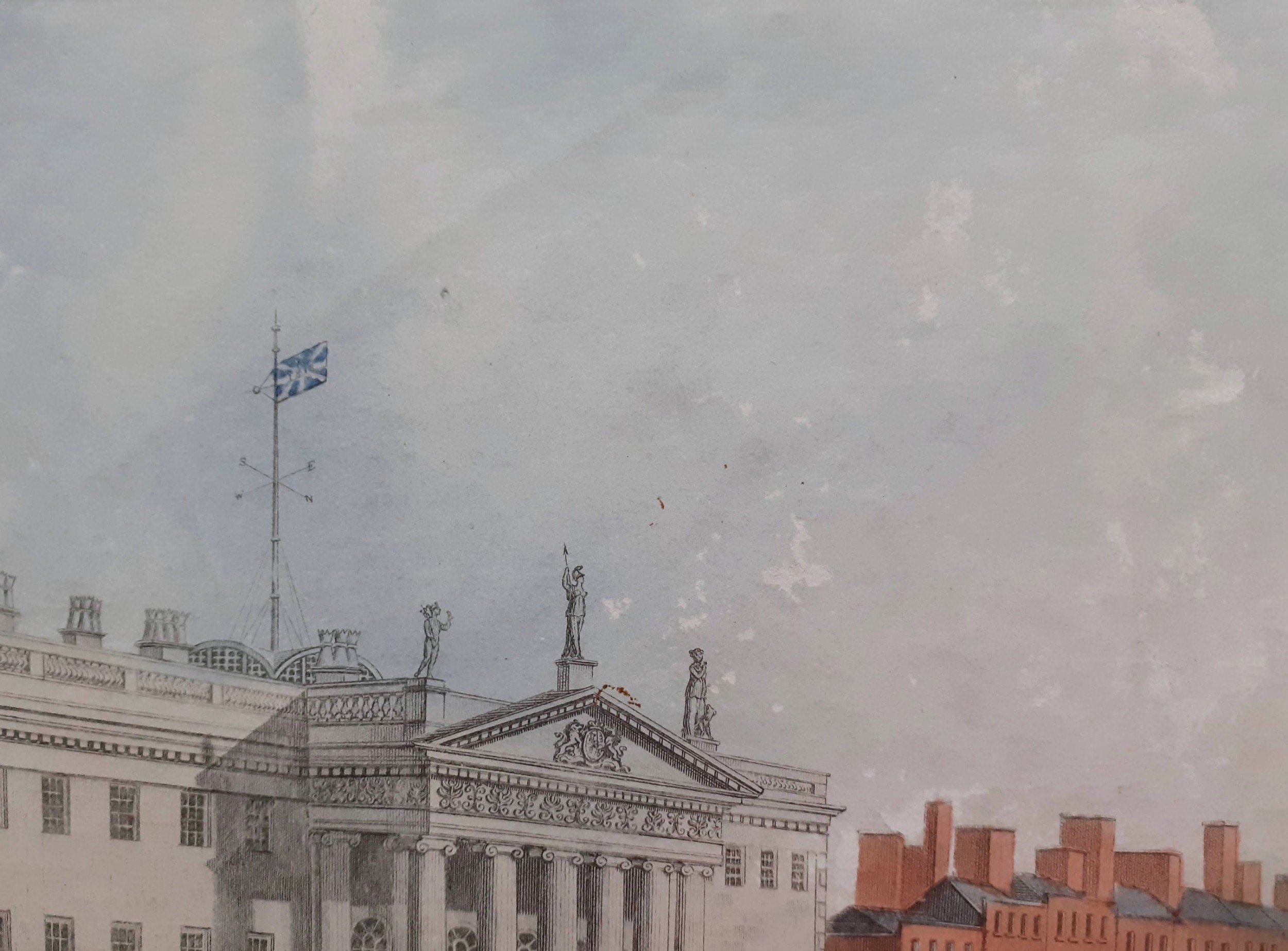
Skippings Fine Arts has dated this piece to the Georgian era.
Samuel Frederick Brocas (1792-1847) was the second son of Henry Brocas (1762-1837), a painter and engraver who exhibited frequently in Dublin, and was Master of the Landscape and Ornament School of the Royal Dublin Society.
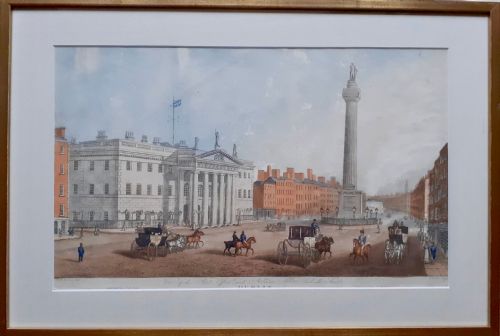
Our coloured etching was originally to create a series of books illustrating the topography of Ireland, but this was never realised. Samuel Frederick Brocas' design was executed by his brother, Henry Brocas Jun.
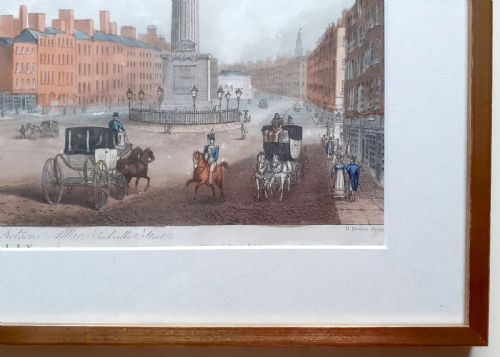
Of the 21 views of Dublin originally promised, only ten were actually engraved, over a period of ten years from 1820, and were published individually. Here is probably the most emblematic of them.
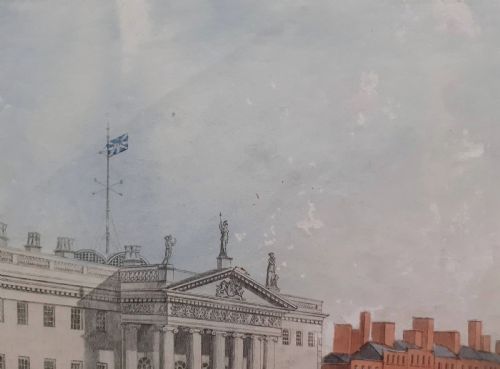
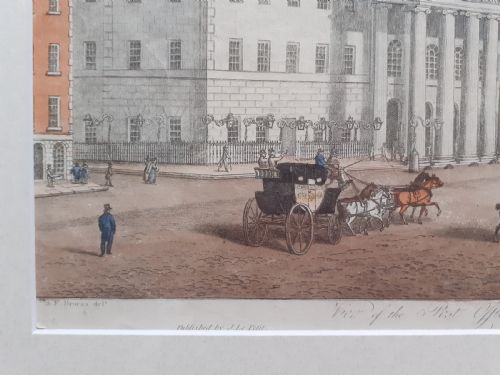
The General Post Office on Sackville Street, modern day O'Connell Street, is perhaps the most iconic of Dublin's buildings, serving as the headquarters of the Irish Republicans during the Easter Rising of 1916. The adjacent Nelson’s Pillar survived the Rising but was destroyed by Republicans in 1966. The rotunda of the Dublin Lying-in Hospital, today the Rotunda Gate Theatre, is visible, as is the spire of the St George’s church.
Literature:
J.R. Abbey, Scenery of Great Britain and Ireland in aquatint and lithography 1770-1860, London, 1952, p. 318, under no. 476 as 'View of the Post Office and Nelson Pillar, Sackville Street./Dublin'.
Much of the above description comes from Christies', where the preparatory drawing for this work was auctioned in 2017 for £20.000
Our hand coloured engraving measures 21.5 x 39 cm at sight, the overall framed size being 31 x 49 cm. Despite cut margins, losses/wear and tear as visible on the photos, the artwork presents well and is a very rare piece.
Please note that we are a offering a companion piece in a separate listing.
Skippings Fine Arts has dated this piece to the Georgian era.
Modern french & continental pictures selected by a former french auction house expert
You can view the stock and full dealer information on the Skippings Fine Arts Profile Page
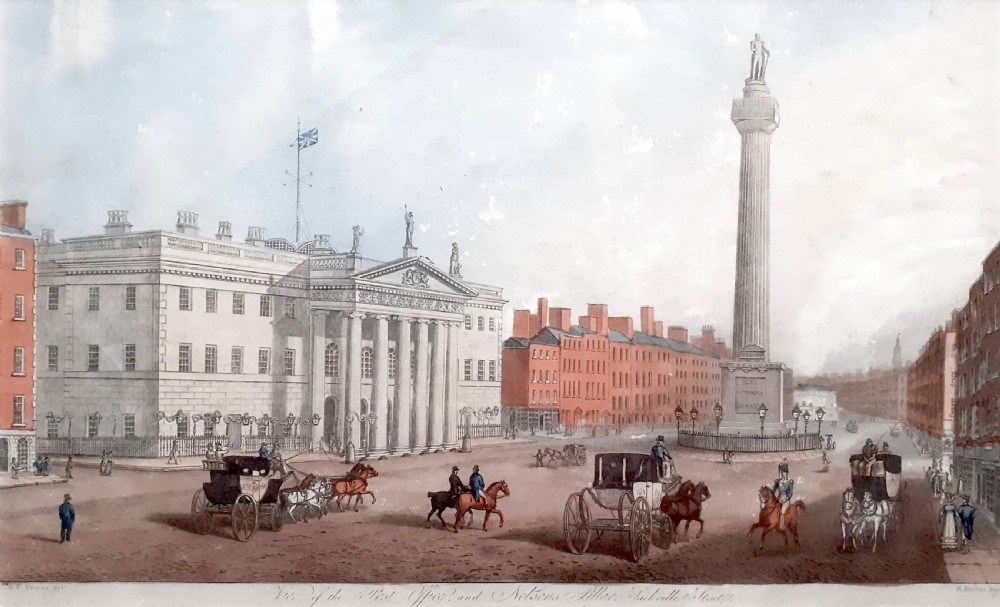

Ireland Ca 1820 Dublin General Post Office and Nelson's Pillar, Sackville Street, Hand Coloured Engraving, Henry Brocas the Younger, Irish, C.1798-1873. After Samuel Frederick Brocas, Irish, C.1792-1847.