
Artware Fineart has dated this piece to the 18th Century.
76.50 x 63.50 cm; 30.12 x 25.00 ins
Edward was one of the outstanding commanders during the Hundred Years' War, winning his major victory at the Battle of Poitiers in 1356. He died one year before his father and so never ruled as king. The throne passed instead to his son Richard, a minor, upon the death of Edward III. The origin of Edward's nickname is obscure. It was not used until the Tudor period and has been variously attributed to his black armour and to French hatred of him. Prince Edward, the eldest son of King Edward III and Queen Philippa of Hainault, was born at the Royal Palace of Woodstock in Oxfordshire, on the 15th June 1330. In his third year, he was created Earl of Chester; four years afterwards Duke of Cornwall; and, in 1343, Prince of Wales.At the institution of the Order of the Garter, Prince Edward had not completed his fourteenth year; and, although included amongst the Founders, in accordance with the design of his royal father that the eldest son of the Sovereign should be always a constituent ember of the Order, the honour of knighthood was reserved for the moment when he should be armed and thereby qualified to enter upon his warlike course. This occasion presented itself when, accompanying the King on his memorable expedition against France, he landed at La Hogue on the 12th July 1346.

At the Battle of Crécy, which was fought on the 26th August following, King Edward, desirous that his noble son should "win his spurs," gave him the command of the van, with the counsel and assistance of the Earl of Warwick and Sir John Chandos. The tradition near the spot is, that the King had ordered the Prince to wear, on that day, a black cuirass, richly ornamented; and that, from this incident, he retained the surname attributed to him in history. The defeat of the enemy is known to have been complete; and the delighted father, embracing his son on the field of victory, eulogised his valour and pronounced him worthy of empire. The magnificent establishment provided for Prince Edward in his early infancy, by his investiture with the ample domains of the County Palatine of Chester and the Duchy of Cornwall, had placed a vast revenue at his disposal as soon as he arrived at an age to administer his own affairs; and we have contemporary testimony of the brilliancy of his court, not only during his residence in England, but especially whilst exercising the supreme authority in Aquitaine.
From a highly interesting volume, unknown to his various biographers, and containing the warrants and accounts of the treasurers and other officers of his household from 1346, and, in a regular series from February 1351 to November 1365, we learn that, upon his return from Calais, in 1347, his town residence was "Pulteney House," situated in or near Candlewick Street, in the parish later called St. Lawrence Pountney in the City of London. This mansion, which had been erected, by Sir John Pulteney (who frequently filled the civic chair), on the site of the later Cold Harbour Palace, is described as having been built on a scale of great splendour. It was, at some time after the death of Sir John, which happened in 1340, and during the minority of his son, tenanted by the Prince, until 1359, in which year directions were given to surrender it to Sir Nicholas Loveyne, who had married the knight's widow. Its front was open to the Thames, where the prince kept swans in considerable number, to which allusion is often made in these accounts.
Artware Fineart has dated this piece to the 18th Century.
You can view the stock and full dealer information on the Artware Fineart Profile Page
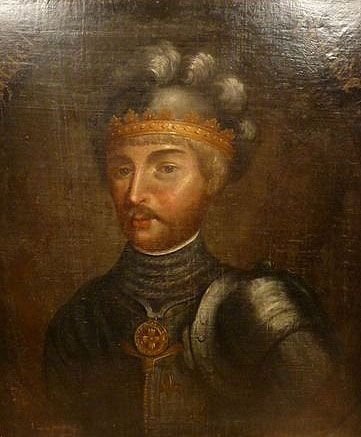
Edward, Prince of Wales (1330-1376), the Black Prince, English School 18th Century