Titan Fine Art has dated this piece to the 18th Century.
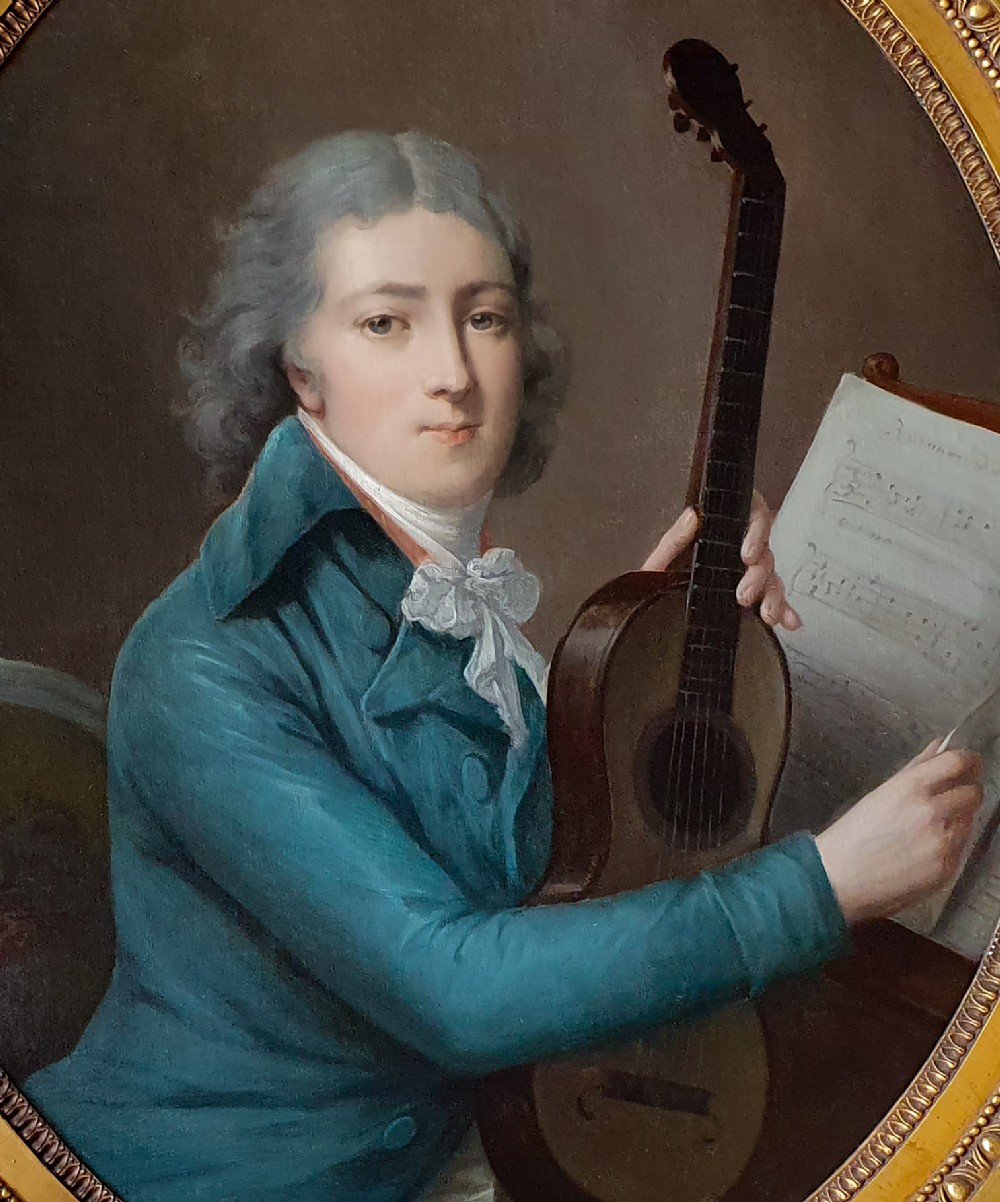
This exquisitely rendered large portrait depicts a charismatic young gentleman with a guitar.
It is as if the portrait has captured a snapshot in time, whilst the young musician has broken off from playing to turn the pages of his music, and any immediately outpouring of feeling or creation of music is paused, and momentarily glance across at the sitter. The portrait is French, in style and colouring, and the fashions of the sitter. It is worth noting that France greatly excelled in the arts during the 18th century and were pre-eminent in Europe, producing some of the highest quality and most sought after works.
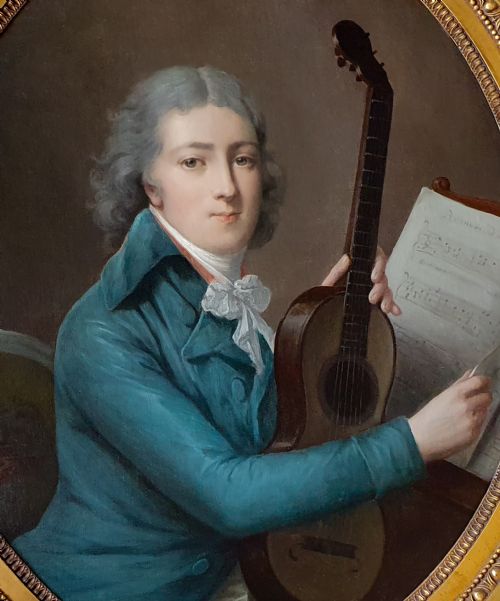
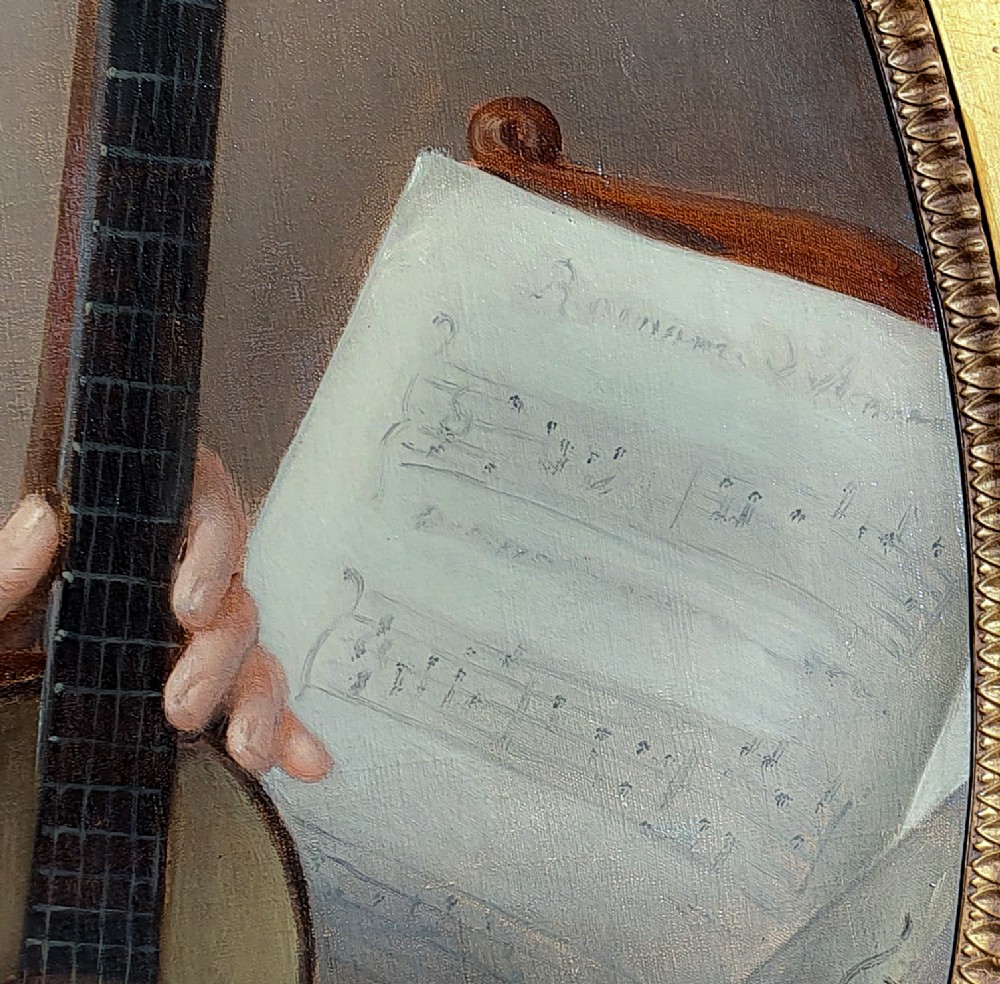
This is a painting about young love. The title on the sheet music reads “Romance d’Amour” and it is likely a composition by the sitter written specially for his loved one – a young man in love, and perhaps practising his guitar so as to be able to serenade his loved one. The rough, thickened grey line under the first system of notation evokes an impression of writing which could be lyrics for the music.
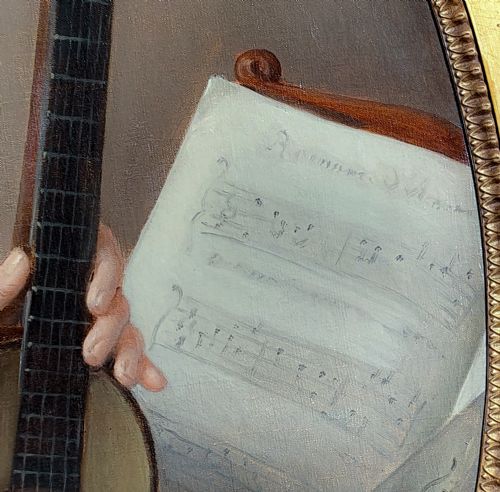
There is an infamous composition called Romance d’Amour – also called "Romance Anónimo" (Anonymous Romance), "Estudio en Mi de Rubira" (Study in E by Rubira), "Spanish Romance", "Romance de España", "Romance de Amor", "Romance of the Guitar", "Romanza" and "Romance d'Amour" - however its tune bears little resemblance to the music in the painting (also, the infamous Romance d’Armour is thought to have originated during the late 19th century).
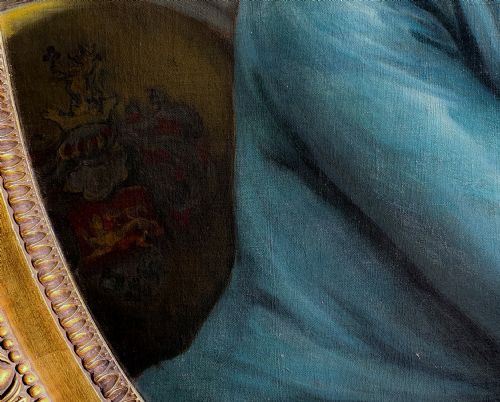
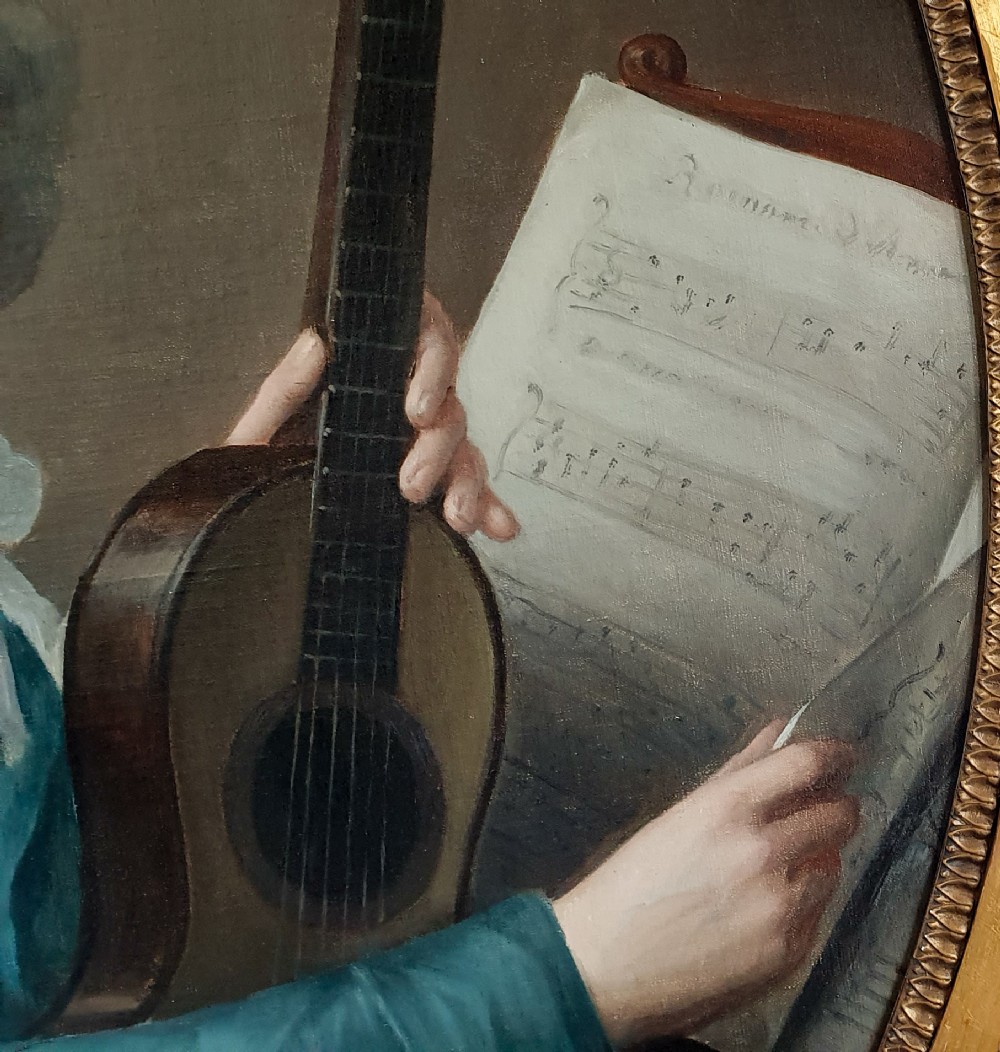
This portrait is datable to circa 1795 not only on stylistic grounds but the fashionable buttoned-up formality of the sitter, the hairstyle, which was now worn longer and more natural, a departure from the omnipresent powered wig, and the guitar. In the 1790s, the guitar was reduced to six single strings and the fingerboard was extended onto the belly. The young man may well be showing off what was then a very new instrument – with
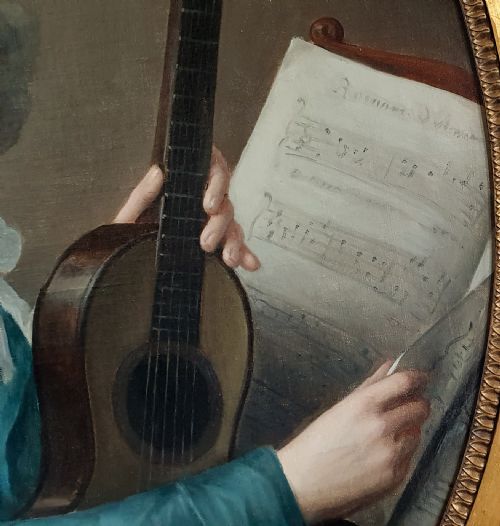
the new extended fingerboard and rich sonorous potential of six strings; even though the design shown retains the influence of the old lute – with the headstock angled backwards. This is possibly one of the first paintings of a six single-string guitar.
He has pride not only in his ‘modern’ instrument but his ability to play and to read the music in front of him which is painted with considerably more detail and accuracy than usual and even may suggest that the painter had music-reading ability. Often sheet music notation in paintings is schematic or placed too far away for the viewer to see.
The music is written in a form that is recognisable today: a five-line staff. This was also new for the guitar at the time.
In 1786, Federico Moretti (1769-1839) released a first manuscript version of his Principles for the Guitar published in 1792 as Principj per la chitarra by Luigi Mareschalchi. Before Moretti, guitar music had been written either in tablature (i.e. lute-style) or in staff notation, with little attempt to separate the different parts and without precise indications of the full duration of all notes. The sheet music in the portrait would, therefore, appear to be very up-to-date in its Morettiinfluenced notation technique with recognisable bar lines, clear durations of notes (crotchets and
quavers are identifiable), two-note chords, and even (at the start of the second system) four marks which could possibly be interpreted as sharps denoting the key of E major. As such it was a respectable and respected instrument, accepted in cultivated circles by this period, despite some of its roots being in the folk guitar.
The unembellished naturalness of the portrait is very pleasing. A f
Titan Fine Art has dated this piece to the 18th Century.
Specialist in 17th & 18thc portraits. Highly curated selection, museum-level research & pro conservation. Exceptional art, expertly vetted.
You can view the stock and full dealer information on the Titan Fine Art Profile Page
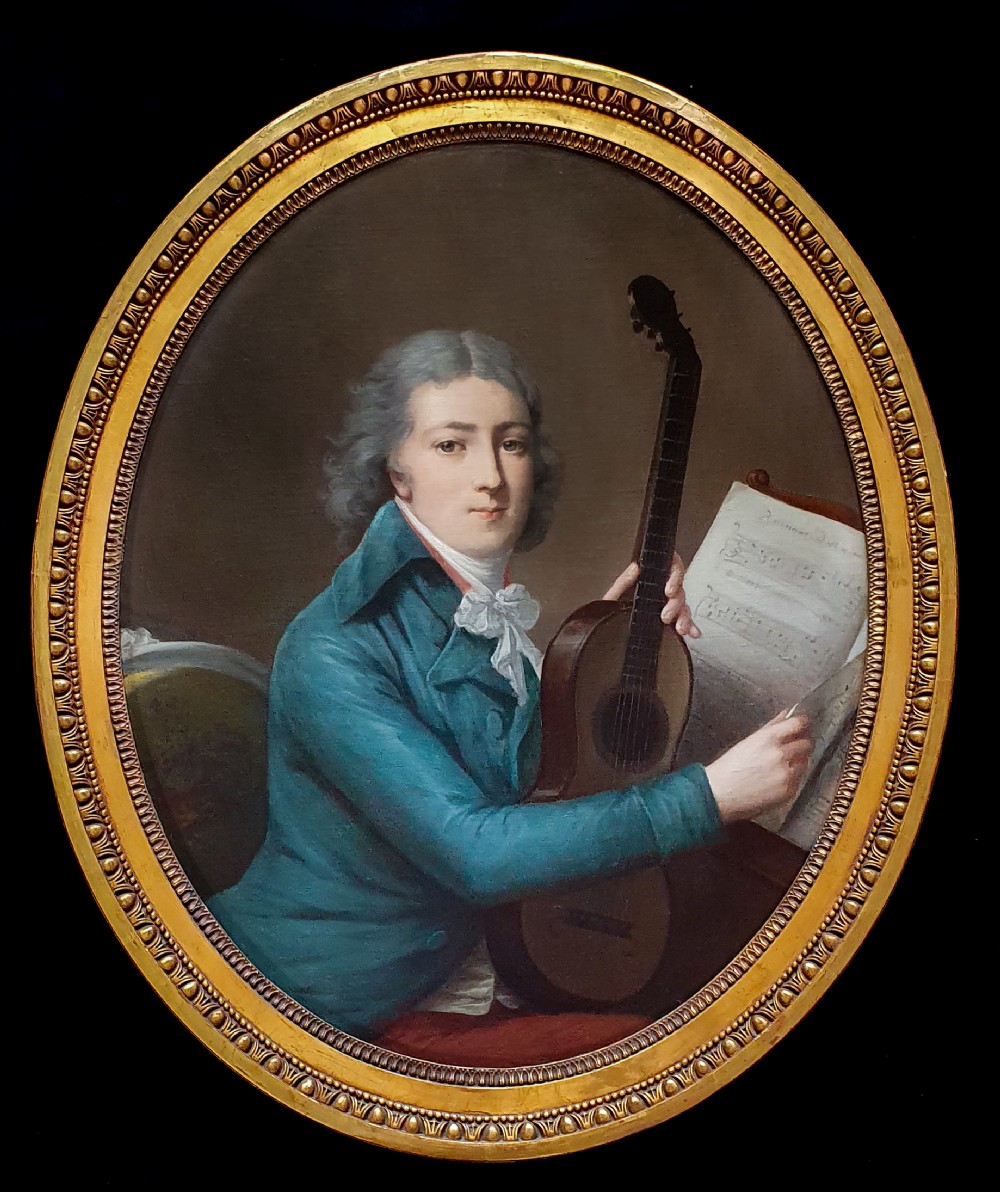
Portrait of a Gentleman with an Early Guitar C.1795; Circle of Antoine Vestier (1740–1824)