16,176  PAGES BROWSED TODAY PAGES TODAY 109 ANTIQUES UPLOADED TODAYNEW ARRIVALS
109 ITEMS ADDED TODAY
Sort Order
Items Per Page
Browse Categories
Sort order
Items per page
ID #SA65625
SOLD
Email Phone WhatsApp
Save
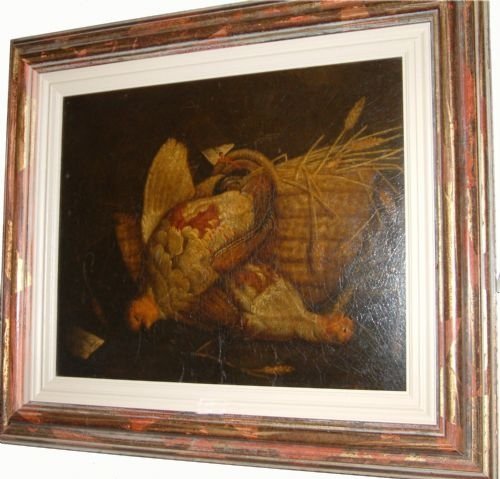
A Still Life of a Brace of Patridge with a Basket of Wheat on a Ledge, English School 18th Century
Sold by Artware Fineart
sold SA65625
Sorry, but this item has been sold.

Artware Fineart

Sellingantiques Verified Since Sep 2008
Id #SA65625
PDF SHARE
SAVE

A Still Life of a Brace of Patridge with a Basket of Wheat on a Ledge, English School 18th Century

18th century
Description

Oil on board, 16.00 x 20.00 ins

signed and inscribed on the painted labels

Partridges are birds in the pheasant family, Phasianidae. They are a non-migratory Old World group. These are medium-sized birds, intermediate between the larger pheasants and the smaller quails. Partridges are native to Europe, Asia, Africa, and the Middle East. Partridges are ground-nesting seed-eaters. According to Greek legend, the first partridge appeared when Daedalus threw his nephew, Perdix, off a roof in a fit of jealous rage. Partridges famously feature the Christmas carol "The 12 Days of Christmas", where it is used in the line, "A partridge in a pear tree."
There are two distinct species of partridges found in the British Isles. The original English grey partridge and the introduced French or red-legged partridge. Both have their place in the shooting scene here in the British Isles and both have much to offer the sportsman. The decline of the native English partridge has been well documented and the irony is that the reasons for its decline is widely known. Loss of habitat is cited as the main reason for the bird's decline in numbers, as miles of hedgerows were grubbed up in the early part of the 20th century in southern Britain in a bid to bring more land into arable use. With the removal of the hedgerows went the bird's protective cover and a major portion of its food source. The spraying cereal crops with insecticide has also contributed to the demise of the grey partridge. A major source of food for partridge chicks is the insect life found at the edges of fields in late spring. Efforts have been made to ensure that spraying is not carried out at the edges of fields and with some success as far as the grey partridge is concerned. In some counties of southern England, grey partridge numbers are holding steady, although they will never again reach the levels of pre first world war.

There is no doubt that the attractive little grey partridge has an appeal to the game shooter. Contrary to belief, the grey partridge is one of the slowest game birds on the wing and can cause confusion to the shooter who is more used to a pheasant exploding from the game coverts or a red grouse speeding towards the butt. The partridge is, none-the-less, a very testing shot as it twists and turns over the hedgerows and stone walls that make up the field boundaries. It is not unusual for a covey of up to a dozen birds to flush from the edge of a field on a walked-up day. As a rule they tend not to fly far or for a sustained period. The coveys usually drop back to earth after a few fields and will give the dogs and shooters an opportunity of a second or even a third flush.

The French or red-legged partridge as it is more commonly known, is not a native bird in the British Isles. Its origins are in the semi arid regions of the Mediterranean but since the 17th century, when it was introduced into southern Britain, it has established itself as a major sporting bird. In Ireland, the red-legged partridge has really only become established in the last thirty years with its introduction into a number of shoots in the country. With the almost total absence of the grey partridge in Ireland as a whole, the red-legged partridge had offered a new game bird species to a generation of Irish sportsmen who would not otherwise have had the opportunity of enjoying partridge shooting. The red-legged partridge has a tendency to run forward before beaters and dogs, unlike many other game birds, including the grey partridge, that will sit tight and then flush before the dogs or beaters.

Declaration

Artware Fineart has dated this piece to the 18th Century.

Reference Numbers
Sellingantiques Reference
SA65625
Dealers Internal Reference
3285
Description
Oil on board, 16.00 x 20.00 ins

signed and inscribed on the painted labels

Partridges are birds in the pheasant family, Phasianidae. They are a non-migratory Old World group. These are medium-sized birds, intermediate between the larger pheasants and the smaller quails. Partridges are native to Europe, Asia, Africa, and the Middle East. Partridges are ground-nesting seed-eaters.

According to Greek legend, the first partridge appeared when Daedalus threw his nephew, Perdix, off a roof in a fit of jealous rage.
Artware Fineart

Partridges famously feature the Christmas carol "The 12 Days of Christmas", where it is used in the line, "A partridge in a pear tree."

fig 1. A Still life of a brace of patridge with a basket of wheat on a ledge, English School 18th Century
fig 1. A Still Life of a Brace of Patridge with a Basket of Wheat on a Ledge, English School 18th Century

There are two distinct species of partridges found in the British Isles. The original English grey partridge and the introduced French or red-legged partridge. Both have their place in the shooting scene here in the British Isles and both have much to offer the sportsman. The decline of the native English partridge has been well documented and the irony is that the reasons for its decline is widely known. Loss of habitat is cited as the main reason for the bird's decline in numbers, as miles of hedgerows were grubbed up in the early part of the 20th century in southern Britain in a bid to bring more land into arable use. With the removal of the hedgerows went the bird's protective cover and a major portion of its food source. The spraying cereal crops with insecticide has also contributed to the demise of the grey partridge. A major source of food for partridge chicks is the insect life found at the edges of fields in late spring. Efforts have been made to ensure that spraying is not carried out at the edges of fields and with some success as far as the grey partridge is concerned. In some counties of southern England, grey partridge numbers are holding steady, although they will never again reach the levels of pre first world war.

There is no doubt that the attractive little grey partridge has an appeal to the game shooter. Contrary to belief, the grey partridge is one of the slowest game birds on the wing and can cause confusion to the shooter who is more used to a pheasant exploding from the game coverts or a red grouse speeding towards the butt. The partridge is, none-the-less, a very testing shot as it twists and turns over the hedgerows and stone walls that make up the field boundaries. It is not unusual for a covey of up to a dozen birds to flush from the edge of a field on a walked-up day. As a rule they tend not to fly far or for a sustained period. The coveys usually drop back to earth after a few fields and will give the dogs and shooters an opportunity of a second or even a third flush.

The French or red-legged partridge as it is more commonly known, is not a native bird in the British Isles. Its origins are in the semi arid regions of the Mediterranean but since the 17th century, when it was introduced into southern Britain, it has established itself as a major sporting bird. In Ireland, the red-legged partridge has really only become established in the last thirty years with its introduction into a number of shoots in the country. With the almost total absence of the grey partridge in Ireland as a whole, the red-legged partridge had offered a new game bird species to a generation of Irish sportsmen who would not otherwise have had the opportunity of enjoying partridge shooting. The red-legged partridge has a tendency to run forward before beaters and dogs, unlike many other game birds, including the grey partridge, that will sit tight and then flush before the dogs or beaters.

Date of Manufacture

Artware Fineart has dated this piece to the 18th Century.

Reference Numbers
Sellingantiques Ref
SA65625
Dealers Internal Ref
3285
Artware Fineart
Sellingantiques verified Since Sep 2008
Dealer Profile

You can view the stock and full dealer information on the Artware Fineart Profile Page
PDF SHARE
SAVE
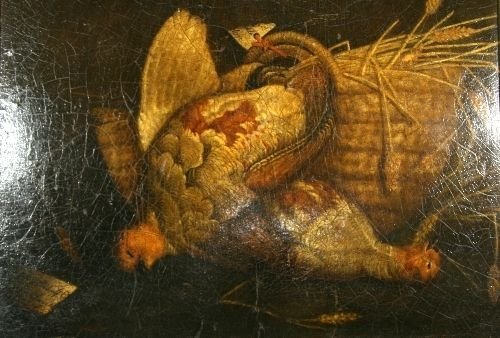
A Still life of a brace of patridge with a basket of wheat on a ledge, English School 18th Century
1 / 2
Archive I A Still life of a brace of patridge with a basket of wheat on a ledge, English School 18th Century

A Still Life of a Brace of Patridge with a Basket of Wheat on a Ledge, English School 18th Century

Archive II A Still life of a brace of patridge with a basket of wheat on a ledge, English School 18th Century View II
Enlarged Archival View
Telephone 07958 699 645
Location
18 La Gare
51 Surrey Row
London
SE1 0BZ
United Kingdom
Verified Since Sep 2008
Items For Sale 243
Items Sold 223
Artware Fineart
Verified Since Sep 2008
View Dealer Info
Location: 18 La Gare , 51 Surrey Row , London , SE1 0BZ , United Kingdom
Verified
Sep 2008
For Sale
243
Sold
223
A Still life of a brace of patridge with a basket of wheat on a ledge, English School 18th Century
Ref: SA65625
A Still life of a brace of patridge with a basket of wheat on a ledge, English School 18th Century
Detail View 1
Archival Detail
Every single antique dealer on our platform is individually approved by our internal team. We verify their professional trade history, ethical standards, and photographic quality to ensure a secure, high-standard buying environment. Upon joining, every dealer agrees to a strict 9-point code of conduct. While issues can occasionally arise, our dealers typically resolve them swiftly and directly with the buyer. In fact, since our founding in 2002, Sellingantiques has only had to step in to help resolve an issue on roughly five occasions—a true testament to the quality of our dealers and their dedication to your happiness.
Our dealers are highly experienced in packing and shipping fragile, high-value antiques. Because you are in direct contact with the dealer, you will be able to easily go through all available shipping and insurance options together to ensure your item arrives safely.
Antiques are the ultimate green purchase. By choosing historical pieces over newly manufactured goods, you completely eliminate the carbon footprint of modern mass production while preserving exceptional, timeless craftsmanship.
items
Add keywords to the filter
Price
£100
£250000
Era
Movements
Material
Origin
Stock Location
Freshness
Online Payments
Categories