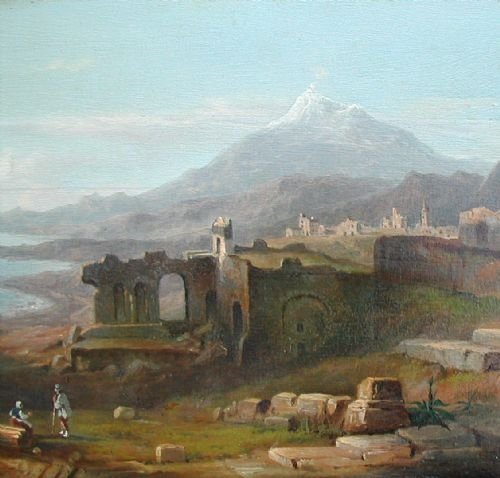
Artware Fineart has dated this piece to the 19th Century.
Taormina has been a very popular tourist destination since the 19th century. It has popular beaches (accessible via an aerial tramway) on the Ionian sea, which is remarkably warm and has a high salt content. Taormina can be reached via highways (autostrade) from Messina from the north and Catania from the south.
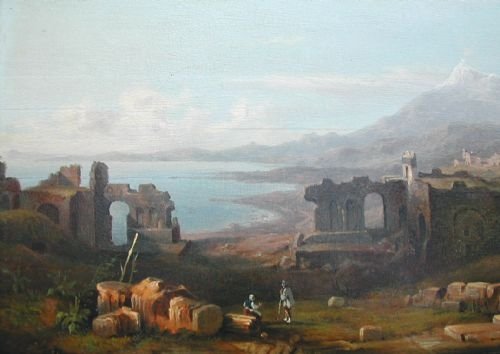
Taormina's area was inhabited by the Siculi even before the Greeks arrived on the Sicilian coast in 832 BC to found a town called Naxos. The theory that Tauromenion was founded by colonists from Naxos is confirmed by Strabo and other ancient writers. The new settlement seems to have risen rapidly to prosperity, and was apparently already a considerable town at the time of the expedition of Timoleon in 345 BC. It was the first place in Sicily where that leader landed, having eluded the vigilance of the Carthaginians, who were guarding the Straits of Messina, and crossed direct from Rhegium (modern Reggio di Calabria) to Tauromenium. The city was at that time still under the government of Andromachus, whose mild and equitable administration is said to have presented a strong contrast with that of the despots and tyrants of the other Sicilian cities. He welcomed Timoleon with open arms, and afforded him a secure resting place until he was enabled to carry out his plans in other parts of Sicily. Andromachus was not deprived of his position of power when all the other tyrants were expelled by Timoleon, but was permitted to retain it undisturbed till his death. (Marcellin. Vit. Thucyd. § 27.) Little is known about Tauromenium for some time after this. It is probable that it passed under the authority of Agathocles, who drove the historian Timaeus into exile; and some time after this it was subject to a domestic despot of the name of Tyndarion, who was contemporary with Hicetas of Syracuse and Phintias of Agrigentum. Tyndarion was one of those who concurred in inviting Pyrrhus into Sicily (278 BC), and when that monarch landed with his army at Tauromenium, joined him with all his forces, and supported him in his march upon Syracuse. A few years later we find that Tauromenium had fallen into the power of Hieron of Syracuse, and was employed by him as a stronghold in the war against the Mamertines. (Id. p. 497.) It was also one of the cities which was left under his dominion by the treaty concluded with him by the Romans in 263 BC.
Artware Fineart has dated this piece to the 19th Century.
You can view the stock and full dealer information on the Artware Fineart Profile Page
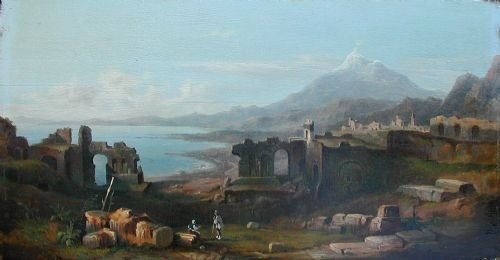
A View of the Greek Theatre at Taormina, Sicilly with Mt Etna and the Bay of Naxos Beyond, English School 19th Century