

It was listed by Artware Fineart. Sold pieces stay on Sellingantiques as a record of what has passed through, and the next one is rarely far away.
Artware Fineart has dated this piece to the 19th Century.
John Knox preaching before the Lords of the Congregation, in the Parish Church of St. Andrew's, 10th June, 1559,
oil on oak panel
30 x 22in. (76.20 x 55.88 cm.)
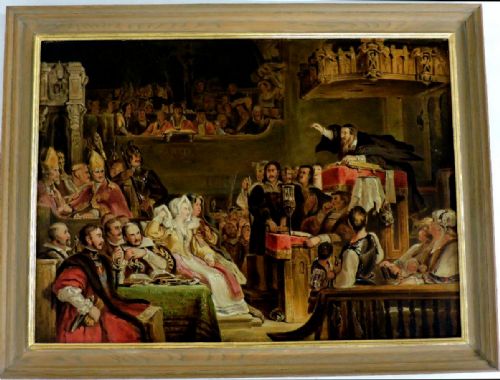
engraved by W. Greatbach, ca. 1845
Notes
There are a number of versions of this painting, one is in the National Trust Collection at Petworth House, there is another in the National Galleries of Scotland, Scottish National Gallery, there is another in the Tate Britain collection (not on display) all three versions and this one are oil on panel and each varey in size the largest being 1226 x 1651 mm.
John Knox (c.
He is believed to have been educated at the University of St Andrews and worked as a notary-priest. Influenced by early church reformers such as George Wishart, he joined the movement to reform the Scottish church. He was caught up in the ecclesiastical and political events that involved the murder of Cardinal Beaton in 1546 and the intervention of the regent of Scotland Mary of Guise. He was taken prisoner by French forces the following year and exiled to England on his release in 1549.
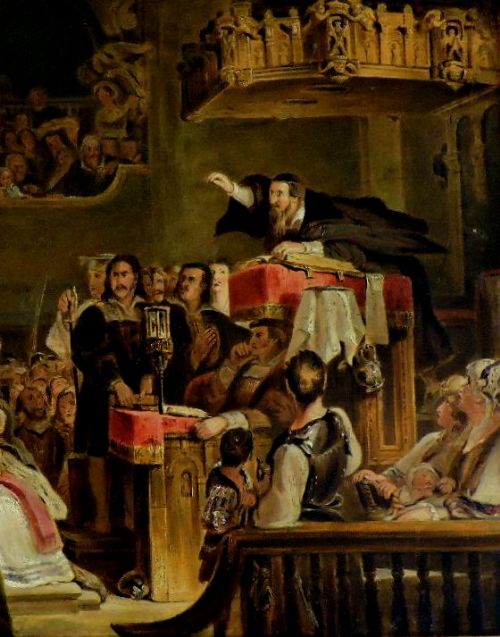
While in exile, Knox was licensed to work in the Church of England, where he rose in the ranks to serve King Edward VI of England as a royal chaplain. He exerted a reforming influence on the text of the Book of Common Prayer. In England he met and married his first wife, Margery Bowes. When Mary Tudor ascended the throne and re-established Roman Catholicism, Knox was forced to resign his position and leave the country. Knox moved to Geneva and then to Frankfurt. In Geneva he met John Calvin, from whom he gained experience and knowledge of Reformed theology and Presbyterian polity. He created a new order of service, which was eventually adopted by the reformed church in Scotland. He left Geneva to head the English refugee church in Frankfurt but he was forced to leave over differences concerning the liturgy, thus ending his association with the Church of England.
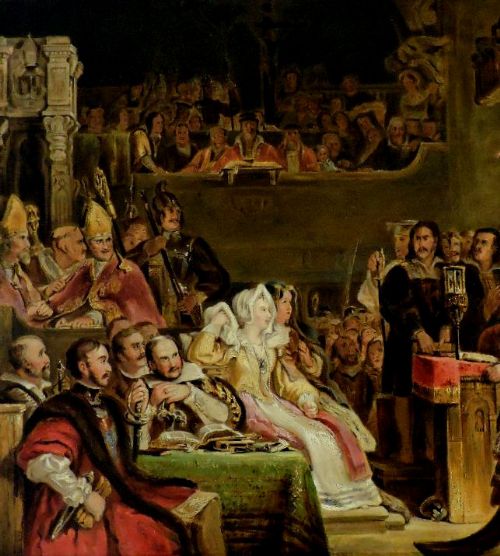
On his return to Scotland he led the Protestant Reformation in Scotland, in partnership with the Scottish Protestant nobility. The movement may be seen as a revolution, since it led to the ousting of Mary of Guise, who governed the country in the name of her young daughter Mary, Queen of Scots. Knox helped write the new confession of faith and the ecclesiastical order for the newly created reformed church, the Kirk. He continued to serve as the religious leader of the Protestants throughout Mary's reign. In several interviews with the Queen, Knox admonished her for supporting Catholic practices. When she was imprisoned for her alleged role in the murder of her husband Lord Darnley, and King James VI enthroned in her stead, he openly called for her execution. He continued to preach until his final days.
John Knox was born sometime between 1505 and 1515 in or near Haddington, the county town of East Lothian. His father, William Knox, was a merchant. All that is known of his mother is that her maiden name was Sinclair and that she died when John Knox was a child. Their eldest son, William, carried on his father's business, which helped in Knox's international communications. Knox was probably educated at the grammar school in Haddington. In this time, the priesthood was the only path for those whose inclinations were academic rather than mercantile or agricultural. He proceeded to further studies at the University of St Andrews or possibly at the University of Glasgow. He studied under John Major, one of the greatest scholars of the time. Knox first appears in public records as a priest and a notary in 1540. He was still serving in these capacities as la
Artware Fineart has dated this piece to the 19th Century.
You can view the stock and full dealer information on the Artware Fineart Profile Page
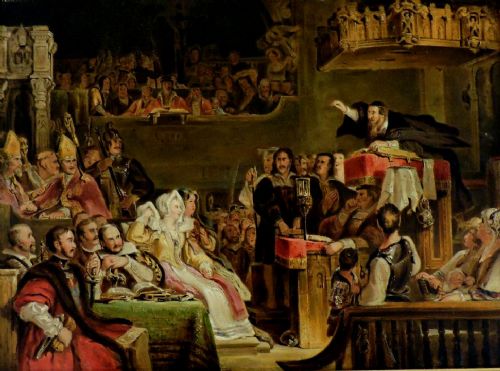
Attributed to Sir David Wilkie, R.a., 1785 – 1841 John Knox Preaching Before the Lords of the Congregation, in the Parish Church of St. Andrew's, 10th June, 1559,
