Titan Fine Art has dated this piece to the 19th Century.
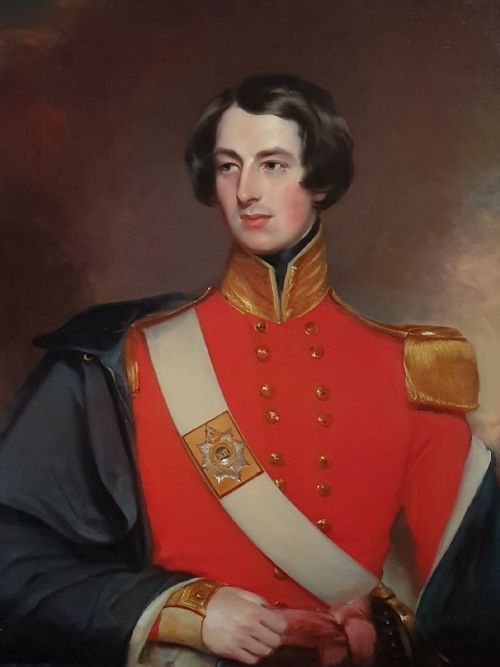
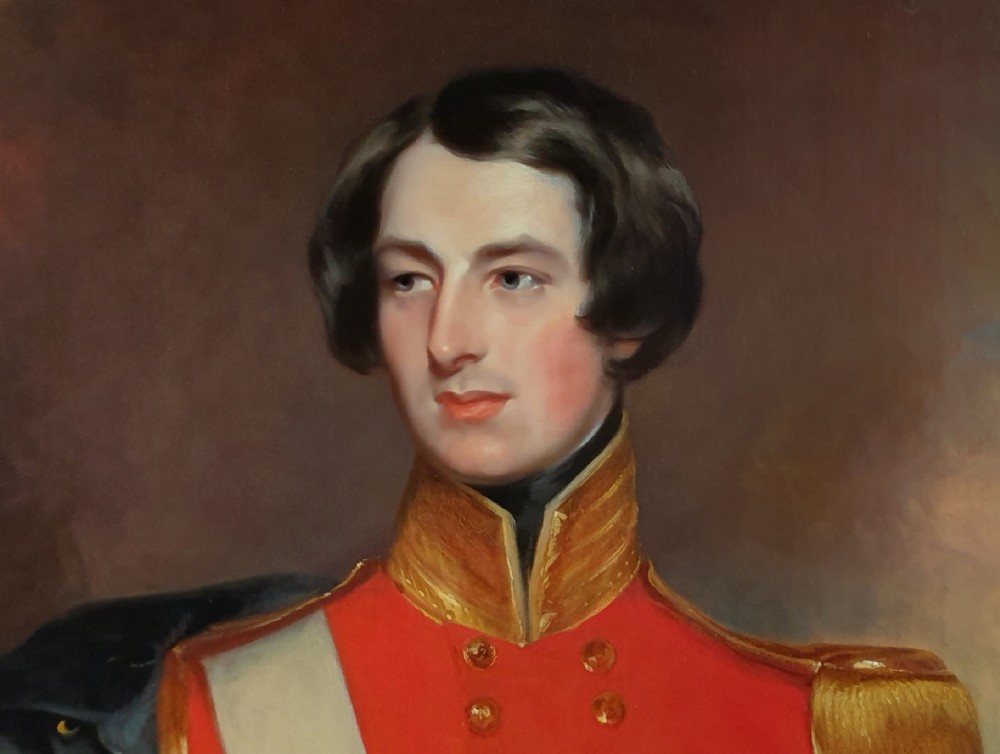
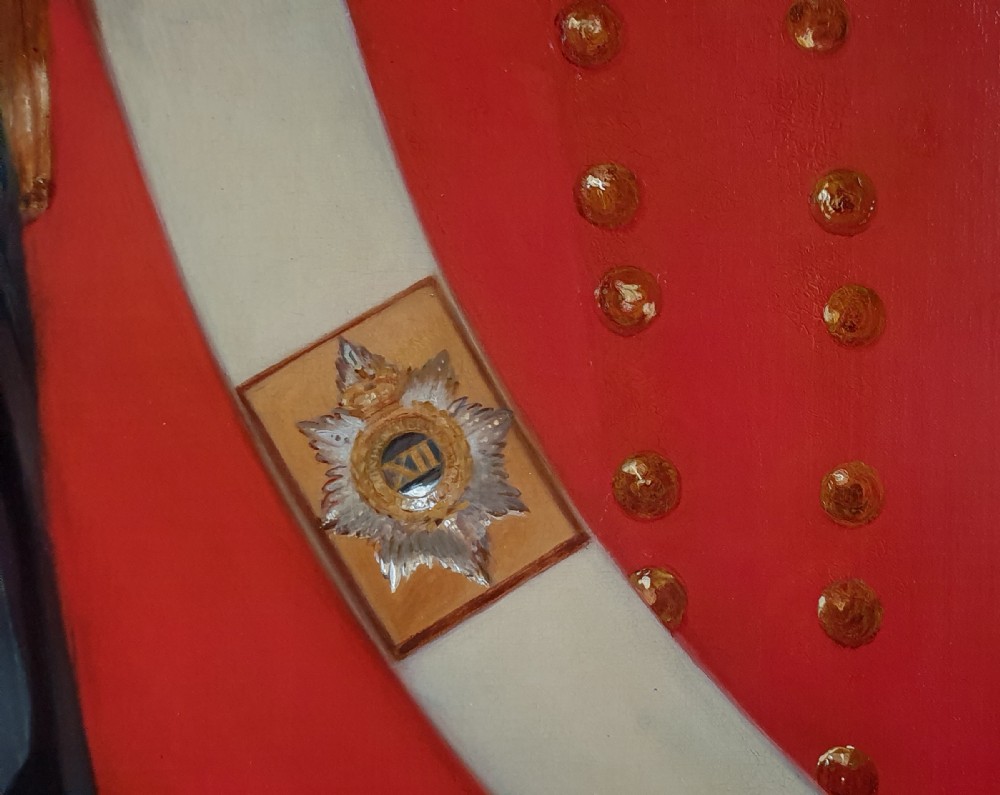
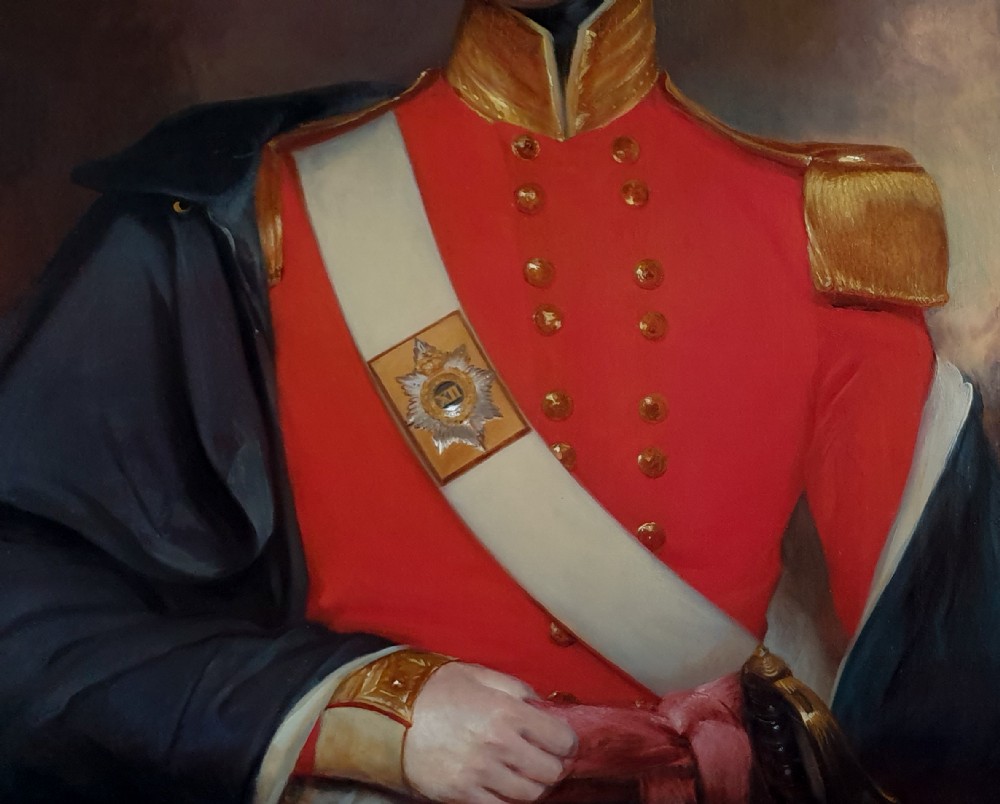
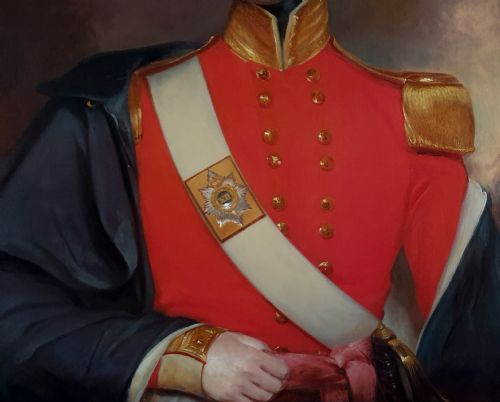
An exquisite kit-cat sized portrait of a dashing young officer wearing an elaborate scarlet coatee, sash and badge, fringed epaulettes, Prussian collar, and a greatcoat arranged across his back. The uniform and accoutrements displayed here are of an officer serving in the 12th (The East Suffolk) Regiment of Foot and the type of badge was in use up to 1842.
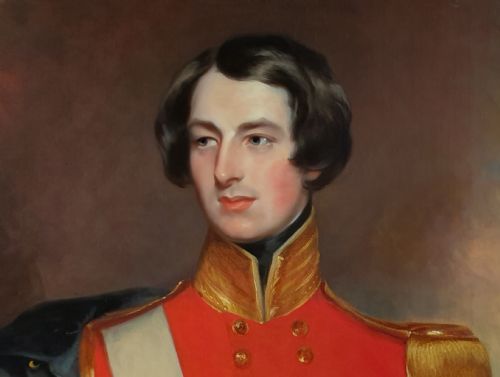
The dashing sitter is Robert George Duff (1817-1890), a distant cousin of the Earls of Fife, and was the second eldest of four sons of Garden Duff, 8th of Hatton, 4th of Whitehill (1779-1858) and Louisa Dunbar (1788-1865). Robert served in the British Army, 12th (The East Suffolk) Regiment of Foot, Ensign on 29th July 1836, made Lieutenant on 26th June 1838, and Captain on 25th Oct 1842. He retired the same year he married Mary Astley (1822-1874) in London in 1847. She was the daughter of William Buckler Astley and Elizabeth Assheton-Smith, in London. He held the office of Deputy Lieutenant of Caernarvonshire sometime between 1852 and 1860. The couple lived at Wellington Lodge, Ryde, Isle of Wight, England and had four children:
George William Duff-Assheton-Smith (1848-1904), High Sheriff Anglesey
Sir Charles Garden Assheton-Smith, 1st Baronet (1851/2-1914)
Louisa Alice Duff (c.1853-1926)
Henry Assheton Duff (1862-1939)
In 1859, George inherited the Vaynol estates and a large fortune and he took the additional surname of Assheton-Smith. He was a great lover of wild animals and kept a number of these, including wild bears and wild white cattle, in the park at Vaynol. At his death the estates and name passed to his next brother Charles.
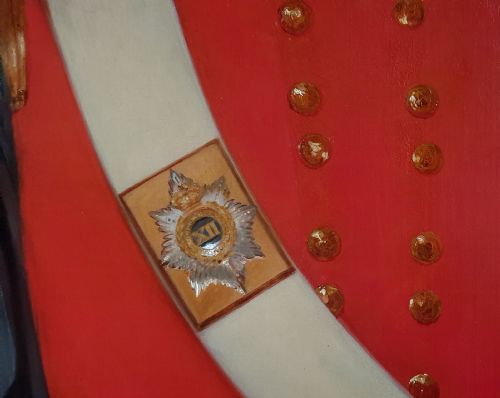
Duff has been portrayed here by Thomas Phillips, a leading English portrait painter who painted many of the great men of the day including scientists, artists, writers, poets and explorers, and he was professor of painting at the Royal Academy. The portrait can be accurately dated to between 1836 (upon joining the 12th Regiment of Foot) and no later than 1843, when a new type of badge was adopted (the badge portrays a scroll "Minden Gibraltar, Seringapatam" over a Laurel spray, to the centre the numerals XII, surmounted by a crown, and was in use between 1825 to 1842). The stencil on the reverse of the canvas (T. Brown, 163 High Holborn London) informs that the canvas was prepared in Sept 1835 by the well-established artist supplier Thomas Brown (c.1778-1840). Thomas Brown and son were in business from 1805/6 and were the business of choice among many professional artists claiming to have supplied all the Royal Academy’s Presidents up to that time, and that they had been the favoured servants of the Academy since its foundation (in 1841 young Brown was the first colourman to introduce oil colours in collapsible metal tubes).
The Duff family claims an origin veiled in the mists of antiquity, and there are preserved many and curious old family trees, but the most common origin derives from Fyfe Maedufl, a chief of great wealth and power, who lived about the year 834.
The portrait is striking in quality, and original condition not having undergone a lining treatment. The work is not merely a likeness – this artist who knew how to get to the heart and soul of their sitter and is a very fine example of British portraiture. Held in its original excellent condition swept frame.
Thomas Phillips was born in Warwickshire, England in 1770. He studied under the glass painter Francis Eginton and worked on the painted glass windows at St Georges Chapel, Windsor. He entered the Royal Acad
Titan Fine Art has dated this piece to the 19th Century.
Specialist in 17th & 18thc portraits. Highly curated selection, museum-level research & pro conservation. Exceptional art, expertly vetted.
You can view the stock and full dealer information on the Titan Fine Art Profile Page

Portrait of Robert George Duff (1817-1890) C.1836; Attributed to Thomas Phillips Ra (1770-1845)