
Artware Fineart has dated this piece to the 19th Century.
signed
The horses who were bread to cope with heavy loads of quarreyed sand from the sand that was tranpsorted in robust carts to the network of canals and from the 1830's the growing newtwork of railways. This painting by Augustus Boult illustrates this particular countryside activity.
The Shire horse is a breed of draught horse (BrE) or draft horse (AmE). The breed comes in many colors, including black, bay and gray. They are a tall breed, with mares standing 16 hands (64 inches, 163 cm) and over and stallions standing 17 hands (68 inches, 173 cm) and over. The breed has an enormous capacity for weight pulling, and Shires have held the world records for both largest overall horse and tallest horse at various times. Throughout its history, the breed has been popular for pulling brewery wagons that delivered ale to customers. This practice continues today, with the breed also being used for forestry, leisure and promotional pursuits. The breed descends from war horses brought to England by William the Conqueror in the 11th century. These were crossed with other breeds, including the Friesian, to create the Shire of today. In 1884, the organization now known as the British Shire Horse Society was created, with the American Shire Horse Association beginning in 1885. The breed was exported from Britain to the United States in large numbers during the late 19th and early 20th centuries, but popularity fell with the advent of mechanization, reaching a low point in the 1950s and 60s. Popularity began to increase again in the 1970s and after. However, population numbers are still considered to be at critical levels by both the UK-based Rare Breeds Survival Trust and the US-based American Livestock Breeds Conservancy. Shire stallions may be black, bay or gray. They may not be roan or have large amounts of white markings. Mares and geldings may be black, bay, gray or roan. In the UK stallions may not be chestnut but the color is allowed by the US registry. Stallions stand 17 hands (68 inches, 173 cm) high when mature, and they average around 17.2 hands (70 inches, 178 cm). Geldings stand at least 16.2 hands (66 inches, 168 cm) high and mares at least 16 hands (64 inches, 163 cm).[citation needed] The Shires' head is long and lean, with large eyes, set on a neck that is slightly arched and long in proportion to the body. The shoulder is deep and wide, the chest wide, the back muscular and short and the hindquarters long and wide. There is not to be too much feathering, and the hair is fine, straight and silky. Smaller horses, under 17 hands (68 inches, 173 cm), are generally preferred for working horses, while taller horses, especially those over 18.2 hands (74 inches, 188 cm), are used for show and promotional purposes. The breed is known for its easy-going temperament.
Artware Fineart has dated this piece to the 19th Century.
You can view the stock and full dealer information on the Artware Fineart Profile Page
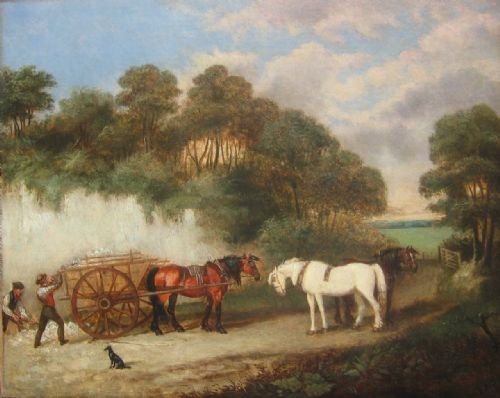
Labourers Quarrying and Loading Sand with Their Resting Shire Horses in a Country Clearing by Augustus S Boult (1815 - 1853)