

It was listed by Artware Fineart. Sold pieces stay on Sellingantiques as a record of what has passed through, and the next one is rarely far away.
Artware Fineart has dated this piece to the 19th Century.
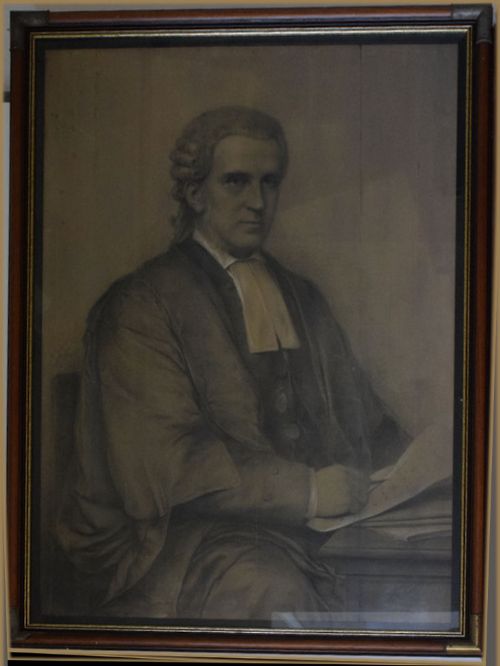
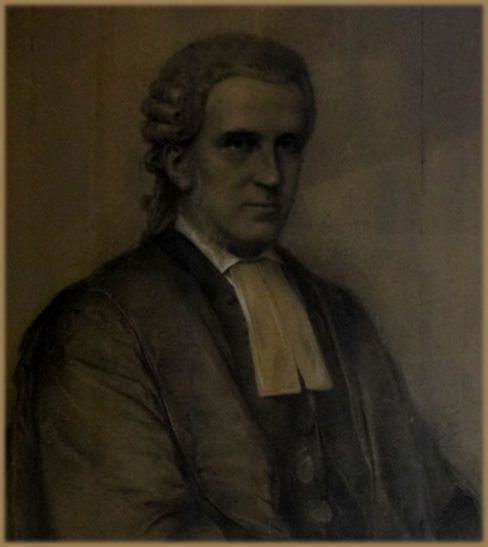
Portrait of Charles Arthur Russell, Baron Russell of Killowen GCMG,PC,QC,DL, 1832-1900 Killowen
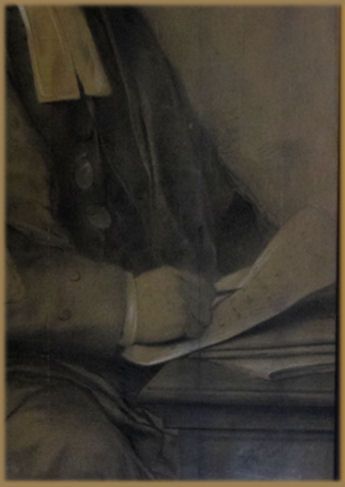
charcoal heightened with white chalk
111 x 80 cm. (44 x 32 in.)
Down, Ireland, the eldest son of Arthur Russell (1785–1845) and his wife, Margaret, daughter of Matthew Mullin and widow of John Hamill, a merchant of Belfast. After his father's death in 1845 Russell, along with his siblings, was brought up by his mother and their paternal uncle, Dr Charles William Russell, then a professor at and afterwards president of St Patrick's College, Maynooth. The Russells were a recusant family and the children were brought up in the Catholic faith. Russell attended a diocesan seminary in Belfast as his first school, was then taught at a private school in Newry, for two years, and finally spent one year at St Vincent's College, Castleknock, co. Dublin. He seems to have worked reasonably hard at school, but was not particularly distinguished. Although he later matriculated at Trinity College, Dublin (1856), he never graduated.
In January 1849 Russell began his legal training under Cornelius Denvir, a solicitor at Newry. After Denvir's death in 1852, his articles were transferred to Alexander O'Rorke of Belfast. Russell was admitted a solicitor in January 1854 and took charge of an office of O'Rorke's in Londonderry for six months. He then returned to Belfast, and practised in the county courts of Down and Antrim. Around that time extreme protestant sentiment had led to riots and other civil disturbances. When the resulting case came before the magistrates, Russell spoke well and defended the Catholics who had been involved in the violence. His speeches were reported in the provincial newspaper and public opinion swung strongly in his favour. His success on this occasion, along with the encouragement and recommendation of those among whom he practised, confirmed his resolve to become a barrister in London.
On 6 November 1856 Russell entered at Lincoln's Inn and moved permanently to London. In 1857 he became a pupil of Henry Bagshawe, then an equity junior with a large practice at the chancery bar. Remembered at this time as being grave, reserved, and hard-working, he acquired a considerable knowledge of real property law, but conveyancing and equity drafting did not interest him, and he left to join the common-law bar. He never attended the chambers of a pleader as the common-law procedure acts had largely removed the need for such specialization. He found time to write for newspapers and magazines, and contributed a weekly letter on current politics to the Dublin Nation. Though unsuccessful as a candidate for the inns of court studentship in 1858, he was awarded a certificate of honour. On 10 August 1858 he married Ellen (1836–1918), eldest daughter of Joseph Stevenson Mulholland MD of Belfast. In the Hilary term of 1859 he again competed for the studentship, which was awarded to Montague Cookson, afterwards Crackanthorpe KC.
On 26 January 1859 Russell was called to the bar and joined the northern circuit. He practised in the passage court, Liverpool, and within four years of being called to the bar was making £1000 per annum. He soon began to be known in London, and argued a case before Lord Westbury with such ability that he was offered a county court judgeship. He was knighted on 8 March 1866.
Judge and MP
In 1872 Russell took silk at the same time as Farrer, afterwards Baron Herschell, with whom he effectively divided all of the business cases on the circuit. In commercial cases, where rights mainly depended on written evidence, Russell's knowledge of business and of the law enabled him to go straight to the point and get through a long list quickly. However, where ther
Artware Fineart has dated this piece to the 19th Century.
You can view the stock and full dealer information on the Artware Fineart Profile Page
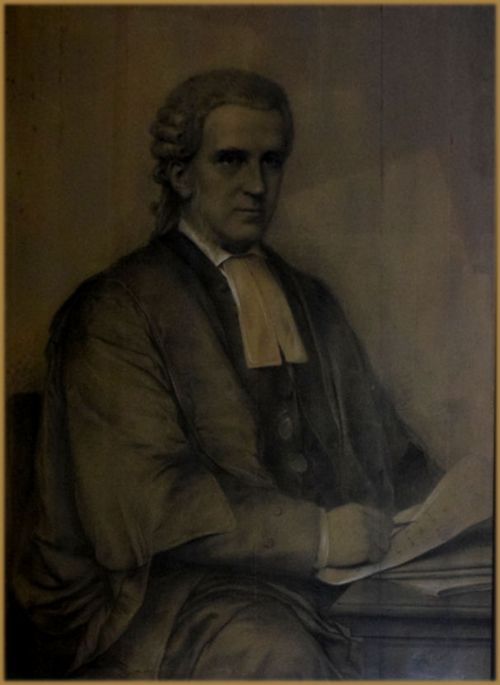
Francois Verheyden, 1843 -1919 Portrait of Charles Arthur Russell, Baron Russell of Killowen Gcmg,pc,qc,dl, 1832-1900 Killowen