
Artware Fineart has dated this piece to the 19th Century.
In his later years he suffered from schizophrenia, which, according to some psychologists, can be seen in his works. Louis William Wain was born on August 5, 1860 in Clerkenwell in London. His father was a textile trader and embroiderer, his mother was French.[2] He was the first of six children, and the only male child. None of his five sisters ever married. At the age of thirty, his youngest sister was certified as insane, and admitted to an asylum. The remaining sisters lived with their mother for the duration of their lifetimes, as did Louis for the majority of his life. Wain was born with a cleft lip and the doctor gave his parents the orders that he should not be sent to school or taught until he was ten years old. As a youth, he was often truant from school, and spent much of his childhood wandering around London. Following this period, Louis studied at the West London School of Art and eventually became a teacher there for a short period. At the age of 20, Wain was left to support his mother and sisters after his father's death.

Wain soon quit his teaching position to become a freelance artist. He specialized in drawing animals and country scenes, and worked for several journals including the Illustrated Sporting and Dramatic News, where he stayed for four years, and the Illustrated London News, beginning in 1886. Through the 1880s, Wain's work included detailed illustrations of English country houses and estates, along with livestock he was commissioned to draw at agricultural shows. His work at this time includes a wide variety of animals, and he maintained his ability to draw creatures of all kinds throughout his lifetime. At one point, he hoped to make a living by drawing dog portraits. At the age of 23, Wain married his sisters' governess, Emily Richardson, who was ten years his senior (which was considered quite scandalous at the time), and moved with her to Hampstead in north London. Emily soon began to suffer from cancer, and died only three years after their marriage. It was during this period that Wain discovered the subject that would define his career. During her illness, Emily was comforted by their pet cat Peter, and Wain taught him tricks such as wearing spectacles and pretending to read in order to amuse his wife. He began to draw extensive sketches of the large black and white cat. He later wrote of Peter, "To him properly belongs the foundation of my career, the developments of my initial efforts, and the establishing of my work." Peter can be recognized in many of Wain's early published works. In 1886, Wain's first drawing of anthropomorphised cats was published in the Christmas issue of the Illustrated London News, titled A Kittens' Christmas Party. The illustration depicted 150 cats, many of which resemble Peter, sending invitations, holding a ball, playing games, and making speeches over eleven panels. Still, the cats remain on all fours, unclothed, and without the variety of human-like expression that would characterize Wain's work. Under the pseudonym George Henri Thompson, he illustrated numerous books for children by Clifton Bingham published by Ernest Nister. In subsequent years, Wain's cats began to walk upright, smile broadly and use other exaggerated facial expressions, and wear sophisticated contemporary clothing.
Artware Fineart has dated this piece to the 19th Century.
You can view the stock and full dealer information on the Artware Fineart Profile Page
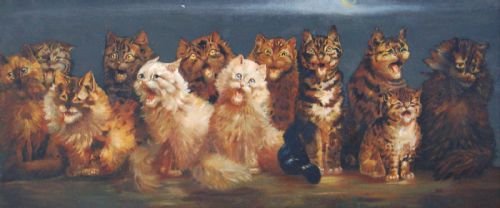
A Choir of Cats Circle of Louis Wain (1860-1939)

