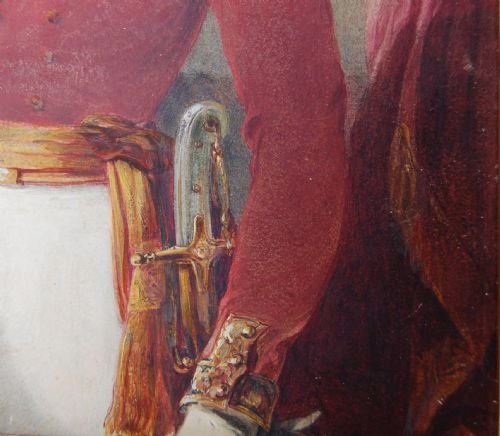
Artware Fineart has dated this piece to the 19th Century.
According to Eugene Barilo von Reisberg, He believes the watercolour was painted after February 1840, when Albert arrived in England, and was made a Field-Marshall (hence he is painted wearing the red Field-Marshall's uniform), but perhaps before May 1841, when Albert was invested with the Order of the Golden Fleece (you would notice that almost all portraits of Albert after that date show him wearing both Orders of the Garter and of the Golden Fleece). Winterhalter did not arrive in England until June 1842.
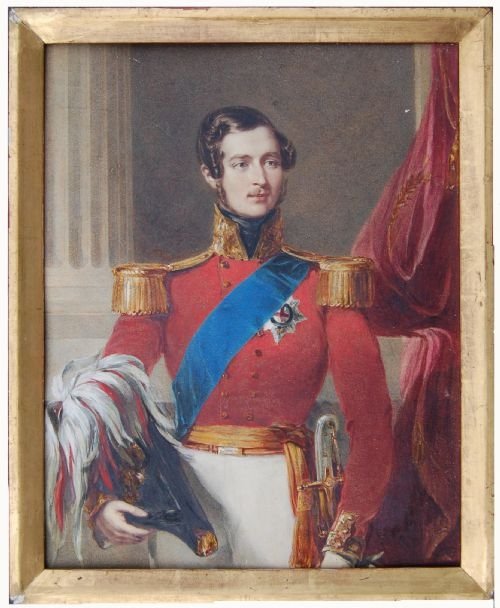
However, stylistically, He is more inclined to attribute the work to Albert Edward Chalon, who is recorded to have painted watercolours of Prince Albert in August 1840 (he also painted Queen Victoria between 1838 and 1839; Chalon's head of Queen Victoria was most famously adapted for the use on British postage stamps).

Prince Albert of Saxe-Coburg and Gotha (in full Francis Charles Augustus Albert Emmanuel), later The Prince Consort, (26 August 1819 – 14 December 1861) was the husband and consort of Queen Victoria of the United Kingdom of Great Britain and Ireland. He was the only husband of a British queen regnant to have formally held the title of Prince Consort. Upon Queen Victoria's death in 1901, the House of Saxe-Coburg and Gotha succeeded the House of Hanover on the British throne. The idea of a marriage between Albert and his cousin Victoria had always been cherished by their uncle, King Leopold I of Belgium, as well as Victoria's mother (Leopold's sister), the Duchess of Kent, and in May 1836 the Duke of Saxe-Coburg and Gotha and his two sons paid a visit to Kensington Palace, where Princess Victoria of Kent (as she then was titled) lived, for the purpose of meeting her.
Alfred Chalon was born in Geneva from a father who soon was hired as professor at the Royal Military Academy Sandhurst, in England. With his brother John James (1778-1854), Alfred became an artist. Entered at the Royal Academy in 1797, he joined the Associated Artists in Water-Colours, a group of aquarellists. In the Academy, he was elected associated in 1812, then academician in 1816. Known for his portraits of the good society of London, he was chosen by Queen Victoria to paint a gift to her mother: Victoria in her State robes going to the House of Lords for her first official act, the prorogation of the Parliament, on 17 July 1847. After this task, Chalon was entitled Portrait Painter in Water Colour to Her Majesty and gained some celebrity. His 1847 portrait was engraved by Samuel Cousins and distributed to the public the day of Victoria's coronation, the 28 June 1848. Then, starting in 1851, the "Chalon head" appeared on some British colonies postage stamps. Bachelors, the Chalon brothers lived together. Alfred died in 1860 at Campden Hill, in Kensington.
Artware Fineart has dated this piece to the 19th Century.
You can view the stock and full dealer information on the Artware Fineart Profile Page

Portrait of Prince Albert of Saxe-coburg and Gotha, the Prince Consort 1819-1861 by Alfred Edward Chalon