

It was listed by Artware Fineart. Sold pieces stay on Sellingantiques as a record of what has passed through, and the next one is rarely far away.
Artware Fineart has dated this piece to the 18th Century.
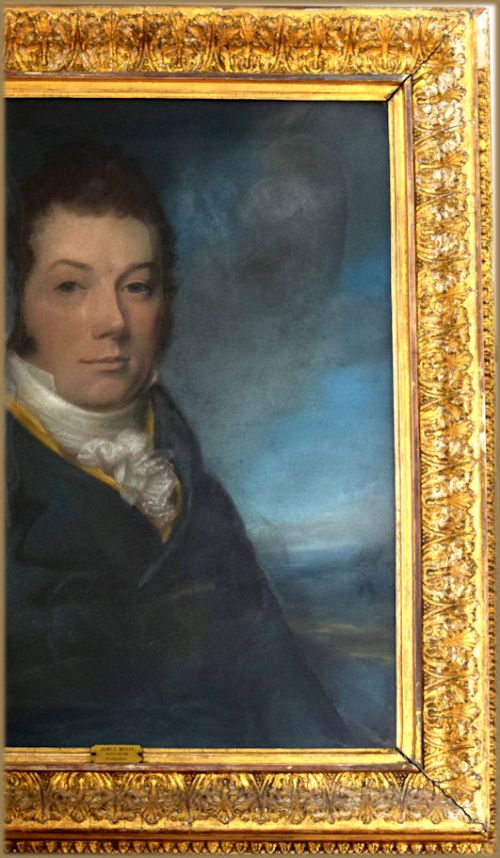
Portrait of James White b.1775 - 1820, Author and Advertising Agent
pastel
61 x 51 cm. (24 x 20 in.)
PROVENANCE : R. F. White & Son Ltd
Neil Jeffares suggests that this portrait is likely to be a later work, from c.1811.
James White, (bap. 1775, d.
He was baptised at the Church of St. John in Bedwardine, Worcester, on April 17, 1775. He was Known as Jem White .He spent 'many of the earliest days of his youth' 'in the Neighbourhood' of the Malvern Hills (White, fol. 6). On 19 September 1783 he was admitted to Christ's Hospital on the presentation of Thomas Coventry. At school he seemed something of a dandy: Leigh Hunt recalled 'admiring his handsome appearance, and unimprovable manner of wearing his new clothes' (Hunt, 2.122). White left the school on 30 April 1790, but continued at Christ's Hospital, working as a clerk in the treasurer's office. A friendship with Charles Lamb, begun in their student days, now ripened. By the mid-1790s White was Lamb's 'most familiar friend' (Life and Correspondence of Robert Southey, 6.286).

Lamb introduced White to Shakespeare's Henry IV and White, a natural humorist, developed a powerful imaginative identification with Falstaff. He would 'talk you nothing but pure Falstaff the long evenings through' (Works of Charles and Mary Lamb, 1.229) and occasionally dressed up as Shakespeare's comic hero. He was even known among his friends as Sir John. This fascination with Falstaff culminated in Original Letters, &c. of Sir John Falstaff and his Friends … from Genuine Manuscripts (1796), written with Lamb's assistance. The volume was designed pleasantly to ridicule William Henry Ireland's recent ‘discovery’ (forgery) of Shakespeare's manuscripts, though Lamb later liked to emphasize the purely literary value of the Letters, deriving, he said, 'from the fullness of a young soul, newly kindling at the Shakspearian flame, and bursting to be delivered of a rich exuberance of conceits'. Letters was not a success on its first publication (there were, however, several posthumous editions) and appears to have been White's only attempt at authorship. In 1800 he founded an advertising agency in Warwick Square which moved to 33 Fleet Street about 1808. and became R F White & Son Ltd. This was, arguably, the first such agency to introduce the idea of writing copy for clients' advertisements. Tradition has it that James White was called on to place advertisements for the school and was thus pulled into the world of newspapers and advertising which had long centered around the taverns of Fleet street. Before long White found himself handling advertsing for other people, he was able to operate this from his house which was next door to the school whilst continuing to work as a clerk in the treasurer's ofice.
White had romantic ideas about the feasting practised in ‘Old’ England and took over Elizabeth Montagu's role as patron of May day feasts for London's chimney sweepers. He served sausages instead of beef and pudding, acting as head waiter himself: Lamb gives an unforgettable account of these occasions in his essay 'The praise of chimney-sweepers'. White married Margaret Faulder (1792–1864), daughter of Robert Faulder, a bookseller, in 1811, and they had six children. He died at his house in Burton Crescent, London, on 13 March 1820, leaving a sizeable fortune, and was buried in Paddington churchyard. Friends remembered him as a man of unmatched good humour and drollness. In 1822 Lamb wrote: 'He [White] carried away with him half the fun of the world when he died—of my world at least' (Works of Charles and Mary Lamb, 2.130). After his death, his business see
Artware Fineart has dated this piece to the 18th Century.
You can view the stock and full dealer information on the Artware Fineart Profile Page

John Raphael Smith, 1752 - 1812 Portrait of James White B.1775 - 1820, Author and Advertising Agent