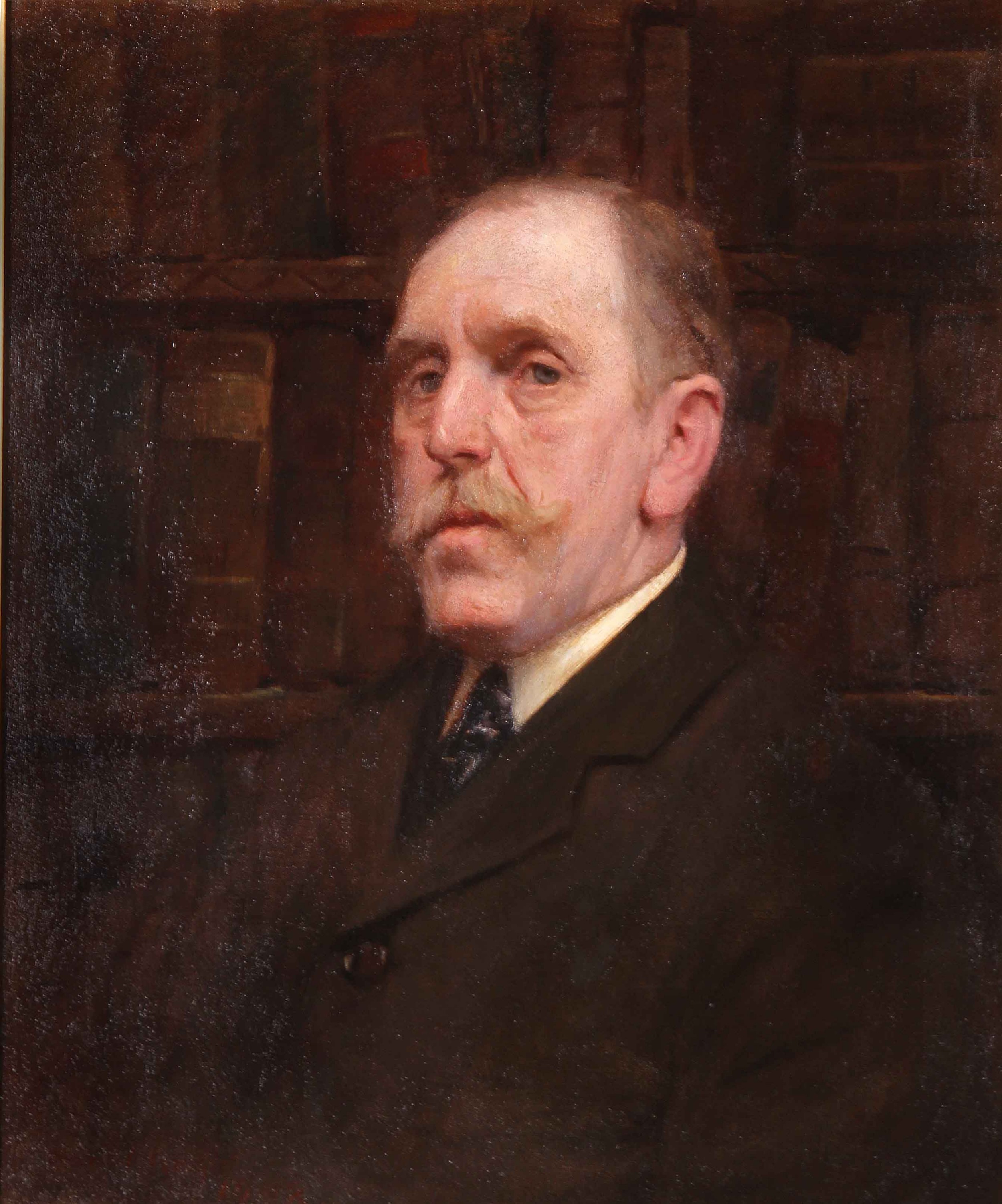
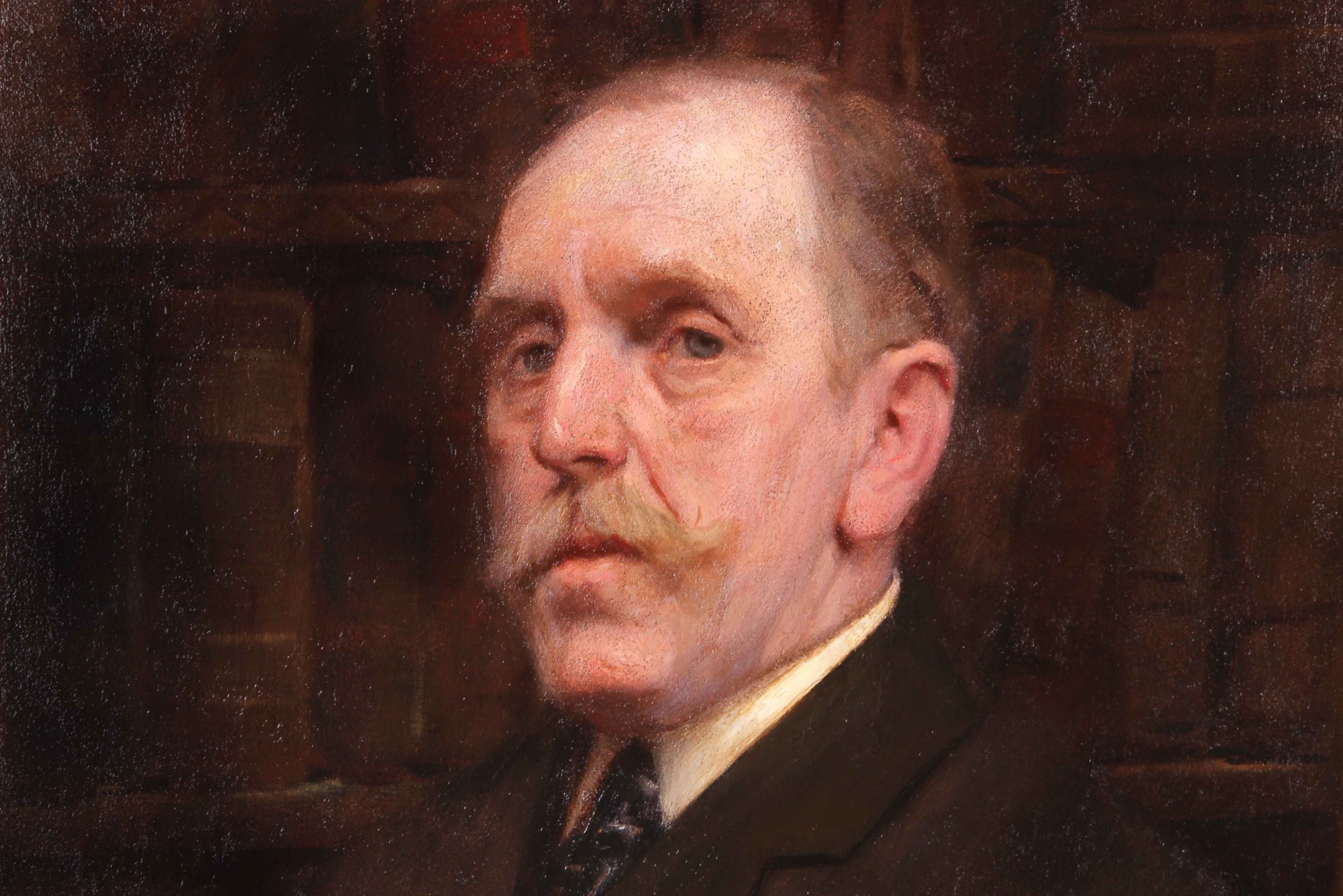
William Greenwood Fine Art has dated this piece to the 1900s.
Title: "James Ward of Nottingham". In a library.
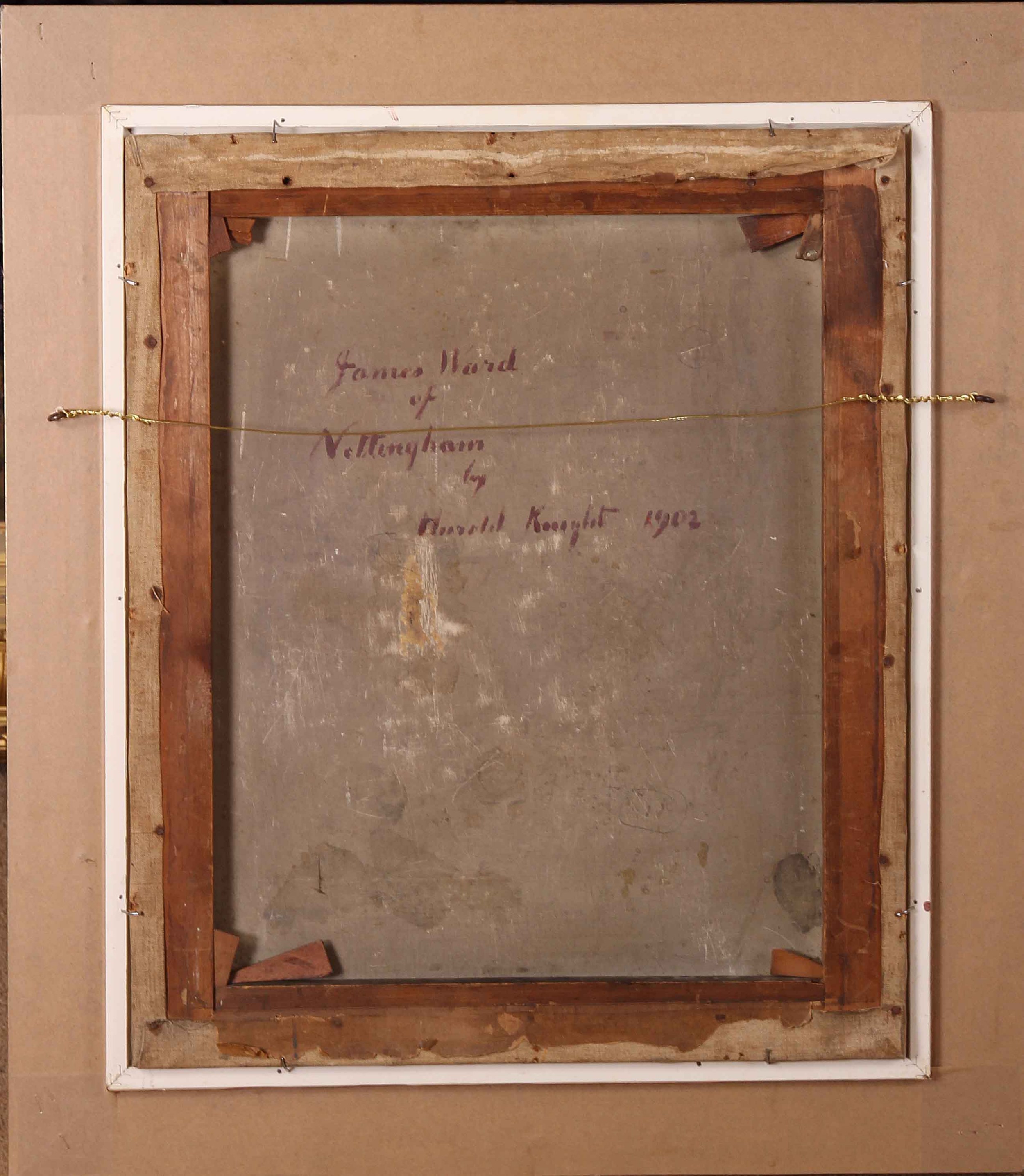
Signed and dated 1902. Extensively inscribed on the reverse of the painting.
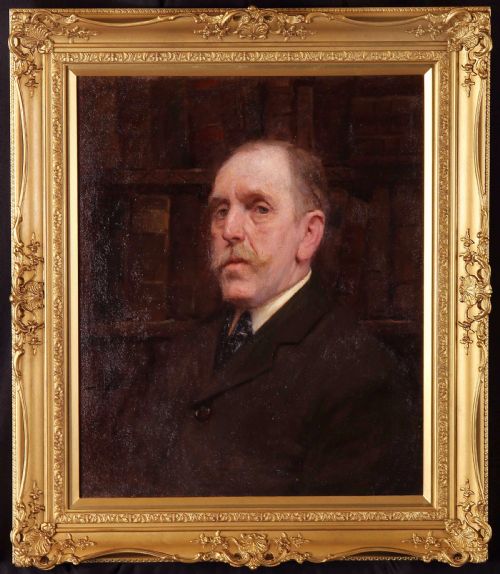
Oil on canvas. Size: 24"x 20". Framed size: 30 1/2"x 26 1/2".
In very good ready to hang condition. Free UK delivery.
Educated at Nottingham High School, he began to study art under William Foster at the local school of art and proved an outstanding student, winning a number of competitions organised by the Royal College of Art. While there, he befriended Laura Johnson (who would become his wife in 1903, and gain fame as Laura Knight). The award of a British Institute scholarship helped him to travel to Paris – in the company of Laura – to study at the Académie Julian under J P Laurens and J J Benjamin-Constant. Soon after their return to England, in 1897, they accepted the invitation of Thomas Barrett, a master at Nottingham School of Art, to stay at his cottage in Staithes, on the North Yorkshire coast. Becoming part of the artistic community that was based there, they both absorbed the free brushwork and bright palette that was its hallmark, and Harold applied them to paintings of the local fishing community. From 1896, he exhibited steadily at the Royal Academy (eventually being elected an Associate in 1928, a Royal Academician in 1937, and a member of several other societies). Other venues for his work included the Leicester Galleries, which, in 1906, mounted the joint show, ‘Dutch Life and Landscape by Mr and Mrs Harold Knight’, the fruit of long stays in Holland during the preceding two years.
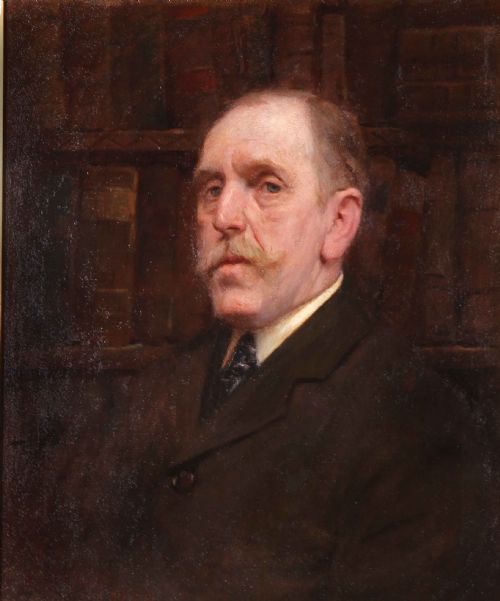
In 1907, the Knights moved to Cornwall, settling first in Newlyn, and becoming part of its artistic colony. Two years’ later, Harold embarked on a long series of paintings of women in interiors. Then in 1912, the couple moved further west to St Buryan, just inland from Lamorna Cove, and so helped to establish a new settlement of artists, alongside Samuel John ‘Lamorna’ Birch, among others. When war broke out in 1914, Harold – already aged 40 – identified himself as a conscientious objector. As a result, he was forced to work as a farm labourer, from 1916 to 1917, being excused when his health began to deteriorate seriously.
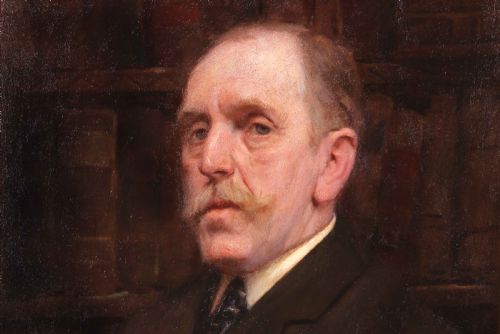
In 1919, the Knights left Cornwall for London, though continued to return to Sennen Cove and Mousehole each summer until the early 1930s. Harold’s steady flow of commissions included portraits for the John Hopkins Memorial Hospital in Baltimore in 1926. From the end of the Second World War, the Knights spent much time at the Park Hotel, Colwall, Herefordshire – below the Malvern Hills – and Harold would die there on 3 October 1961.
His work is represented in numerous public collections, including the National Portrait Gallery; Nottingham Castle Museum & Art Gallery; and Cardiff Council.
William Greenwood Fine Art has dated this piece to the 1900s.
You can view the stock and full dealer information on the William Greenwood Fine Art Profile Page
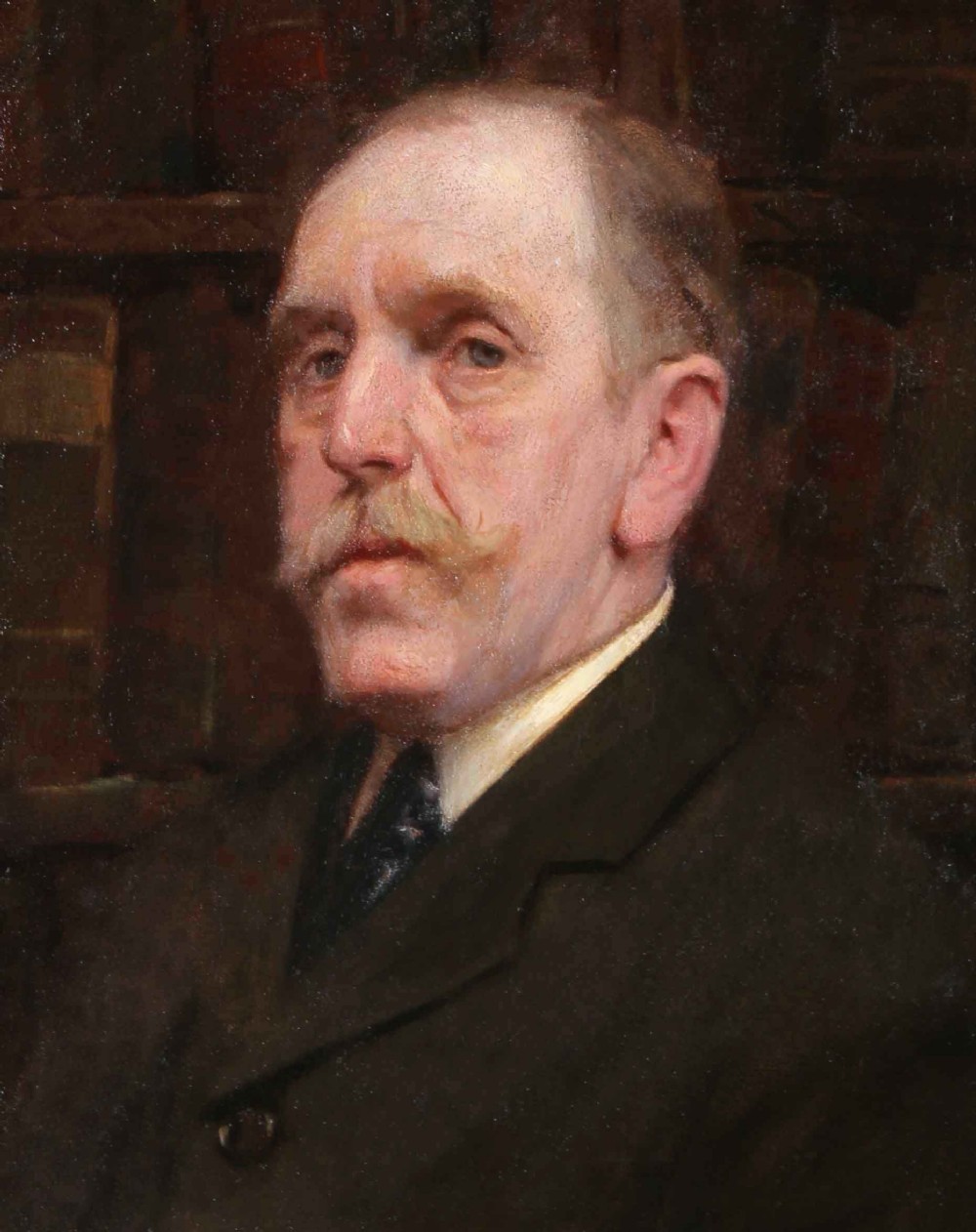
Harold Knight Ra. "James Ward of Nottingham". Portrait Oil.