
Artware Fineart has dated this piece to the 18th Century.
Windsor Castle, in Windsor in the English county of Berkshire, is the largest inhabited castle in the world and, dating back to the time of William the Conqueror, is the oldest in continuous occupation. The castle's floor area is approximately 484,000 square feet (44,965 square metres).
Queen Elizabeth II spends many weekends of the year at the castle, using it for both state and private entertaining. Her other two residences, Sandringham House and Balmoral Castle, are the Royal Family's private homes. Most of the Kings and Queens of England, later Kings and Queens of Great Britain, and later still kings and queens of the Commonwealth realms, have had a direct influence on the construction and evolution of the castle, which has been their garrison fortress, home, official palace, and sometimes their prison. Chronologically the history of the castle can be traced through the reigns of the monarchs who have occupied it. When the country has been at peace, the castle has been expanded by the additions of large and grand apartments; when the country has been at war, the castle has been more heavily fortified. This pattern has continued to the present day.
Throughout its 900-year history, the design of Windsor Castle has changed and evolved according to the times, tastes, requirements and finances of successive Monarchs. Nevertheless, the positions of the main features have remained largely fixed and the modern plan below is a useful guide to locations. The castle today, for example, remains centred on the motte or artificial hill ("A" on the plan) on which William the Conqueror built the first wooden castle between 1070 and 1086 AD. The Castle was later rebuilt in stone, and grew in importance over the years. Henry II constructed the Round Tower and the original stone outer wall. The highly visible landmark of the castle, the Round Tower , is in reality far from cylindrical, its shape being dictated by the irregular, but seemingly round, artificial hill on which it sits. The castle's layout dates back to the medieval fortifications. The Round Tower divides the castle into two distinct sections known as wards. The Lower Ward ("F") is home to St George's Chapel , while the upper ward contains the private Royal Apartments and the more formal state rooms , which include St George's Hall, a vast room which has a ceiling decorated with the coats of arms of past and present members of the Order of the Garter. The immediate environs of the castle, known as the Home Park, comprise parkland and two working farms along with many estate cottages mainly occupied by employees. The estate of Frogmore also lies within the Home Park.
Artware Fineart has dated this piece to the 18th Century.
You can view the stock and full dealer information on the Artware Fineart Profile Page
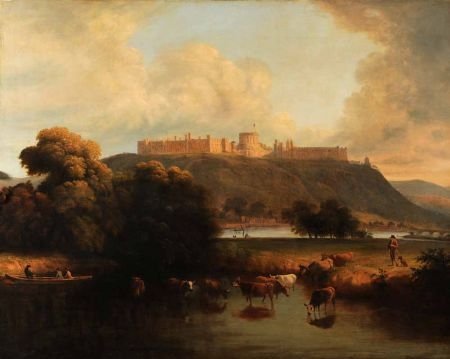
Windsor Castle with a Heardsman and His Cattle Watering at the Thames and Figures in a River Punt Beyond, Attributed to Patrick Nasmyth