
Sir Thomas More (7 February 1478 – 6 July 1535), also known as Saint Thomas More, was an English lawyer, author, and statesman who in his lifetime gained a reputation as a leading Renaissance humanist scholar, and occupied many public offices, including Lord Chancellor (1529–1532).
He was beheaded in 1535 when he refused to sign the Act of Supremacy that declared King Henry VIII Supreme Head of the Church of England. In 1935, four hundred years after More's death, Pope Pius XI canonized him in the Roman Catholic Church. More was declared Patron Saint of politicians and statesmen by Pope John Paul II in 2000. In 1969, More's name was included in the General Roman Calendar, with a Memorial in which he is venerated with Saint John Fisher on 22 June, the day of the latter's death. In 1980, More was added to the Church of England's calendar of saints, again jointly with John Fisher, but on July 6, the day of More's death.
Born in Milk Street, London, Thomas More was the eldest son of Sir John More, a successful lawyer who served as a judge in the King's Bench court. The younger More was educated at St Anthony's School and was later (1491) a page in the household service of John Morton, the Archbishop of Canterbury, who declared that young Thomas would become a "marvellous man." Morton sent More to attend the University of Oxford for two years as a member of Canterbury Hall (subsequently absorbed by Christ Church), where he was a friend of Erasmus, John Colet, and William Lilye. A pupil of Thomas Linacre and William Grocyn, More studied Latin and logic. He then returned to London, where he studied law with his father and was called to the bar. Admitted to Lincoln's Inn in 1496, in 1501 More became a barrister, where he was eminently successful. To his father's great displeasure, More seriously contemplated abandoning his legal career in order to become a monk. From 1499 to 1503 he lodged at the London Charterhouse, subjected himself to the discipline of a Carthusian monk, and also considered joining the Franciscan order. He abandoned the order, however, perhaps because he judged himself incapable of celibacy. More finally decided to marry in 1505, but for the rest of his life he continued to observe many ascetical practices, including self-punishment: he wore a hair shirt every day and occasionally engaged in flagellation. After becoming a Member of Parliament in 1504, More successfully opposed Henry VII's demand for monetary aid upon the marriage of then-Princess Margaret Tudor. More had four children by his first wife, Jane Colt, who died in 1511. He remarried almost immediately, to a rich widow named Alice Middleton who was several years his senior.
You can view the stock and full dealer information on the Artware Fineart Profile Page
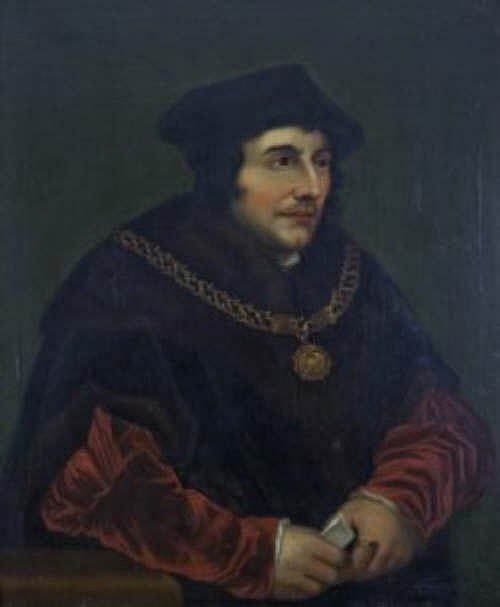
Portrait of Sir Thomas More 1478-1535, Lord Chancellor; After After Hans Holbein