
Artware Fineart has dated this piece to the 19th Century.
In 1874, Gilbert wrote a short libretto on commission from producer–composer Carl Rosa, whose wife would have played the leading role, but her death in childbirth cancelled the project and left the libretto an orphan.
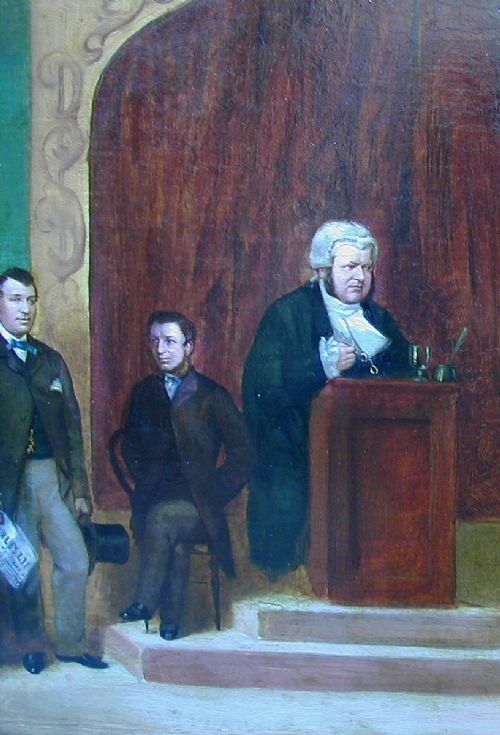
Gilbert already had available the libretto he had written for Rosa, and Carte suggested that Sullivan write the score. The composer was delighted with it, and Trial by Jury was composed in a matter of weeks. D. H. Friston's engraving of the original production of Trial by JuryThe piece is one of Gilbert's humorous spoofs of the law and the legal profession, based on his short experience as a barrister. It concerns a breach of promise of marriage suit. The defendant argues that damages should be slight, since "he is such a very bad lot," while the plaintiff argues that she loves the defendant fervently and seeks "substantial damages." After much argument, the judge resolves the case by marrying the lovely plaintiff himself. With Sullivan's brother, Fred, as the Learned Judge, the opera was a runaway hit, outlasting the run of La Périchole. Provincial tours and productions at other theatres quickly followed. Fred Sullivan was the prototype for the "patter" (comic) baritone roles in the later operas. F. C. Burnand wrote that he "was one of the most naturally comic little men I ever came across. He, too, was a first-rate practical musician... As he was the most absurd person, so was he the very kindliest..." Fred's creation would serve as a model for the rest of the collaborators' works, and each of them has a crucial comic little man role, as Burnand had put it. The "patter" baritone (or "principal comedian", as these roles later were called) would often assume the leading role in Gilbert and Sullivan's comic operas, and was usually allotted the speedy patter songs. After the success of Trial by Jury, Gilbert and Sullivan were suddenly in demand to write more operas together. Over the next two years, Richard D'Oyly Carte was one of several theatrical managers who negotiated with the team but were unable to come to terms. Carte also proposed a revival of Thespis for the 1875 Christmas season, which Gilbert and Sullivan would have revised, but he was unable to obtain financing for the project.
Gilbert and Sullivan refers to the Victorian era partnership of librettist W. S. Gilbert (1836–1911) and composer Arthur Sullivan (1842–1900). The two men collaborated on fourteen comic operas between 1871 and 1896, of which H.M.S. Pinafore, The Pirates of Penzance and The Mikado are among the best known.
Artware Fineart has dated this piece to the 19th Century.
You can view the stock and full dealer information on the Artware Fineart Profile Page

A Scene from Trial by Jury by Gilbert and Sullivan, 19th Century English School