

It was listed by Artware Fineart. Sold pieces stay on Sellingantiques as a record of what has passed through, and the next one is rarely far away.
Artware Fineart has dated this piece to the 19th Century.
Signed/Inscribed:
on the reverse "Lord Gough by Sir F Grant PRA".
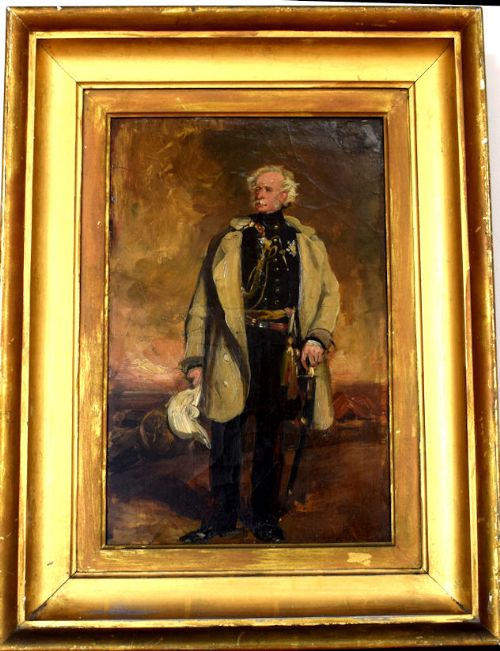
oil on canvas
20 x 15in. (51 x 38.10 cm.)
General Sir Hope Grant, (brother to Sir Francis Grant PRA) who would have known Gough well, died without children, it is possible that Francis Grant gave the porrait sketch to him.
Provenance
By descent from the artist to his brother General Sir Hope Grant and then to Charles Grant of Kilgraston (Sir Francis Grant's nephew) and thence by descent to John Patrick Grant and then to Basil Brooke of Beil Estate
Notes
This portrait sketch is one of a number of working preparatory studies made for the full length portrait that hangs at the United Services Club owned by the Crown Commissioners. The full length portrait was exhibited in 1854, the other known study for this portrait is a pen and ink drawing made in 1853 and now in the National Portrait Gallery London. (NPG 805) showing Gough in a different pose, holding his trade mark hat in his left hand and pointing with his left hand. The mezzotint by S. Cousins published in or after 1866, (NPG D34648) shows the final version of the full length portrait where the artist has followed the pose outlined in the pen and ink study rather than this oil study.
Hugh Gough, , first Viscount Gough (1779–1869), army officer, was born on 3 November 1779 at Woodsdown, co. Limerick, Ireland, fourth son of George Gough of Woodsdown and his wife, Letitia, daughter of Thomas Bunbury of Lisnavagh and Moyle, co. Carlow. In 1793 he received a commission in the new Limerick city militia, of which his father was lieutenant-colonel, and on 7 August 1794 was promoted ensign in Hon. Robert Ward's regiment of foot, from which he was transferred in October to the 119th, of which he was adjutant at the age of fifteen. On 6 June 1795 he was promoted lieutenant in the 78th Highlanders, on the formation of its 2nd battalion, and was present with it at the capture of the Cape of Good Hope that year, and at the surrender of the Dutch fleet in Saldanha Bay in 1796. His friends had meanwhile procured his transfer to the 87th Prince of Wales's Irish, with which he served against the brigands in St Lucia, at the capture of Trinidad, the attack on Puerto Rico, and the capture of Surinam, serving with it in the West Indies and at Curaçoa until 1803. In 1803 he obtained command of a company in a second battalion of the regiment formed at Frome, Somerset, by Sir Charles William Doyle from men enrolled in the army of reserve in the counties of Tipperary and Galway. Gough became major in the battalion in 1805, and in 1807 he married Frances Maria, daughter of General Edward Stephens, Royal Artillery. They had a son, the second viscount, and four daughters. Lady Gough died in 1863.
Doyle having been sent to Spain, Gough commanded the battalion when it embarked for Portugal on 28 December 1808, and at the battle of Talavera on 28 July 1809, where the ‘Faugh a Ballaghs’ (‘Clear the Ways’), as this regiment was called from its Irish battle-cry, sustained heavy losses. Gough was severely wounded, and had his horse shot under him. At Wellington's request Gough's commission as lieutenant-colonel was antedated to the battle, the first British officer to receive brevet promotion in action at the head of a regiment. In 1810 the battalion was with Graham at Cadiz, and formed part of the force that disembarked at Algeciras, and fought the battle of Barossa on 5 March 1811, when Gough, with the 87th and three companies 1st guards, made a famous charge on the French 8th light infantry. An ‘eagle’—the first taken in the Peninsular War—was captured by Sergeant Patrick Masterson of the 87th, and an eagle with collar of gold and the figure 8 was thereaf
Artware Fineart has dated this piece to the 19th Century.
You can view the stock and full dealer information on the Artware Fineart Profile Page
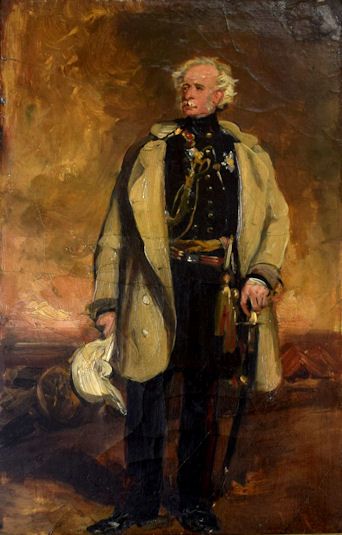
Sir Francis Grant, Pra, 1803-1878 Portrait Study of Field Marshal Hugh Gough, 1st Viscount Gough, Kp, Gcb, Gcsi, Pc (3 November 1779 – 2 March 1869)