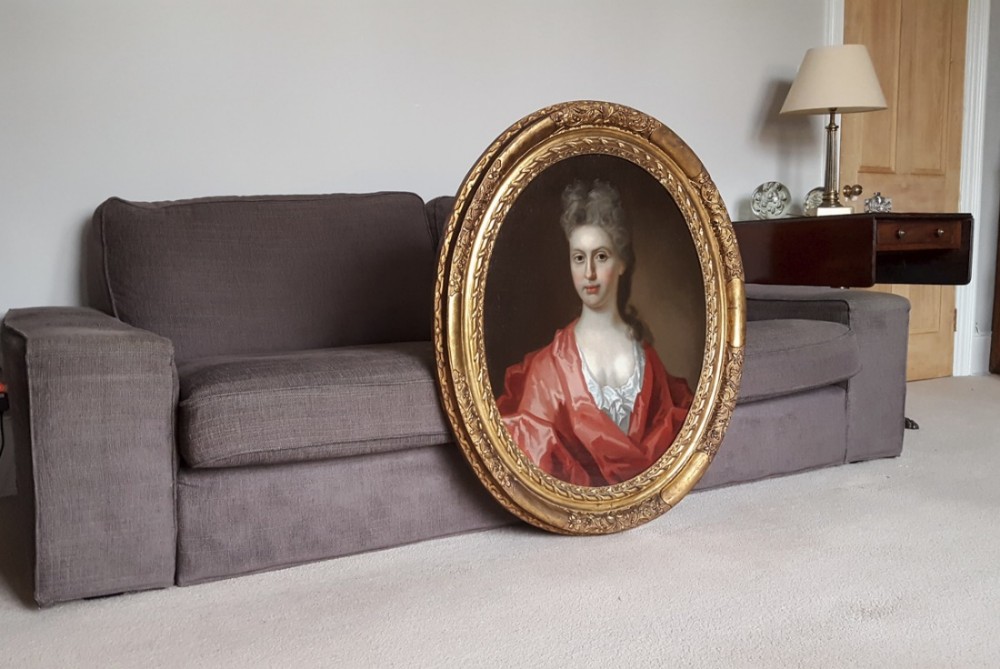
Titan Fine Art has dated this piece to the 17th Century.
Large c.
It is a family unique in being able to trace an unbroken inheritance from son to son for 800 years (from the 12th century to 1974) with only one exception in the 18th century. Stylistically the work follows the English late 17th and early 18th century tradition of portrait painting, epitomised by the likes of Kneller and Dahl. The handling and rendering along with the palette allude to William Sonmans who was a Dutch painter working in London and Oxford.
The Palmes family of Naburn Hall are an ancient English aristocratic family with a cadet branch at Lindley Hall, North Yorkshire, and an Irish line at Carcraig. Manfred Palmes held lands in Taunton Deane, Somerset in 1140 during the reign of King Stephen and William Palmes acquired the Lordship of Naburn in 1226 from Robert de Todeni (died 1088) who was an ancestor and a powerful Norman baron that was granted 80 estates in 11 counties. To settle the debts of George Palmes over 800 acres of the estate was sold in 1775-9. It passed through the Palmes family until the death of Commander George Bryan Palmes in 1974 where it then comprised of 1100 acres. The will of Brian Palmes of Naburn Hall (31 October 1519) shows that in addition to Naburn the family held nine other estates. The Palmes family were recorded as recusants or non-communicants from the 1570s onwards and the family remained Roman Catholics until the death of John Palmes in 1784 after years of pressure and fines. Edmund Burke described the family as "one of serious antiquity". See the family pedigree attached.
The Palmes family of Naburn are direct descendants of Catherine Boleyn who is generally believed to have been the daughter of Henry VIII of England and Anne Boleyn who was the second wife of Henry VIII and the mother of Elizabeth I of England. The branch of the family seated at Lindsey Hall began with Guy Palmes who was Sergeant at Law for Henry VII and Henry VIII.
William Sonmans (or Wilhelm Sunman) (fl.1670-1708) was born in Dordrecht and was a portrait painter influenced by the work of John Riley (1646-1691). According to Vertue, he followed the much travelled path from Holland to England of artists during the reign of Charles II in the 17th century. He first worked in London in the 1670s and later in Oxford where he rose significantly in notoriety after the death of Sir Peter Lely in 1680. There he benefited from many commissions and painted the great founders of the University that were in the picture gallery (present location unverified). Afterwards he tended to work in Oxoford during term-time and in London during the remaining part of the year. He died at his house in Gerard St, Soho (London) and was interred 15 July 1708.
Held in a good quality 17th century carved and giltwood frame and ready to hang.
Provenance: By descent through the Palmes family to a branch now resident in Kent.
Measurements: Height 96cm, Width 83cm framed (Height 37.75”, Width 32.5” framed)
Titan Fine Art has dated this piece to the 17th Century.
Specialist in 17th & 18thc portraits. Highly curated selection, museum-level research & pro conservation. Exceptional art, expertly vetted.
You can view the stock and full dealer information on the Titan Fine Art Profile Page
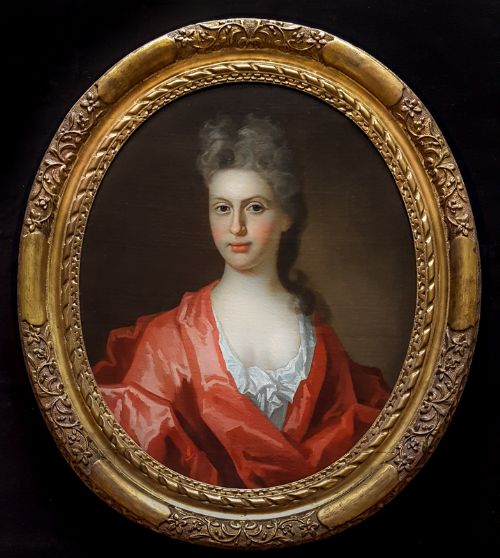
Portrait of a Member of the Palmes Family C.1695, Attributed to William Sonmans (Fl.1670-1708)