Artware Fineart has dated this piece to the 19th Century.
9 x 13 in. (23 x 34 cm. )
Thomas Hosmer Shepherd (1792 – 1864) was a watercolor artist well known for his architectural works.
His paintings were the basis for steel engravings in many books.
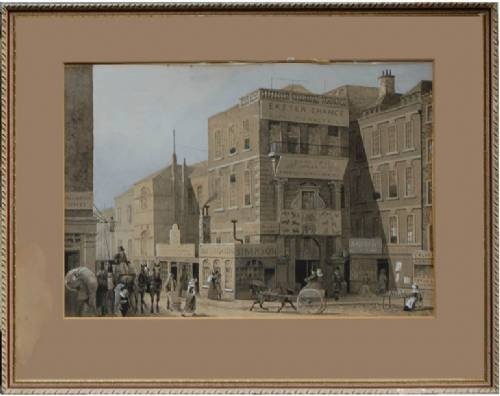
Shepherd's work, mostly topographical, is characterized by an attention to detail, along with lifelike scenes that contained people, carriages and horses. His first acclaim came with Metropolitan improvements, a publication of modern London architecture commissioned by Jones & Co. He worked mostly for Frederick Crace, who employed him to paint old London buildings prior to their demolition, with much of the work surviving in the Crace collection at the British Museum.
The Exeter Exchange (popularly known as Exeter Change) was a building on the north side of the Strand in London, with an arcade extending partway across the carriageway. It is most famous for the menagerie that occupied its upper floors for over 50 years, from 1773 until it was demolished in 1829. Exeter Exchange was built in 1676, on the site of the demolished Exeter House (formerly Burghley House and Cecil House), London residence of the Earls of Exeter, almost opposite the Savoy. Around the same time, the nearby Burleigh Street and Exeter Street were laid out. The Exeter Exchange originally housed small shops (milliners, drapers, hosiers) on the ground floor, and rooms above which were let to the Land Bank. Over time, the traders on the ground floor were replaced by offices, and the upper rooms were used for storage.
Artware Fineart has dated this piece to the 19th Century.
You can view the stock and full dealer information on the Artware Fineart Profile Page
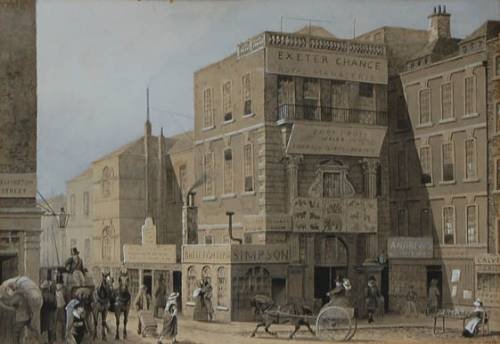
The Exeter Exchange, Popularly Known as Exeter Change by Thomas Hosmer Shepherd