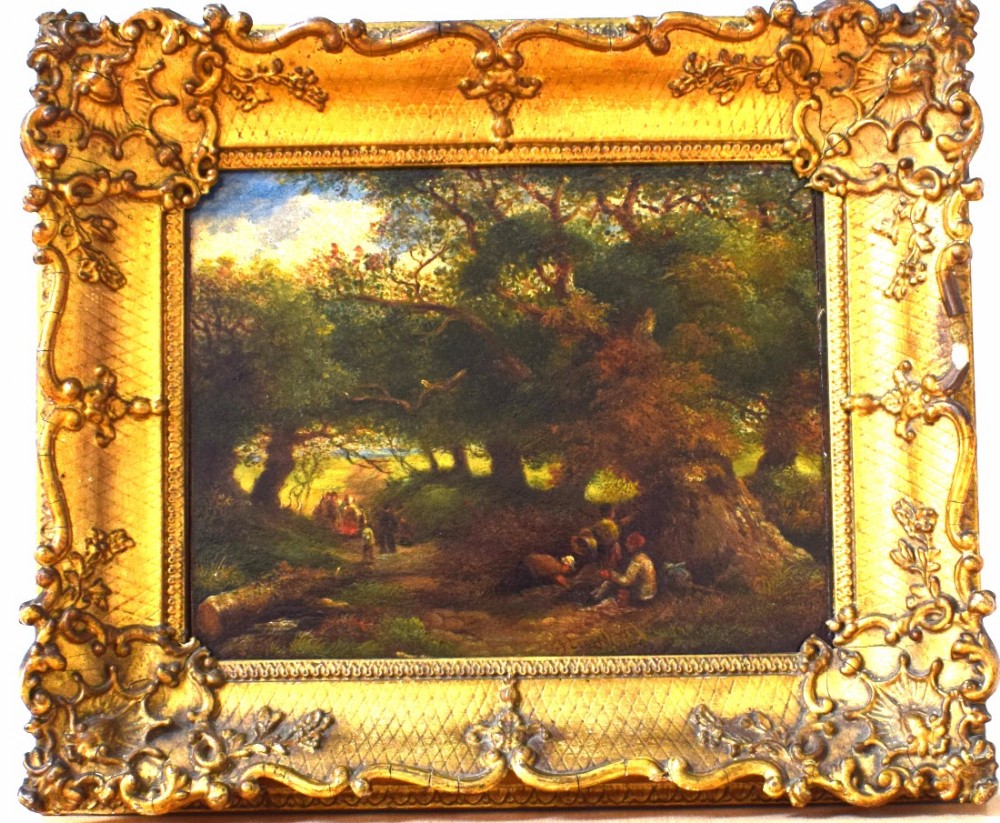
Artware Fineart has dated this piece to the 19th Century.
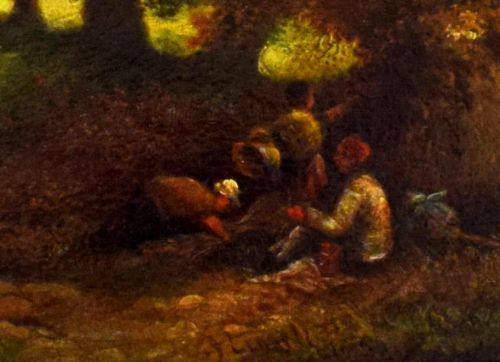
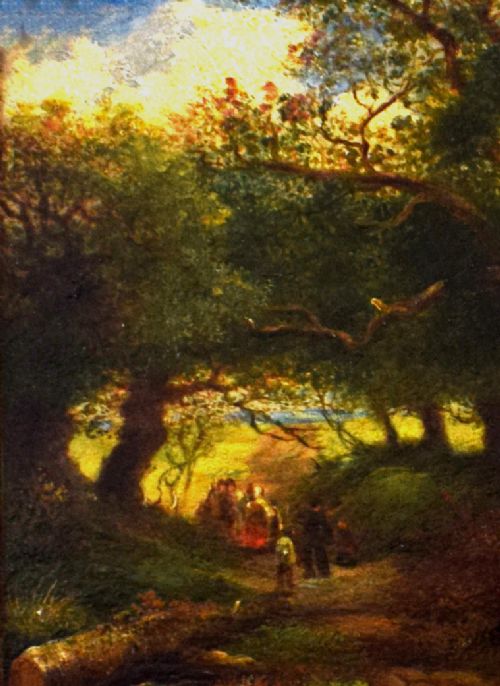
Children playing in a Wooded Clearing
Signed/Inscribed: "John Linnell " lower right
oil on panel
19.69 x 25.40 cm. (7.3/4 x 10 in.)
Linnell, John (1792–1882), landscape and portrait painter, was born on 16 June 1792 in Plum Tree Street, Bloomsbury, London, the fourth and youngest child of James Linnell (1759–1836), woodcarver, framemaker, and picture dealer, and his wife, Mary Susannah, née Welshman (d. 1825). Linnell had a long and very successful career as an artist, but modern assessments of his importance centre on his early work, and on his relationships with his fellow artists William Blake and Samuel Palmer, who became his son-in-law in 1837.
Early years, 1792–1811
He was introduced to artists by the latter, and c.1804 made visits to Benjamin West, who looked at his sketches and offered advice. In his diary entries for 9 and 14 November 1806 Farington mentioned that his small-scale oil studies had attracted the attention of David Wilkie, Benjamin Haydon, and Sir George Beaumont. In 1805 Linnell entered the Royal Academy Schools, and at about this time he became a pupil of John Varley. With William Mulready and William Henry Hunt, also pupils of Varley, he made oil sketches from nature along the banks of the Thames, for example, Study of Buildings: Sketch from Nature (1806; Tate collection). He was especially close to Mulready, with whom he was to share lodgings between 1809 and 1811. In the evenings, at this early period, c.1805–6, Linnell copied drawings in the house of the art patron Dr Thomas Monro. From 1807 to 1811 he exhibited oil paintings at the Royal Academy and at the British Institution, mainly genre scenes and landscapes which show the influence of seventeenth-century Dutch art, for example, The Quoit Players, 1810, which was bought by Sir Thomas Baring for 75 guineas. At the British Institution Linnell won a premium of 50 guineas in 1809 for Removing Timber in Autumn.
During this period Linnell was apprenticed to his father, having signed an indenture for seven years in 1806.
Early landscapes, 1811–1818
In 1811 Linnell left the Academy Schools. His friendship with Cornelius Varley, brother of John, seems to have stimulated both a religious conversion and a new approach to landscape painting in this year. He joined the Baptist church in January 1812, becoming a member of the chapel at Keppel Street, Bloomsbury, and bought drawing instruments which would enable him to transcribe what he saw with scientific accuracy. He read the writings of William Paley, whose natural theology encouraged Linnell, like many other artists of his time, to regard the study of landscape as a valuable response to the work of God. In his subject matter a new interest in working figures is evident, especially in Kensington Gravel Pits (1812; Tate collection). Many of his watercolour studies in this decade adopt unconventional compositions, suggesting a self-consciously haphazard, informal method of constructing landscape, such as Brick Kiln, Kensington, 1811–12 (priv. coll.). When the Society of Painters in Water Colours changed its name to the Society of Painters in Oil and Water Colours in 1813, Linnell was a founding member, and contributed fifty-two works (probably all oils) to its exhibitions between 1813 and 1820. Many of these were based on sketching trips made in 1813, 1814, and 1815. In 1813, with George Robert Lewis, he visited north Wales, where he was impressed by the wild scenery, writing many years later, ‘I could almost fancy myself living in the times of Jacob and Esau and might expect to meet their flocks’ (Linnell, autobiography, 45–6). In 1814 he was in Derbyshire, making drawings for an edition of I. Walton and C. Cotton's Compleat Angler, commi
Artware Fineart has dated this piece to the 19th Century.
You can view the stock and full dealer information on the Artware Fineart Profile Page
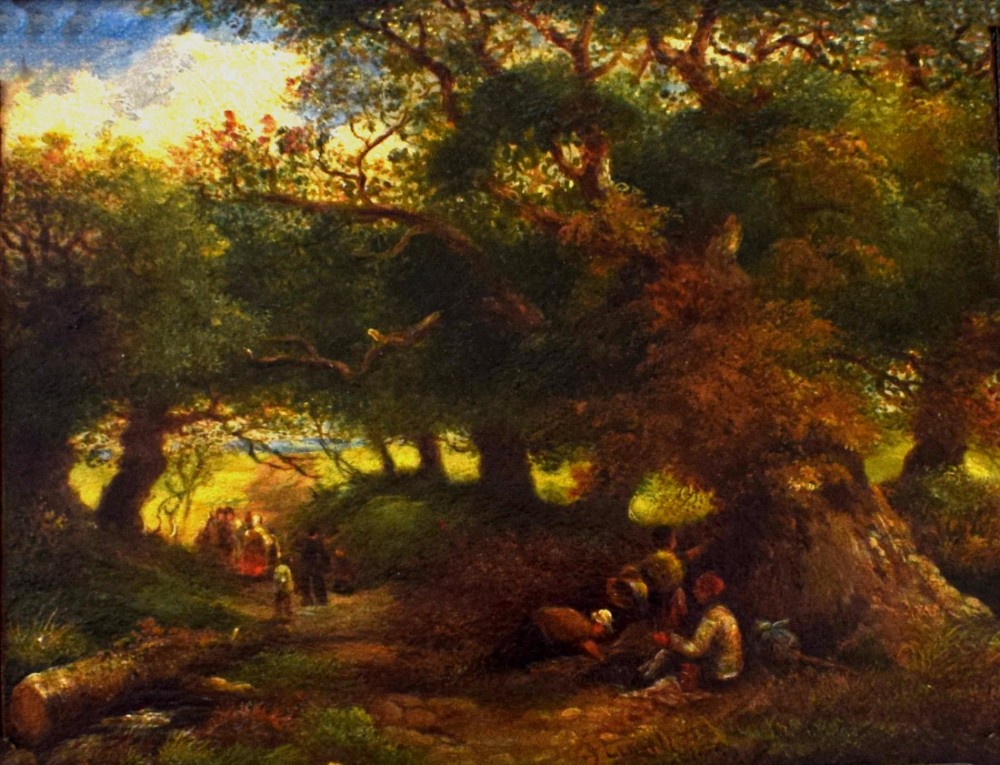
John Linnell 1792–1882 Children Playing in a Wooded Clearing