

It was listed by Artware Fineart. Sold pieces stay on Sellingantiques as a record of what has passed through, and the next one is rarely far away.
Artware Fineart has dated this piece to the 1800s.
Portrait of Frances "Fanny" Kemble Mrs Twiss
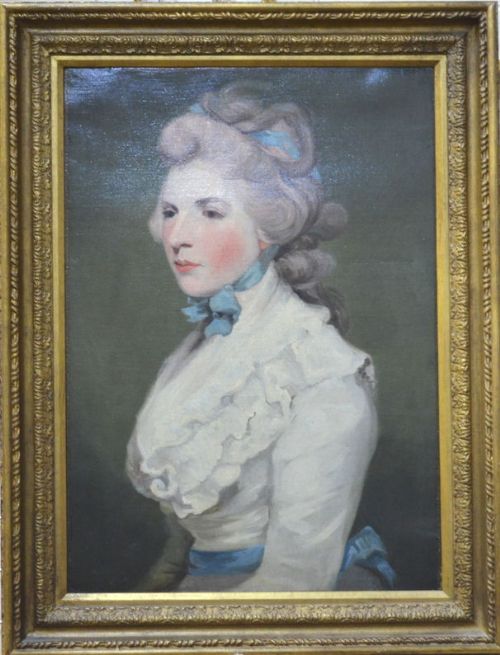
oil on canvas
28 x 19 in. (71 x 48 cm.)
The date of the hairstyle and clothing looks to be about 1785-1790. The ornate hair styles of this decade incorporated ribbons and it was fashionable to wear a ribbon around the neck, sometimes with a brooch pinned to it. With thanks to Dr Susan North with her help in dating that clothing. The Original portrait by Sir Joshua Reynolds is in the National Museum, Havana, Cuba.
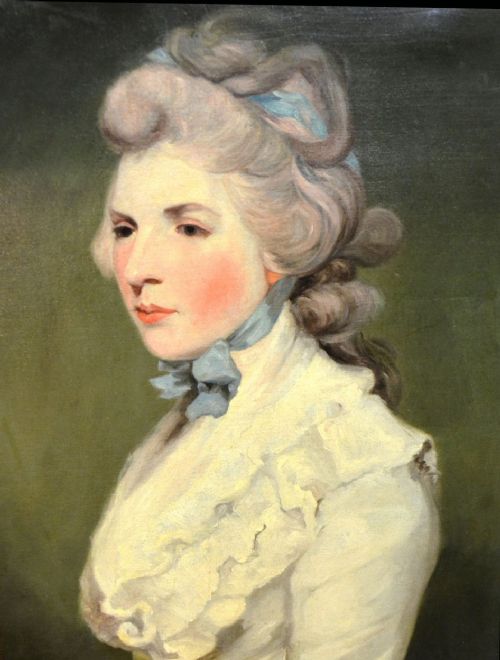
Engraved by John Jones, after Sir Joshua Reynolds mezzotint, published 1784 (1783)
Frances Kemble was born in 1759. She was the daughter of Roger Kemble and Sarah Ward. She married Francis Twiss, son of Francis Twiss and Anne Hussey, on 22 April 1786 at St. Giles-in-the-Fields, London, England.2 She died in 1822. Frances Kemble also went by the nick-name of Fanny. She was a stage actress. From 11 May 1786, her married name became Twiss. She had 8 children .

Elizabeth Twiss2 d. 1858
Horace Twiss+3 b. 28 Feb 1787, d. 4 May 1849
unknown daughter Twiss2 b. c 1789, d. 1789
Frances Ann Twiss2 b. 1790, d. 1864
Amelia Twiss2 b. 1791, d. 1852
Caroline Twiss3 b. c 1792, d. c 1 May 1808
Edward Twiss3 b. 16 Mar 1795
John Twiss2 b. 1798, d. 1866
Her Husband Francis Twiss (bap. 1759, d. 1827), concordance compiler, was born in Rotterdam, and baptized at the English Episcopal Church there on 5 April 1759, the sixth, and third surviving, of the eight children of Francis Twiss and his wife, Anne, née Hussey. The eldest child Richard Twiss (1747–1821) survived, but the next three died in infancy. Francis Twiss the father was an English merchant from Norwich and descended from Richard, the fourth son of Richard and Frances Twiss, who had gone to co. Kerry in Ireland about 1640, resided in the castle of Castle Island, and acquired possession of Killintierna (Burke, Gen. GB, 1871, 1424).
Of his early life it is known only that Twiss was admitted as a pensioner to the second table at Pembroke College, Cambridge, on 30 October 1776, under the college tutors Turner and George Pretyman, but evidently remained in residence for only one year. In the early 1780s he was evidently living mainly in the London area, and acquiring a reputation as a critic of Shakespearian acting. He became a friend of John Philip Kemble, and reputedly developed ‘a hopeless passion’ for Kemble's sister Sarah Siddons, sufficient to draw him to Belfast to watch her performances there in 1785 (Kemble, 1.21; Parsons, 151–2, 98). He also befriended Elizabeth Inchbald, reading with her and criticizing her plays (Manvell, 33–4, 48); she described him as one ‘whose integrity nothing could warp’ (Parsons, 151).
Sarah Siddons was doing all she could to promote the theatrical careers of her sisters and brothers. Her sister Frances Kemble (1759–1822) appeared on stage in Bath and Bristol in 1780–81, and in London first on 6 January 1783, but critics began to find her diffidence and lack of dramatic power irritating; and the compiler of ‘Theatrical intelligence’ for the Public Advertiser became obsessively harsh about her, often reducing her to bitter weeping. To her defence came the Shakespearian commentator George Steevens, with a letter of protest published in that paper (Boaden, Siddons, 2.20–26), and other expressions of support and admiration. He proposed marriage, but she and her family found him ‘too vehement and impracticable a suitor, too ill-tempered and capricious’ (Fitzgerald, 230), and instead, on 1 May 1786, in the church of St Giles-in-the-Fields, London, Fanny married by licence Francis Twiss. Sarah wrote of him as ‘a most respectable man, though of but small fortune, and I thank God that she is off the stage’ (letter to the Revd Thomas Whalley, 11 Aug 1786, cited in Parsons, 152).
Artware Fineart has dated this piece to the 1800s.
You can view the stock and full dealer information on the Artware Fineart Profile Page
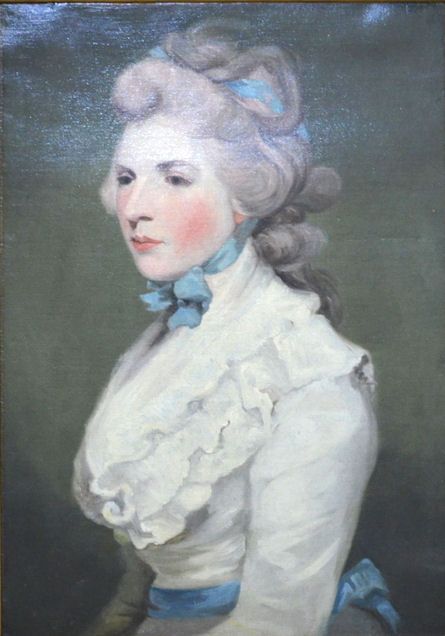
Studio of Sir Joshua Reynolds, Pra, 1723–1792 Portrait of Frances "Fanny" Kemble Mrs Twiss (1759-1822) in a White Dress with a Blue Neck Bow and Her Hair Tied with Blue Ribbon