

It was listed by Artware Fineart. Sold pieces stay on Sellingantiques as a record of what has passed through, and the next one is rarely far away.
Artware Fineart has dated this piece to the 18th Century.
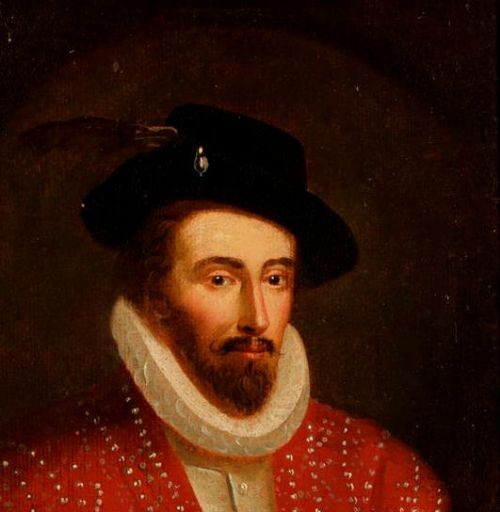
Portrait of Sir Walter Raleigh 1554 - 1618
Sir Walter Raleigh , 1554 - 1618
oil on panel
7.1/2 x 6 in. (19.30 x 15.24 cm.)
This oil on panel portrait was executed in the 18th century or early 19th century and it is derived from the engraving of Raleigh by Jacobus Houbraken 1698 – 1780 the Dutch engraver, published in 1739. see the engraving in the National Portrait Gallery, NPG D27997.
Notes
Sir Walter Ralegh, (1554–1618), courtier, explorer, and author, was born at Hayes, near East Budleigh, Devon, the second son and third surviving child of Walter Ralegh (1504/5–1581), landowner, of East Budleigh, and his third wife, Katherine (d. 1594), daughter of Sir Philip Champernowne of Modbury, Devon, and his wife, Catherine.
The family was protestant. Walter Ralegh the elder was deputy vice-admiral in the south-west under Mary I from 1555 to 1558. Katherine Ralegh's children from her first marriage, to Otho Gilbert (d. 1547) of Compton, Devon, included the noted mariner and soldier Sir Humphrey Gilbert (1537–1583), whose adventurous career greatly influenced the young Ralegh, and Adrian Gilbert (c.1541–1628).
Although much has been conjectured, little is in fact known about Ralegh's early career. In particular, it is not understood for certain how he came to acquire the formidable learning displayed in later life. Sir Robert Naunton may give a lead when he writes that Ralegh was ‘an indefatigable Reader, whether by sea or Land, and none of the least observers both of men and the times’ (Naunton, 49). So far as can be discerned from the meagre clues to hand, some of them throwaway remarks in Ralegh's History of the World (1614), he served as a volunteer in France from 1569 with the Huguenot armies during the second phase of the wars of religion, and tasted an early military reverse at the battle of Moncontour in October. Campaigning took him across northern and south-western France, the barbarities and valour he witnessed making a deep impression on him. It appears that he returned to England after the peace of St Germain was concluded in 1570.
The date of Ralegh's matriculation at Oriel College, Oxford, remains uncertain, although he probably went up to the university in 1572. He was the youngest of four surviving sons—there were two half-brothers from his father's first marriage, John (d. 1588) and George (1527–1597), as well as an elder brother from his father's third marriage, Carew [see below]—and his means may accordingly have been somewhat limited. Thomas Child of Worcestershire told John Aubrey that Ralegh, pressed for money, ‘borrowed a gowne of him when he was at Oxford … which he never restored, nor money for it’ (Brief Lives, 2.179). Ralegh left Oxford without a degree, and was admitted to the Middle Temple on 27 February 1575. On admission he was described as being ‘late of Lyons Inne’ (H. A. C. Sturgess, ed., Register of Admissions to the Honourable Society of the Middle Temple, 3 vols., 1949, 1.39). His first published poem appeared in 1576, as a commendatory verse in George Gascoigne's The Steele Glass. He was living at Islington, Middlesex, in 1577, entering into a bond for one of his servants summoned to answer charges in December.
Records of Ralegh's early contacts with the court also remain elusive. His mother's elder sister, Katherine Astley (d. 1565), was Princess Elizabeth's governess from 1544, became chief gentlewoman of the privy chamber in 1558 and of the bedchamber in 1559, and remained an intimate companion of the queen until her death in July 1565. This connection may have afforded Ralegh an initial introduction, but it was perhaps through Humphrey Gilbert's means that he first met leading courtiers, among them Sir
Artware Fineart has dated this piece to the 18th Century.
You can view the stock and full dealer information on the Artware Fineart Profile Page

English School 18th, Century portrait of Sir Walter Raleigh 1554 - 1618