It was listed by Artware Fineart. Sold pieces stay on Sellingantiques as a record of what has passed through, and the next one is rarely far away.
Artware Fineart has dated this piece to the 1800s.
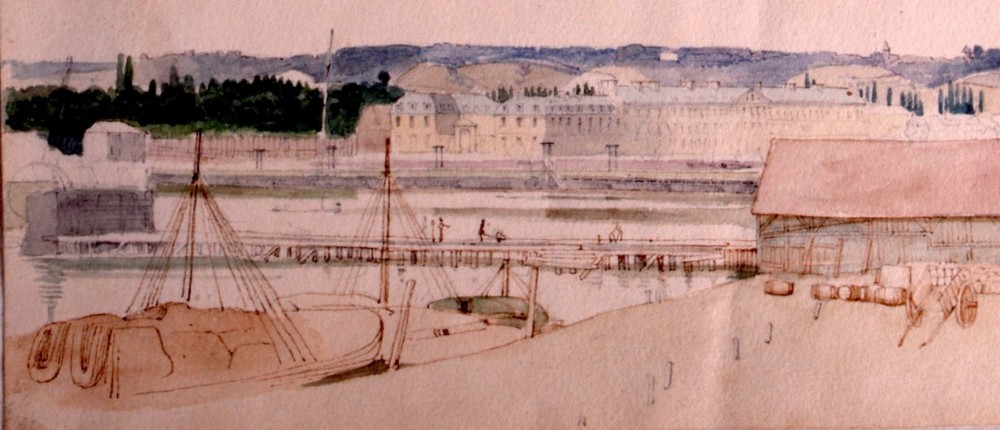
The Docks on the River Seine , Rouen
Signed/Inscribed:
"Rouen from our Inn"
pencil and watercolour
9 x 19.50 cm. (3.1/2 x 7.3/4in.)
page from artists sketch book
Notes
Rouen is a city on the River Seine in the north of France. It is the capital of the region of Upper Normandy and the historic capital city of Normandy.
It was one of the capitals of the Anglo-Norman dynasties, which ruled both England and large parts of modern France from the 11th to the 15th centuries. It was here that Joan of Arc was executed in 1431. People from Rouen are called Rouennais.
Unknown to Julius Caesar, Rouen was founded by the Gaulish tribe of the Veliocasses, who controlled a large area in the lower Seine valley, which retains a trace of their name as the Vexin. They called it Ratumacos; the Romans called it Rotomagus. Roman Rotomagus was the second city of Gallia Lugdunensis after Lugdunum (Lyon) itself. Under the reorganization of the empire by Diocletian, Rouen became the chief city of the divided province of Gallia Lugdunensis II and reached the apogee of its Roman development, with an amphitheatre and thermae of which the foundations remain. In the 5th century, it became the seat of a bishopric and later a capital of Merovingian Neustria.
From their first incursion into the lower valley of the Seine in 841, the Vikings overran Rouen until some of them finally settled and founded a colony led by Rollo (Hrolfr), who was nominated count of Rouen by the king of the Franks in 911. In the 10th century Rouen became the capital of the Duchy of Normandy and residence of the dukes, until William the Conqueror established his castle at Caen. In the early 12th century the city's population reached the size of 30,000.[4] In 1150, Rouen received its founding charter, which permitted self-government. During the 12th century, Rouen was probably the site of a Jewish yeshiva. At that time, about 6,000 Jews lived in the town, comprising about 20% of the total population. In addition, there were a large number of Jews scattered about another 100 communities in Normandy. The well-preserved remains of a medieval Jewish building, that could be a yeshiva, were discovered in the 1970s under the Rouen Law Courts.
In 1200, a fire destroyed part of the old Romanesque cathedral, leaving St Romain's tower, the side porches of the front, and part of the nave. New work on the present Gothic cathedral of Rouen was begun, in the nave, transept, choir, and the lowest section of the lantern tower. On 24 June 1204, Philip II Augustus of France entered Rouen and annexed Normandy to the French Kingdom. The fall of Rouen meant the end of Normandy's sovereign status. He demolished the Norman castle and replaced it with his own, the Château Bouvreuil, built on the site of the Gallo-Roman amphitheatre. A textile industry developed based on wool imported from England, for which the northern County of Flanders and Duchy of Brabant were constantly fierce but worthy competitors, and finding its market in the Champagne fairs. Rouen also depended for its prosperity on the river traffic of the Seine, on which it enjoyed a monopoly that reached as far upstream as Paris. Wine and wheat were exported to England, with tin and wool received in return.
In the 14th century urban strife threatened the city: in 1291, the mayor was assassinated and noble residences in the city were pillaged. Philip IV reimposed order and suppressed the city's charter and the lucrative monopoly on river traffic, but he was quite willing to allow the Rouennais to repurchase their former liberties in 1294. In 1306, he decided to expel the Jewish community of Rouen, which then numbered some five or six thousand in the
Artware Fineart has dated this piece to the 1800s.
You can view the stock and full dealer information on the Artware Fineart Profile Page
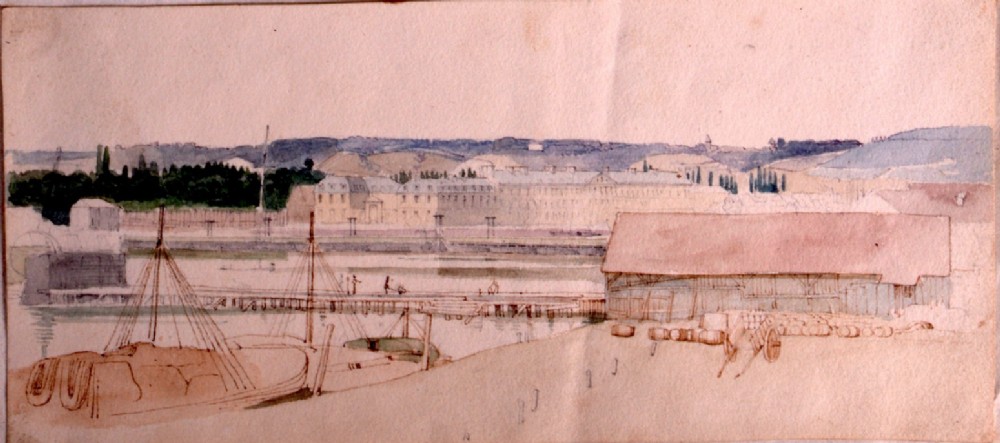
Attributed Thomas Shotter Boys, 1803–1874 The Docks on the River Seine , Rouen