

It was listed by Artware Fineart. Sold pieces stay on Sellingantiques as a record of what has passed through, and the next one is rarely far away.
Artware Fineart has dated this piece to the 18th Century.
Portrait of Oliver Cromwell the Lord Protector 1599-1658
oil on canvas
50 x 40 in. (127 x 101 cm.)
There are a number of versions of this portrait, either by the artist or studio of the artist, including a portrait in the collection of the Britsih Museum, the Chequers Trust and others in private collections.
Notes
1617) and his wife, Elizabeth Steward (d. 1654); he was born in Huntingdon on 25 April 1599 and was baptized in St John's Church there four days later. He was named after his father's elder brother, Sir Oliver Cromwell of Hinchingbrooke and of Ramsey, who almost certainly stood as his godfather.
Family background and life to 1628
The Cromwell fortune and name derived from Cromwell's great-grandfather, Morgan Williams, a Welshman from Glamorgan who had settled in Putney as an innkeeper and brewer and who had had the good fortune to marry the elder sister of Henry VIII's great minister Thomas Cromwell before the latter's rise to greatness. Williams and his son Richard were beneficiaries of this relationship and received enough confiscated church lands to become one of the most prominent families in Huntingdonshire. In slightly defiant gratitude (Thomas Cromwell having been beheaded in 1540) Richard changed his family name to Cromwell. Conscious of the circumstances, Oliver, throughout his life and even as lord protector, occasionally described himself as Williams alias Cromwell. Richard's son Sir Henry Cromwell (‘the golden knight’, 1536–1604) built substantial houses on the sites of a dissolved Benedictine convent (Hinchingbrooke, half a mile from Huntingdon) and a dissolved Benedictine abbey (Ramsey, 15 miles away in the fenland). Sir Oliver (1563–1655), uncle and godfather of the future lord protector, thus inherited a large but debt-laden estate (debt made worse by over-frequent receptions of members of the royal family as they travelled up the Great North Road, less than a mile away). Cromwell's father in contrast inherited a modest cluster of urban properties and impropriations in and around Huntingdon, but no manors or freehold land. With an income of perhaps £300 per annum and a seven-room town house, Robert Cromwell was a substantial inhabitant of a secondary town. He represented it in the parliament of 1593. None the less, as the eldest (surviving) son of the younger son of a knight Cromwell's social status was ambiguous.
Oliver Cromwell's mother was the daughter of William Steward. William's father in the early days of the Reformation had secured from his own brother, as prior of Ely, long leases of abbey (later dean and chapter) lands. Those leases passed to Elizabeth's childless brother Thomas, and eventually to Oliver.
Very little is known about Cromwell's first forty years. Only four of his personal letters survive, together with the précis of a speech he made when the House of Commons was in grand committee in 1628. He made only fleeting and impersonal appearances in public records. During his first decade there is the record of his baptism and of his having been a boy at the town grammar school, sitting at the feet of Thomas Beard, a pluralist and rather complacent conformist, whose reputation rested principally on his having written a best-seller on the way God visited divine justice in this world on scandalous sinners. There is a story that when the future Charles I, aged three, stayed at Hinchingbrooke on his way south to join his father, Sir Henry brought his four-year-old grandson Oliver to play with him; and that they squabbled and Oliver punched the prince on the nose and made it bleed. The story was recorded only after Oliver had orchestrated Charles's death, and it seems just too good to be true.
During
Artware Fineart has dated this piece to the 18th Century.
You can view the stock and full dealer information on the Artware Fineart Profile Page
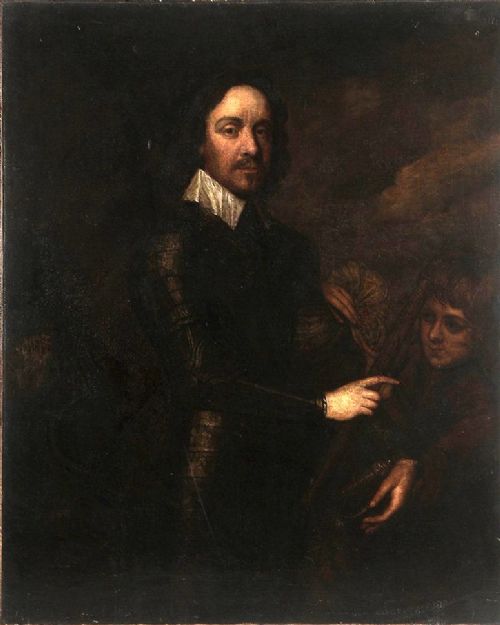
After Robert Walker, 1599–1658 Portrait of Oliver Cromwell the Lord Protector 1599-1658