

It was listed by Artware Fineart. Sold pieces stay on Sellingantiques as a record of what has passed through, and the next one is rarely far away.
Artware Fineart has dated this piece to the 1860s.
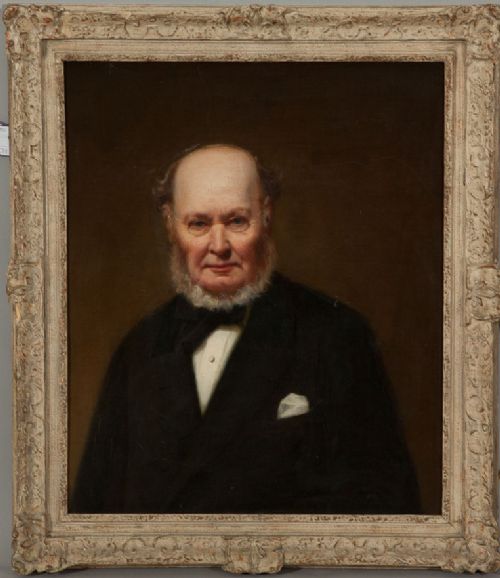
Portrait of SIR JAMES WATSON 1801–1889
oil on canvas
30 x 25 in. (76 x 64 cm.)
He was Lord Provost of Glasgow from 1871 to 1874.
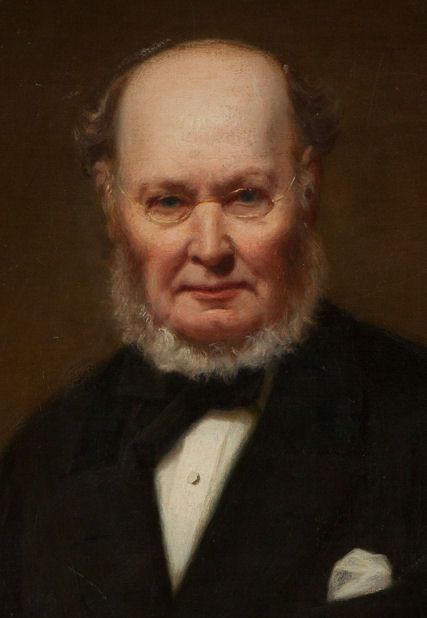
Watson was Chairman of the Glasgow Stock Exchange for twenty-two years from its opening in 1844. He was involved with Lord Provost John Blackie Jr in the Philanthropic Company, set up in 1861 to acquire property for clearance. In 1866 he became the first Deputy Chairman of the City Improvement Trust and he was one of the founders of Glasgow's first three model lodging houses, and of the Mechanics' Institution. He was knighted in 1874.
Artist Biography
Herdman, Robert (1828–1888), painter, was born at Rattray, Perthshire, on 17 September 1828, the fourth and youngest son of the Revd William Herdman, minister of that parish, and his wife, Sophia Walker. Herdman attended Rattray parish school until his father died in 1838. The family then moved to St Andrews where he studied for five sessions at Madras College. In 1843 he entered the University of St Andrews, taking the full arts curriculum, and he was a promising Greek scholar. At this time he spent the summer vacations back in Rattray where he enjoyed sketching and painting. This became Herdman's true vocation although he retained a deep belief in the importance of scholarship for the rest of his life. In June 1847 Herdman moved to Edinburgh and entered the Trustees' Academy. He studied first under Robert Ballantyne and later under the inspirational teaching of Robert Scott Lauder. He was one of a group of particularly gifted students which included William McTaggart, George Paul Chalmers, and John Pettie, and he was successful himself, winning prizes in 1848, 1850, 1851, and 1852. He attended the Royal Scottish Academy life school between 1852 and 1855 under the tuition of James Drummond. In 1854 Herdman won the academy's newly established Keith prize for the best historical picture in the Royal Scottish Academy's annual exhibition by a student and in 1855 he won the academy's bronze medal.
In the mid-1850s the Royal Scottish Academy was expanding its collection of copies of old masters for use as teaching aids. At Herdman's request Robert Scott Lauder recommended him to the academy's council to undertake the task of making old master copies. Herdman was duly commissioned to travel to Florence to copy one of Masaccio's frescoes in the Brancacci Chapel, Santa Maria del Carmine. On his return to Edinburgh further watercolours after Masaccio, Perugino, Raphael, and others were shown to the council who duly purchased a total of nine paintings including The Agony in the Garden, after Perugino (c.1855–1856; Royal Scottish Academy, Edinburgh). The impact of Herdman's months in Italy was profound. Not only did his study of early and high Renaissance art have a deep impact on his own work but the light, colours, and exoticism of everyday Italian life inspired a lengthy series of paintings over the next few years. As well as painting the street life of itinerant musicians or pifferari, he painted more general subjects such as The Mandolin Player(1856; Perth Museum and Art Gallery) in which a woman instrumentalist is seated in a window before a distant landscape reminiscent of Italy.
Robert Herdman first exhibited at the Royal Scottish Academy annual exhibitions in 1850 and remained a regular contributor for the rest of his life. On 17 September 1857 he married Emma Catherine Abbott (1835–1890) in Edinburgh. He rapidly became an established figure in the Edinburgh art world and was elected an associate of the Royal Scottish Academy in 1858 and an academician in 1863 when he was only thirty-four. His diploma work, La culla (1864; Royal Scottish Academy), shows t
Artware Fineart has dated this piece to the 1860s.
You can view the stock and full dealer information on the Artware Fineart Profile Page
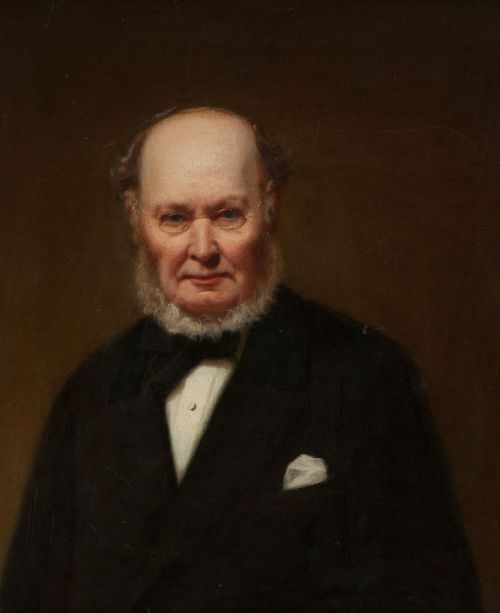
Robert Inerarity Herdman, 1829–1888 Portrait of Sir James Watson 1801–1889