
Artware Fineart has dated this piece to the 1910s.
Portrait of a WW I Allied Aviator in Flying Dress a Leather Coat and leather Flying Cap
inscribed and dated "A Rubin /1918"
oil on canvas
51 x 42 cm. (20 x 16.54 cm.)
According to Ewen Cameron , Ian Thirsk & Vernon Creek from the Royal Air Force Museum , Flying Coat is probably British, although the not standard issue British helmet or coat but there was so much private purchase of flying kit being used at this time. The coat is a similar design to a fabric example The RAF Musuem has in the collection.
The readily available motoring apparel was the norm and could be obtained at reasonable cost. By the start of the War in 1914, developments by the Royal Aircraft Factory and British industry had provided more refined aircraft in which the pilot was contained more within the fuselage, rather than perched on a wicker seat and fully exposed to the elements. At this stage there was no formal issue of clothing specifically for flying but the military, with their wide experience of Army motor transport, had a range of readily available motoring garments which they offered to the newly formed Royal Flying Corps and Royal Naval Air Service pilots. Thus, at the start of the war pilots were provided with a more formalised issue of motoring gear – weatherproof coats, goggles, gauntlets, leather boots etc. – all of which were worn over the uniform. Although pilots were able to use the military issue they were also at liberty to purchase their own clothing and commercial companies continued to develop their motoring clothing into more specialised flying clothing.
Although both the RFC and the RNAS supplied clothing to their pilots and observers, there was the freedom to purchase from commercial suppliers which allowed the crews to incorporate individual needs from their London tailors
In the winter of 1916 the first significant stride was made to providing effective protection for the pilot and this arrived from the brain of Sidney Cotton, an RNAS pilot with No.8 Squadron. Cotton had been working on his own aircraft when a ‘scramble’ was called and he flew in his dirty overalls for an hour or so and upon landing found that, unlike his fellow pilots who were shivering from the cold, he was quite unaffected. Having thought through this effect, he realised that it was the oil and grease soaked into the overalls that had retained the body heat.
Picking up on the idea, he took leave and travelled to London, to Robinson & Cleaver, where he had a flying suit made for him to his design. The suit had three layers, a thin lining of fur, a layer of airproof silk, and an outside layer of light Burberry material, all made into a one-piece
suit, just like his overalls. Robinson & Cleaver were asked to register the design on behalf of Cotton and the flying suit took its name from the inventor and was called the Sidcot suit. By late 1917, tests had shown that the Sidcot Flying Suit No 5 was regarded by pilots as the most suitable for operational use. Consequently the manufacturers of the suit, Robinson & Cleaver, were asked to produce 250 suits per week, just fourteen days after the order. Deliveries were later expected to reach 1,000 per week just four weeks after the initial order. By December 1917 the orders for leather flying coats, some 3,000, were cancelled in favour of the Sidcot suit. This suit met virtually every requirement for protection against the primary threat, the cold, and was in service in a number of modified and development forms right through into WW2 and only ceased being used as closed cockpits, combined sometimes with cabin heating, became the norm in aircraft design.
World War I
Artware Fineart has dated this piece to the 1910s.
You can view the stock and full dealer information on the Artware Fineart Profile Page
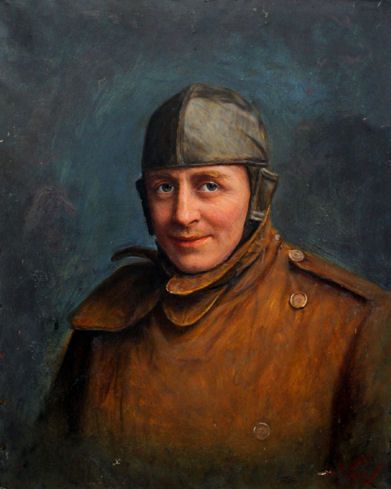
Portrait of a Ww I Allied Aviator in Flying Dress a Leather Coat and Leather Flying Cap by Albert Rubin 1887 - 1956