
oil on canvas
He had earlier served as The Prince Regent when his father, George III, suffered from a relapse into insanity from an illness that is now suspected to have been porphyria.[1] The Regency, George's nine-year tenure as Prince Regent, which commenced in 1811 and ended with George III's death in 1820, was marked by victory in the Napoleonic Wars in Europe.George was a stubborn monarch, often interfering in politics, especially in the matter of Catholic emancipation, though not as much as his father. For most of George's regency and reign, Lord Liverpool controlled the government as Prime Minister.
George is remembered largely for the extravagant lifestyle that he maintained as prince and monarch. By 1797 his weight had reached 17 stone 7 pounds (111 kg or 245 lb),[2] and by 1824 his corset was made for a waist of 50 inches (127 cm).[3] He had a poor relationship with both his father and his wife, Caroline of Brunswick, whom he even forbade to attend his coronation. He was a patron of new forms of leisure, style and taste. He commissioned architects John Nash to build the Royal Pavilion in Brighton and remodel Buckingham Palace, and Sir Jeffry Wyatville to rebuild Windsor Castle. He was largely instrumental in the foundation of the National Gallery, London and King's College London. It is now believed that King George III suffered from the hereditary disease porphyria. In the summer of 1788 his mental health deteriorated, but he was nonetheless able to discharge some of his duties and to declare Parliament prorogued from 25 September to 20 November. During the prorogation George III became deranged, posing a threat to his own life, and when Parliament reconvened in November the King could not deliver the customary Speech from the Throne during the State Opening of Parliament. Parliament found itself in an untenable position; according to long-established law it could not proceed to any business until the delivery of the King's Speech at a State Opening. Although theoretically barred from doing so, Parliament began debating a Regency. In the House of Commons, Charles James Fox declared his opinion that the Prince of Wales was automatically entitled to exercise sovereignty during the King's incapacity.
You can view the stock and full dealer information on the Artware Fineart Profile Page
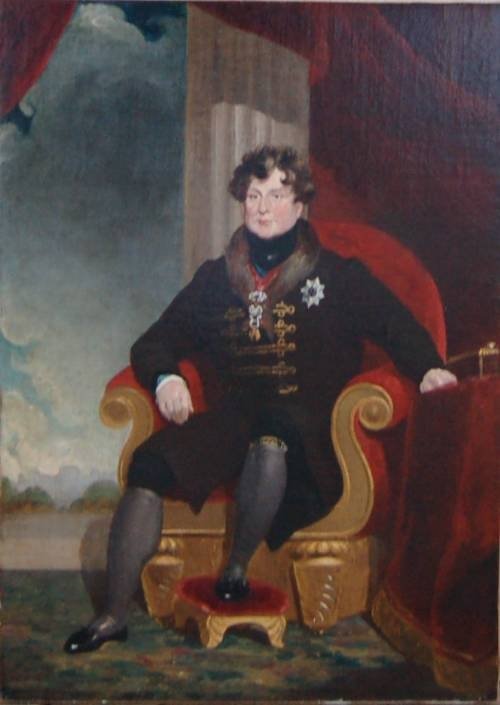
Portrait of George IV as Prince Regent Seated 1762-1830 by English School