
oil on canvas
18th Century
David Garrick (born 19 February 1717 in Hereford – 20 January 1779) was an English actor, playwright, theatre manager and producer who influenced nearly all aspects of theatrical practice throughout the 18th century and was a pupil and friend of Dr Samuel Johnson.
Impressed by his portrayals of Richard III and a number of other roles, Charles Fleetwood engaged Garrick for a season at the Theatre Royal, Drury Lane. He remained with the Drury Lane company for the next five years and purchased a share of the theatre with James Lacy. This purchase inaugurated twenty-nine years of Garrick's management of the Drury Lane, during which time, it rose to prominence as one of the leading theatres in Europe. At his death, three years after his retirement from Drury Lane and the stage, he was given a lavish public funeral at Westminster Abbey where he was laid in Poet's Corner.
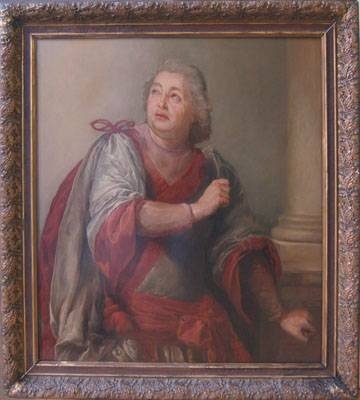
Benjamin Wilson (1721-1788) was an English painter, etcher and scientist.[1] He was the 14th child of Major Wilson, a wealthy York clothier whose house was decorated by a French artist, Jacques Parmentier (d 1730). His father's business failed and Wilson moved to London, where he became a clerk and began to study painting, possibly with Thomas Hudson. In 1746 and 1748-50 he was in Dublin, where he practised successfully as a portrait painter. On his return to London he settled into Godfrey Kneller's old house in Great Queen Street and built up a lucrative portrait practice, which was probably patronized chiefly by Yorkshiremen in London. One of these, Sir John Savile, later Earl of Mexborough, may have introduced him to Edward Augustus, Duke of York (1739-67), who in 1773 appointed Wilson painter to the Board of Ordnance, though he painted little after 1769.
When he became a scientist he opposed Benjamin Franklin's theory of positive and negative electricity. Instead, Wilson supported Isaac Newton's gravitational-optical ether, which he supposed to differ in density around bodies in accordance with their degrees of electrification. Wilson also opposed Franklin's theory of lightning rods, holding that blunt conductors performed better than pointed ones. His best experimental work was on the electrical properties of the tourmaline. He was elected fellow of the Royal Society in 1751 and received its gold medal in 1760 for his electrical experiments.
You can view the stock and full dealer information on the Artware Fineart Profile Page
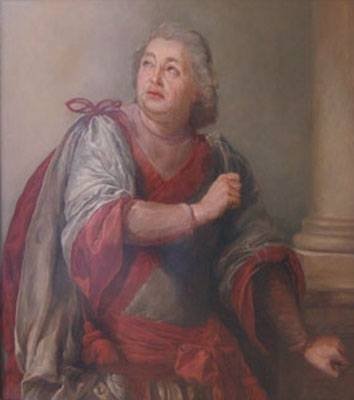
Portrait of David Garrick (1717-1779), as Periander in Eurydice