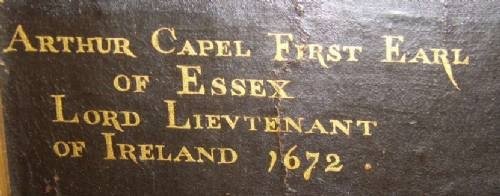
oil on canvas
30 x 25in.
He was the son of Arthur Capel, 1st Baron Capel (who was executed in 1649) and of Elizabeth Morrison, daughter and heir of Sir Charles Morrison of Cassiobury in Hertfordshire, and was baptized on 2 January 1632.In June 1648, then a sickly boy of sixteen, he was taken by Lord Fairfax's soldiers from Hadham to Colchester, which his father was defending, and carried every day around the works with the hope of inducing Lord Capel to surrender the place.At the Restoration he was created Viscount Malden and Earl of Essex (April 20, 1661), the latter title having previously died out with Robert Devereux, 3rd Earl of Essex. It was granted with special remainder to the male issue of his father, and Capel was made lord-lieutenant of Hertfordshire and a few years later Lord Lieutenant of Wiltshire.
Early on, he showed himself antagonistic to the court, to Roman Catholicism, and to the extension of the royal prerogative, and was coupled by Charles II with Denzil Holles as "stiff and sullen men," who would not yield against their convictions to his solicitations. In 1669 he was sent as ambassador to King Christian V of Denmark, in which capacity he gained credit by refusing to strike his flag to the governor of Kronborg.In 1672 he was made a privy councillor and lord-lieutenant of Ireland. He remained in office till 1677, and his administration was greatly commended by Burnet and Ormonde, the former describing it "as a pattern to all that come after him." He identified himself with Irish interests, and took immense pains to understand the constitution and the political necessities of the country, appointing men of real merit to office, and maintaining an exceptional independence from solicitation and influence.
Essex was one of the ablest statesmen under Charles II, serving as Lord Lieutenant of Ireland, 1672-77, and First Lord of the Treasury, 1679. Fearing the prospect of a Catholic monarch, he became involved with attempts to exclude James, Duke of York from the succession and, more dangerously, with the schemes of the Duke of Monmouth. Betrayed and imprisoned in the Tower, he was found with his throat cut. Although his death was recorded as suicide, he was probably murdered.
You can view the stock and full dealer information on the Artware Fineart Profile Page

Portrait of Arthur Capell, First Earl of Essex 1631-1683 Studio of Sir Peter Lely 1618-1680