It was listed by Artware Fineart. Sold pieces stay on Sellingantiques as a record of what has passed through, and the next one is rarely far away.
Artware Fineart has dated this piece to the 19th Century.
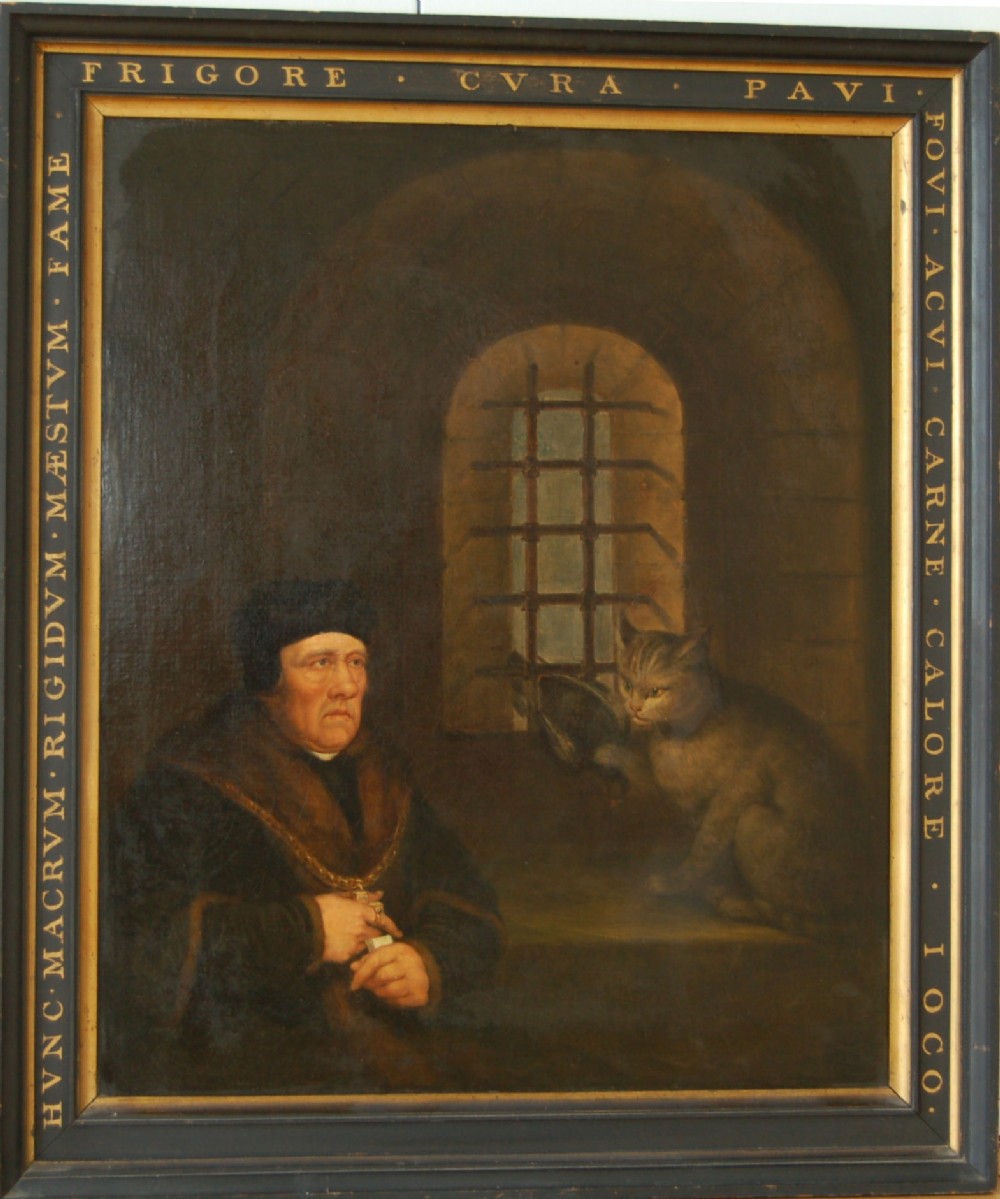
Portrait of Sir Henry Wyatt circa 1460 - 1536
oil on canvas
76.20 x 63.50 cm. (30 x 25 in.)
PROVENANCE : Earl of Romney
Sir Henry Wyatt (c.
His skill as a soldier and reliability as a financier made him one of the longest-serving courtiers of Henry VII and Henry VIII. His support for Henry Tudor began before 1483, and he probably participated in Buckingham's unsuccessful revolt against Richard III in that year. Family legend has it that he was imprisoned and interrogated by Richard III himself, and that during his imprisonment he was fed on pigeons brought to him by a cat. After the victory of Henry VII at Bosworth he received a number of grants and favours. In 1485 he became keeper of Norwich Castle and gaol, and before September 1486 he was made clerk of the king's jewels. He succeeded to the increasingly influential position of master of the king's jewels in June 1488, combining the office with that of clerk of the king's mint. By 1494 he was keeper of the change, assayer of the money and coinage, and comptroller of the mint. From these grants and offices came sufficient wealth to purchase in 1492 Allington Castle in Kent. Sir Henry retained his Yorkshire links, however, and in March 1487 he became joint bailiff and constable of Conisbrough Castle in Yorkshire. In June of that year he fought against the pretender Lambert Simnel in the battle of Stoke-on-Trent. He became governor of the city and castle of Carlisle in 1494, and at some point was captured and held to ransom by the Scots, for which he was reimbursed by a grant on 22 August 1515. This ‘two yeres and more prisonment in Scotland, in Irons and Stoks’ (Muir, 40), referred to by Sir Thomas Wyatt in a letter to his son, may have occurred between 1494 and 1496. By June 1496, however, Sir Henry wrote to the king from Carlisle to discuss preparations for putting down the rebellion of Perkin Warbeck, and in June 1497 he was present at the battle of Blackheath. About 1502 he married Anne Skinner. Thomas Scott's anecdotes of the family (BL, Wyatt papers, 29) present her as a powerful overseer of the household, who caught the abbot of Boxley in a compromising position with one of her maids, and stocked him. They had two sons, Thomas and Henry (who is assumed to have died in infancy), and a daughter, Margaret, who married Sir Anthony Lee, MP for Buckinghamshire. Her portrait by Holbein survives in the Metropolitan Museum of New York.
Sir Henry became a privy councillor in 1504, and was granted arms in 1507–8. He was an executor of Henry VII's will, and remained in high office in the reign of Henry VIII. Having been granted livery by virtue of his office as master of the king's jewel house at the funeral of Henry VII in May 1509, he was made knight of the Bath at the coronation of Henry VIII, and was appointed to the new privy council. He was commissioner of the peace for Middlesex and Surrey from 1509 to 1515. He established close ties with his Kentish neighbours the Boleyns of Hever Castle (Sir Henry became captain of Norwich Castle jointly with Thomas Boleyn in 1511), and with Thomas Cromwell, who became one of his executors. His military activity also ensured his continuing favour: with a retinue of 102 he accompanied the king to Calais in 1513, and was made knight-banneret after the battle of the Spurs in August 1513. In 1519 he again attended Henry VIII to Calais. In 1520 it fell to him to transport gold and silver plate sufficient for the banquet at the Field of Cloth of Gold. He attended Henry at Canterbury during his reception of Charles V in May 1522, and was by that date sheriff of Kent. By the later 1520s Sir Henry be
Artware Fineart has dated this piece to the 19th Century.
You can view the stock and full dealer information on the Artware Fineart Profile Page

Portrait of Sir Henry Wyatt Circa 1460 - 1536 English School 18/19th Century Partly After Hans Holbein Circa 1497 - 1543