
Artware Fineart has dated this piece to the 19th Century.
Portrait of William Ewart Gladstone 1809 - 1898
oil on canvas
76.20 x 63.50 cm. (30 x 25 in.)
Gladstone, William Ewart (1809–1898), prime minister and author, was the fifth child and fourth and youngest son of Sir John Gladstone, first baronet (1764–1851), and his second wife, Anne, née Robertson (1771/2–1835).
John Gladstones (he dropped the ‘s’ informally in 1787 and by letters patent in 1835) had established himself as a leading member of that community and it was at the fashionable address of 62 (formerly 1) Rodney Street, Liverpool, that his fourth son was born on 29 December 1809.
Gladstone was born into an evangelical family, his mother and his sister Anne (who was his godmother) both combining prolonged illnesses with intense evangelical pietism. His mother was of Scottish Episcopal origins, and his father joined the Church of England, having been a Presbyterian when he first settled in Liverpool. William was thus baptized into the Church of England, in St Peter's Church, Liverpool. But the Scottish ties of the family remained strong: William probably first visited that country in 1814, aged four, recalling in old age having heard the guns of Edinburgh Castle fired, probably to celebrate the abdication of Napoleon that spring. Gladstone's upbringing in the Liverpool area rooted him in northern England, midway between the metropolitan south, which was to be the centre of his political and intellectual life, Scotland, whither his father retired in 1830, Ireland just across the sea, and Wales, where his family home was to be from 1839. Gladstone recalled, ‘I was not a devotional child’ (Morley, 1.13), but this may have been a self-deprecation arising from the reverence in which he held the religiosity of his mother and sister Anne. From an early age he read copiously—he later recalled the ‘great and fascinating hold’ (ibid.) that Bunyan's Pilgrim's Progress took upon him and remembered weeping profusely at the description of the life and death of William Wallace in Jane Porter's Scottish Chiefs.
By the 1810s the Gladstones were a rich family, their fortune based on transatlantic corn and tobacco trade and on the slave-labour sugar plantations they owned in the West Indies. William attended the small school at Bootle near Liverpool kept by William Rawson, a moderate evangelical, previously private tutor in the Gladstone household. He thought he learned little from Rawson. In 1821 John Gladstone sent his son to Eton College, where the eldest son, Thomas, was already a pupil. John Gladstone was determined that at least one of his children should succeed in the political world, and he saw an education at Eton and Christ Church, Oxford, as the best preparation for that success. William, who was an oppidan, roomed with Thomas, their ‘dame’ being Mrs Shurley. Already well exposed to tory politics, for his father was George Canning's chief supporter and political organizer in Liverpool, Gladstone at Eton also met whigs, notably Arthur Henry Hallam [see under Hallam, Henry], for whom in 1824 he formed a close affection. For Gladstone, Hallam, and others such as Francis Doyle and James Milnes-Gaskell, the chief focus of their Eton life was the Eton Society (later ‘Pop’) which they ran as an intellectual and debating club, and from whose coterie was published the Eton Miscellany (1827), edited by Gladstone (writing as Bartholomew Bouverie) and George Selwyn (later the noted bishop). In the Eton Society, Gladstone learned that readiness of public speaking which never left him. Gladstone's tutor at Eton was the whiggish H. H. Knapp, but E. C. Hawtrey was the master whose intellectual encouragement Gladstone especially value
Artware Fineart has dated this piece to the 19th Century.
You can view the stock and full dealer information on the Artware Fineart Profile Page
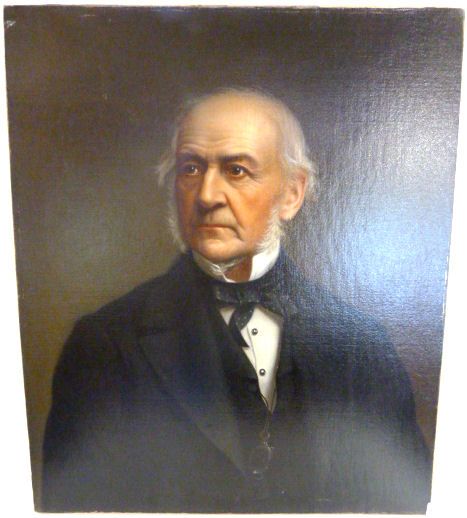
Edward Travanyon Haynes 1840 - 1922, Portrait of William Ewart Gladstone 1809 - 1898