Artware Fineart has dated this piece to the 1900s.
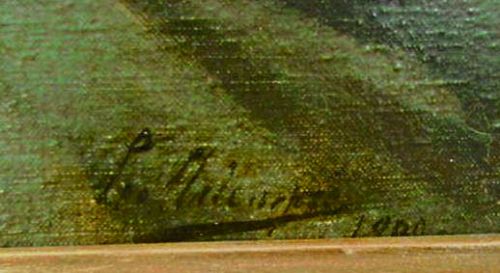
1900
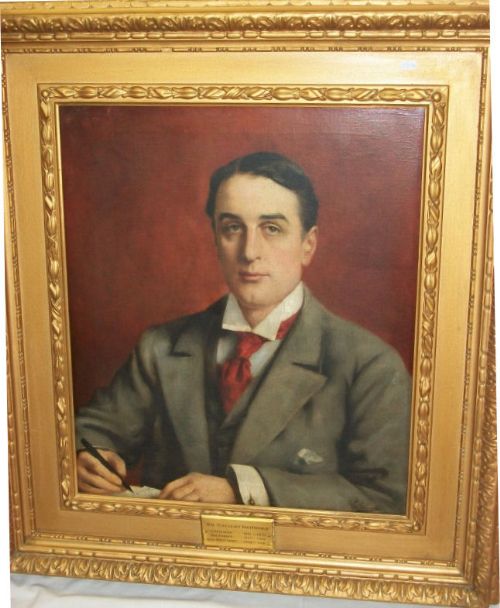
Oil on Canvas
indistinctly signed and dated
30 x 25 in. (76 x 64 cm.)
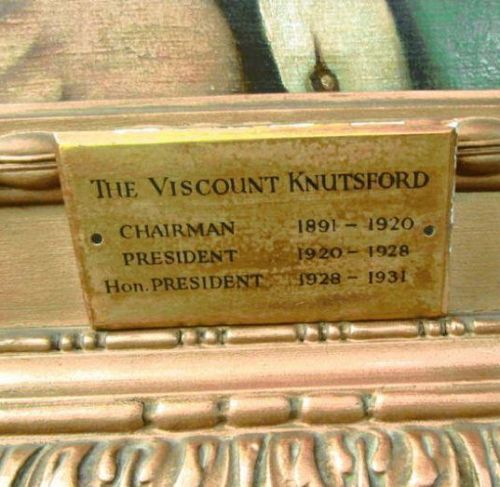
Holland, Sydney George, second Viscount Knutsford (1855–1931), hospital administrator and reformer, was born in London on 19 March 1855, the elder of the twin sons of Sir Henry Thurstan Holland, second baronet and first Viscount Knutsford (1825–1914), and Elizabeth Margaret (1825–1855), elder daughter of Nathaniel and Emily Hibbert, of Munden, Hertfordshire, and a granddaughter of Sydney Smith; she died shortly after giving birth. His grandfather was Sir Henry Holland (1788–1873), the physician.
In 1858 their father married Margaret Jean, elder daughter of Sir Charles Edward Trevelyan (1807–1886), sister of Sir George Trevelyan, and niece of Lord Macaulay; though she was a good mother to the twins, their unconventional and even prodigal outlook was not learned at her knee. Sir Henry, their father, a busy lawyer and later a statesman, was not able to see much of them, and they passed their summer holidays with their grandmother Mrs Hibbert or at Knutsford with their great-aunts Mary and Lucy Holland, the prototypes of the ladies in Elizabeth Gaskell's Cranford. Holland was sent to Wellington School, where he came under the influence of the historian Osmund Airy, who opened the boy's mind and humanized his outlook, turning his thoughts to social service. Holland's father intended him for the army, but his educational standard proved too low for Woolwich. He fell back on the bar, to please his father, and in 1873 went to Trinity Hall, Cambridge, where he made many friends and spent his days in debates and rowing and swimming, in which last he became an expert. After leaving Cambridge with a third-class degree in 1876 he read for the bar and was called by the Inner Temple in 1879. Holland next entered the chambers of George Baugh Allen, a well-known special pleader of the day. He began to interest himself in boys' clubs, did some competitive swimming, and learned conjuring from professionals. He achieved moderate success in the criminal courts and later at the parliamentary bar, but a flair for business and a call to social service decided, and divided, his life's activities. In the cause of temperance he helped to launch a scheme of coffee taverns. In 1882 he inherited a house and competence, and on 23 January 1883 he married Lady Mary Ashburnham (d. 1947), fourth and youngest daughter and tenth child of Bertram Ashburnham, fourth earl of Ashburnham (b. 1797). Holland's name now began to be known through letters to the press and pamphlets on many social questions. In 1888 he was elected a director of the East and West India Dock Company, and in the dockers' strike of 1889 he took a leading part in voicing the employers' case, in which The Times and even John Burns acknowledged his fairmindedness. His interest led him to visit various dock labourers at the Poplar Hospital in east London. Horrified by what he found, he launched without previous experience into hospital management in 1891. As a dock company director and chairman of Poplar Hospital at critical junctures he quickly put both concerns on their feet again. In four and a half years he raised enough money to turn the Poplar Hospital from a small, thirty-bed institution into one of the best of the smaller London hospitals, with more than 100 beds. In 1896, at the suggestion of Miss Eva Luckes, matron of the London Hospital, Holland applied to be put on the London Hospital committee; in the same year he was elected chairman, an office he continued until his death. His fame rests on those thirty-five years. An obituary notice in The Times asserted:
Artware Fineart has dated this piece to the 1900s.
You can view the stock and full dealer information on the Artware Fineart Profile Page
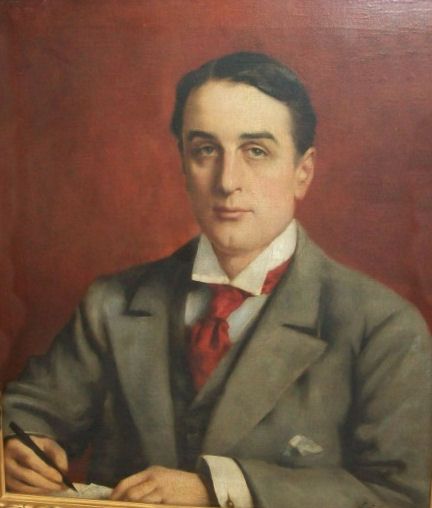
Circle of Sir Edward Poynter 1836 -1919 Portrait of Sydney George Holland, Second Viscount Knutsford 1855-1931