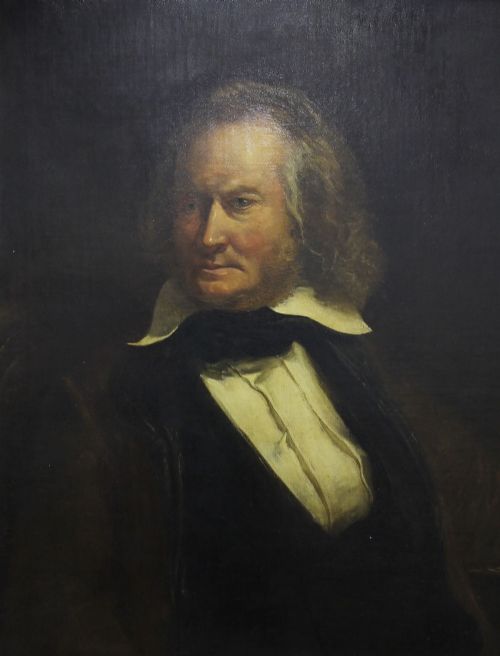
Artware Fineart has dated this piece to the 1800s.
circa 1830
UK
Oil on Canvas
36 x 28 in. (92 x 72 cm.)
John Wilson of Ellerey FRSE (18 May 1785 – 3 April 1854) was a Scottish advocate, literary critic and author, Moral Philosopher and the writer most frequently identified with the pseudonym Christopher North of Blackwood's Edinburgh Magazine. He was professor of Moral Philosophy at Edinburgh University (1820–51).
He was the fourth child, but the eldest son, and he had nine brothers and sisters. He was only twelve when he entered the University of Glasgow, and continued to attend various classes for six years, mostly under Professor George Jardine, with whose family he lived. During this period Wilson excelled in sport as well as academic subjects, and fell in love with Margaret Fletcher, who was the object of his affections for several years. In 1803 Wilson was entered as a gentleman commoner at Magdalen College, Oxford. He was inspired by Oxford, and in much of his later work, notably in the essay called "Old North and Young North", he expresses his love for it. But his Magdalen days were not altogether happy, though he obtained a brilliant first class degree. His love affairs did not go happily, his "Margaret" eloped to New York with his younger brother, Charles and he made no close friends at his own college and few in the university. He took his degree in 1807, and at twenty-two was his own master, with a good income, no guardian to control him, and no need to work for a living. His profession was an estate on Windermere called Elleray, ever since connected with his name. Here he built, boated, wrestled, shot, fished, walked and amused himself for four years, besides composing or collecting from previous compositions a considerable volume of poems, published in 1812 as The Isle of Palms. He became intimate with William Wordsworth, Samuel Taylor Coleridge, Robert Southey and Thomas de Quincey. In 1811 he married Jane Penny, daughter of the Liverpool merchant and slave trader James Penny, and they were happy for four years, until the event which made a working man of letters of Wilson, and without which he would probably have produced a few volumes of verse and nothing more. Most of his fortune was lost by the dishonest speculation of an uncle, in whose hands Wilson had carelessly left it. His mother had a house in Edinburgh, in which she was able and willing to receive her son and his family; he was not forced to give up Elleray, though he was no longer able to live there. He read law and was elected to the Faculty of Advocates in 1815, still with many outside interests, and in 1816 produced a second volume of poems, The City of the Plague. In 1817, soon after the founding of Blackwood's Magazine, Wilson began his connection with the Tory monthly and in October 1817 he joined with John Gibson Lockhart in the October number working up James Hogg's MS a satire called the Chaldee Manuscript, in the form of biblical parody, on the rival Edinburgh Review, its publisher and his contributors. He became the principal writer for Blackwood's, though never its nominal editor, the publisher retaining supervision even over Lockhart's and "Christopher North's" contributions, which were the making of the magazine.In 1822 began the series of Noctes Ambrosianae, after 1825 mostly Wilson's work. These are discussions in the form of convivial table-talk, including wonderfully various digressions of criticism, description and miscellaneous writing. There was much ephemeral, a certain amount purely local, and something occasionally trivial in them. But their dramatic force, their i
Artware Fineart has dated this piece to the 1800s.
You can view the stock and full dealer information on the Artware Fineart Profile Page
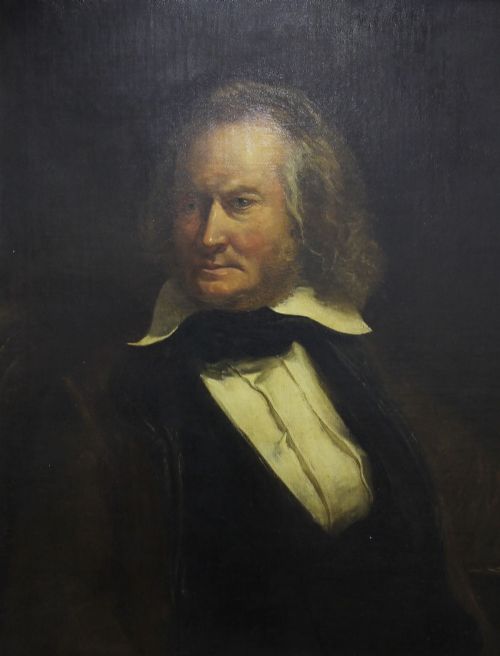
Portrait of Professor John Wilson of Ellerey, (Nom De Plume " Christopher North " ) 1785-1854 by Sir George Harvey, Prsa 1806-1876