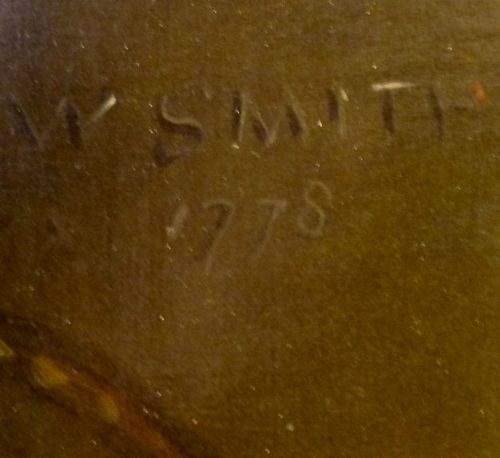
1778
UK
Oil on Canvas
Frame size 46 x 37 in.

35 x 27 in. (89 x 69 cm.)
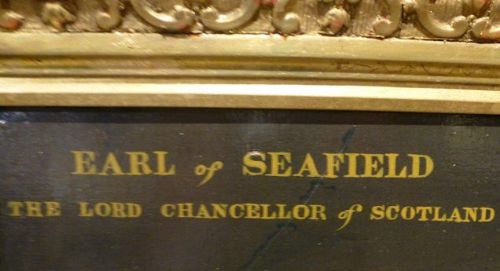
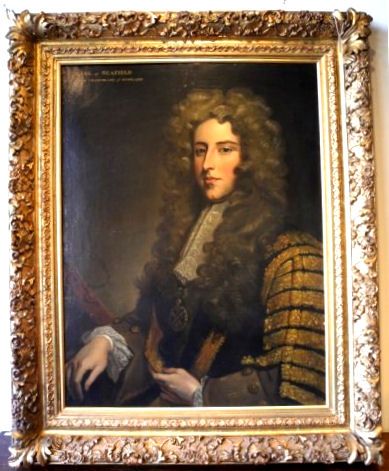
This portrait is after Sir Godfrey Kneller's three quarter length Portrait currently in a private Scottish Collection. The artist entered the RA schools in 1772 aged 19, he exhibited mainly miniatures at the RA 1774. He was patronized mainly by the Duke of Gordon's family from the 1780's until his death. The artist also painted oil portraits in the north east of Scotland around the same time and painted these in the manner of Philip Reinagle. Ogilvy, James, fourth earl of Findlater and first earl of Seafield (1663–1730), politician, was born on 11 July 1663, the second son of the five children of James Ogilvy, third earl of Findlater (d. 1711), and Lady Anna Seton (c.1632–1687), eldest daughter of Hugh Montgomery, seventh earl of Eglinton. He was educated under the guidance of a private tutor, Patrick Innes, and in May 1675 he proceeded to Marischal College, Aberdeen, where he studied for three years. After a brief stay in the Netherlands in 1683, he settled down to his legal studies and was admitted to the bar as an advocate on 16 January 1685. In 1687 he married Anne (1671/2–1708), daughter of Sir William Dunbar. Ogilvy's political and parliamentary career began when he was elected to represent the burgh of Cullen, Banffshire, in the 1689 convention of estates, and he also represented Cullen in the parliament of 1689–95. Ogilvy initially played a dubious role in the convention. On 16 March he subscribed the act which stated that the convention was a free and lawful meeting of the estates, but he was also one of the five members who voted against the ‘forfaulture’ of James VII. George Lockhart of Carnwath in his memoirs observed that Ogilvy was ‘much taken notice of by reason of a speech he made against the forfeiting of King James’ (‘Scotland's Ruine’, 18). Yet Ogilvy appears to have fallen into line with the dominant faction very quickly, and on 5 April he was nominated to the committee of the convention instructed to oversee the election of magistrates for a new town council for Edinburgh, to be held in St Giles's on 10 April. Furthermore, on 13 April he was named as a member of the committee to consider the political condition and state of the councils and magistrates in the burghs of the kingdom as a whole. Ogilvy's speedy rehabilitation with the dominant faction was reflected in his appointment to the three-man committee of 12 April which was ordered to consider a proclamation in which no one would be allowed to speak or write against the government. On 23 April Ogilvy was also appointed as one of the commissioners to treat for a union of the kingdoms with England. He was also politically active in the parliamentary session of 15 April to 22 July 1690. On 27 July he was appointed to a committee to consider overtures given by the viscount of Tarbat in open parliament, and on 1 July he was added to the committees for the act concerning lease making, fines and forfeitures, and prohibiting the import of brandy and rum. Likewise, on 18 July he was appointed to the commission for plantation of kirks. In 1693 Ogilvy was knighted and appointed as sheriff of Banffshire as well as solicitor-general of Scotland, a position which, according to Lockhart of Carnwath, was due to the patronage of William, third duke of Hamilton. He took the oath of allegiance and the assurance in parliament on 18 April 1693, and he was a member of the committee for security of the kingdom in the 1695 session of parliament. He supported the parliamentary report into the Glencoe massacre, but, pragmatic as ever, he informed William Carstares, the king's c
You can view the stock and full dealer information on the Artware Fineart Profile Page

William. A. Smith 1753 - 1793 Portrait of James Ogilvy, 4th Earl of Findlater & 1st Earl of Seafield 1663-1730