
Artware Fineart has dated this piece to the 1870s.
Oil on Board
11.02 x 7.87 in. (28 x 20 cm.)
Irving was a close friend of Millais, so much so that he was a pall bearer at Millais's funeral. In Irving Correspondence, Millais name is referred to "the Garrick Club portrait". This portrait is a small portrait sketch which could have been done very quickly by the artist. Irving's 1879 production of The Merchant of Venice was as revolutionary as his Hamlet.
His treatment of the play met with criticism but was otherwise a spectacular success and ran for 250 nights. It was the play that Irving presented in 1889 when first summoned to perform for Queen Victoria and when he took his final curtain at the Lyceum on the 19 July 1902, it was as Shylock. IRVING, HENRY (1838-1905), English actor, whose original name was John Brodribb, was born at Keinton-Mandeville, Somerset, on the 6th of February 1838. After a few years' schooling he became a clerk to a firm of East India merchants in London, but he soon gave up a commercial career and started as an actor. On the 29th of September 1856 he made his first appearance at Sunderland as Gaston, duke of Orleans, in Bulwer Lytton's Richelieu, billed as Henry Irving. This name he eventually assumed by royal license. For ten years he went through an arduous training in various provincial stock companies, acting in more than five hundred parts. By degrees his ability gained recognition, and in 1866 he obtained an engagement at the St. James Theatre, London, to play Doricourt in The Belle's Stratagem. A year later he joined the company of the newly-opened Queen's Theatre, where he acted with Charles Wyndham, J.L. Toole, Lionel Brough, John Clayton, Mr. and Mrs. Alfred Wigan, Ellen Terry and Nelly Farren. This was followed by short engagements at the Haymarket, Drury Lane and Gaiety. At last he made his first conspicuous success as Digby Grant in James Albery's The Two Roses, which was produced at the Vaudeville on the 4th of June 1870 and ran for 300 nights. In 1871 he began his association with the Lyceum Theatre by an engagement under Bateman's management. The fortunes of the house were at a low ebb when the tide was turned by Irving's immediate success as Mathias in The Bells, a version of Erckmann-Chatrian's Le Juif Polonais by Leopold Lewis. The play ran for 150 nights. With Miss Bateman, Irving was seen in W.G. Wills' Charles I and Eugene Aram, in Richelieu, and in 1874 in Hamlet. The unconventionality of this last performance, during a run of 200 nights, aroused keen discussion, and singled him out as the most interesting English actor of his day. In 1875, still with Miss Bateman, he was seen as Macbeth; in 1876 as Othello, and as Philip in Tennyson's Queen Mary; in 1877 in Richard III and The Lyons Mail. In 1878 Irving opened the Lyceum under his own management. With Ellen Terry as Ophelia and Portia, he revived Hamlet and produced The Merchant of Venice (1879). His Shylock was as much discussed as his Hamlet had been, the dignity with which he invested the Jew marking a departure from the traditional interpretation of the rôle, and pleasing as much as it offended others. After the production of Tennyson's The Cup, a revival of Othello (in which Irving played Iago to the Othello of Edwin Booth) and of Romeo and Juliet, there began a period at the Lyceum which had a potent effect on the English stage. The Lyceum stage management, and the brilliance of its productions in scenery, dressing and accessories, were revelations in the art of mise-en-scène. Much Ado About Nothing (1882) was followed by Twelfth Night (1884), Olivia--an adaptation of Goldsmith's Vicar of Wakefield by W.G. Wills (1885
Artware Fineart has dated this piece to the 1870s.
You can view the stock and full dealer information on the Artware Fineart Profile Page
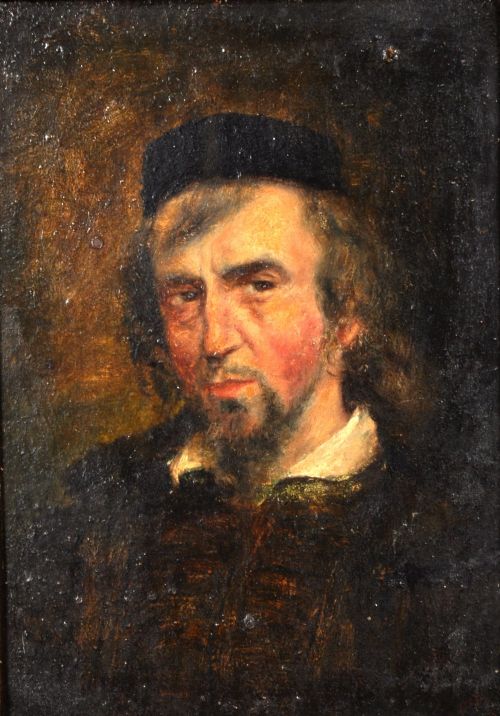
Attributed to Sir John Everett Millais, Bt 1829-1896 Portrait of Sir Henry Irving 1838-1905, in the Character of Shylock